Most small businesses don't have a lead problem — they have a system problem. They try a bit of Google Ads one month, post on social media the next, hand out a few leaflets, and then wonder why results are inconsistent. The truth is that local lead generation works brilliantly when it's structured, and it falls flat when it's improvised.
This article is part of my small business marketing guide.
This guide covers everything you need to know: what local lead generation actually is, why it delivers a stronger return than most other marketing approaches, and — most importantly — how to build a reliable system that brings in enquiries month after month.

What Is Local Lead Generation?
Local lead generation is the process of attracting potential customers from a specific geographic area — usually the towns, cities, or postcodes closest to where your business operates.
Unlike national marketing campaigns that cast a wide net, local lead generation focuses on the people most likely to actually use your services: those nearby, searching for what you do, right now. A plumber in Leeds wants calls from homeowners in Leeds. A salon in Bristol wants bookings from people in Bristol. There's no point paying to reach someone three hundred miles away.
For service-based businesses and tradespeople especially, local lead generation is the engine that drives growth. You're not selling a product someone can buy from anywhere — you're offering a service tied to a location. Getting in front of the right local audience is everything.
Why Local Lead Generation Is Worth the Investment
It targets the people most likely to buy
Local lead generation lets you focus your marketing budget on a defined audience — people in specific postcodes, towns, or boroughs who can realistically become your customers. That precision means less wasted spend and a higher chance of converting enquiries into paying jobs.
It delivers a stronger return than broad advertising
Because you're reaching high-intent, geographically relevant prospects, the conversion rates from local lead generation tend to beat those of broad national campaigns. Clients of ours pay anywhere between £6 and £20 per lead depending on their industry — a fraction of what they'd spend on untargeted advertising. That's a return that most small business owners find hard to argue with.
It builds community credibility
When local people start recognising your name — in search results, in reviews, from a neighbour's recommendation — you become the default choice in your area. That kind of trust compounds over time. One happy customer tells another, and your reputation starts doing some of the marketing for you.
6 Sources of Local Leads (and How to Use Them)
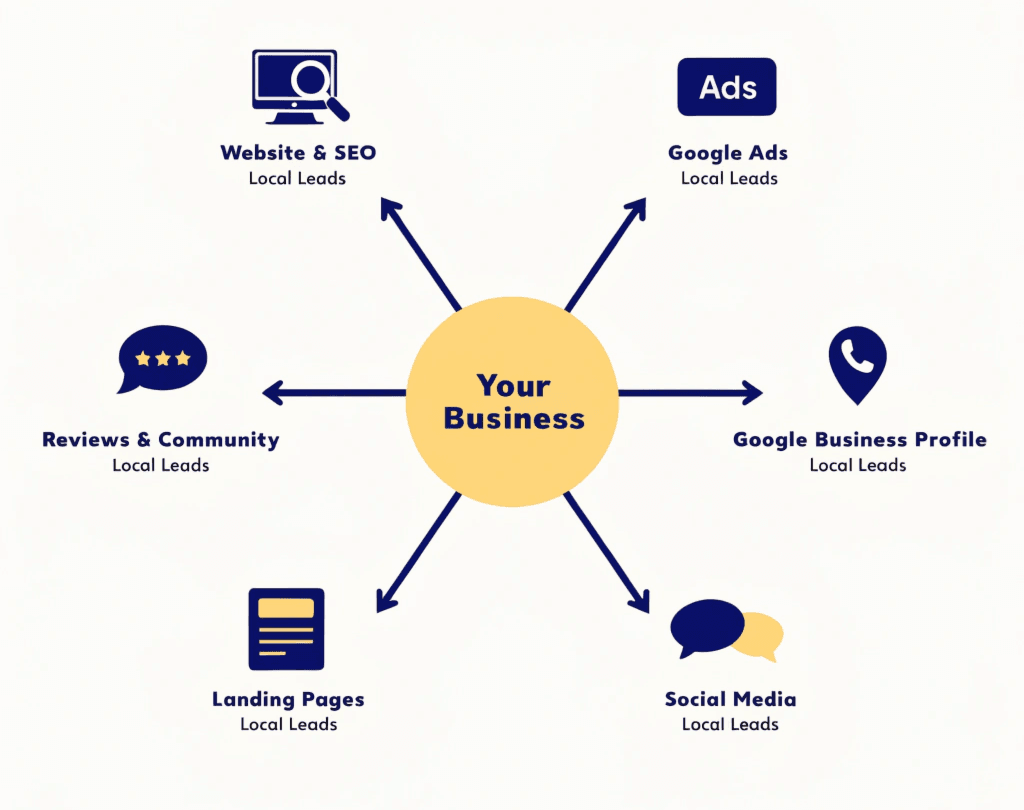
1. Your Website, Local SEO, and Google Business Profile
These three work together, and they're the foundation of any local lead generation strategy.
Your website is where enquiries happen — but only if people can find it. Local SEO is the process of making your site visible when someone in your area searches for the services you offer. That means optimising your pages for location-based keywords, building local citations, earning reviews, and ensuring Google understands exactly where you operate and what you do.
Your Google Business Profile (formerly Google My Business) is equally important. A well-optimised profile gets your business into the local map pack — those three listings that appear at the top of Google when someone searches "plumber near me" or "hair salon in [town]". Claim your profile if you haven't already, add photos, keep your hours accurate, and respond to every review.
One stat worth knowing: studies suggest that around 76% of people who conduct a local search on their smartphone visit a related business within 24 hours. That's high intent, and local SEO is how you capture it.
2. Google Ads and Local Services Ads
Paid search is the fastest way to generate local leads — particularly when you're new to an area or looking to supplement organic traffic while your SEO builds momentum.
Standard Google Ads let you target by location, keyword, time of day, and device. Used well, they put you in front of people actively searching for exactly what you offer. Pair them with location extensions so potential customers can see your address or call you directly from the ad.
Worth mentioning separately: Google Local Services Ads (LSAs) are available to certain service categories and work on a pay-per-lead model rather than pay-per-click. They appear above standard ads and above organic results, and qualifying businesses receive a Google Screened or Google Guaranteed badge — which builds instant credibility. If LSAs are available in your trade or profession, they're worth exploring.
If you're already running Google Ads or thinking about starting, our PPC management service handles campaign setup, targeting, and ongoing optimisation so your budget works as hard as possible.
3. Social Media and Targeted Social Ads
Organic social media is useful for staying visible and building familiarity, but it's social advertising where local businesses tend to see real lead generation results.
Facebook and Instagram ads let you target by postcode, town, radius from your location, age, interests, and more. You can run lead generation campaigns where users submit their contact details directly within the platform — no need to visit your website — which removes friction and increases completion rates.
A simple starting approach: run a small test campaign (£5–£10 per day) targeting your core service area with a clear offer. Measure the cost per lead, adjust the creative and targeting, and scale what works.
4. Dedicated Landing Pages
If you're running any paid advertising — whether on Google or social media — you need a dedicated landing page to send that traffic to. Sending paid visitors to your homepage is one of the most common and costly mistakes small businesses make.
A good local landing page does a few things well: it matches the message of the ad that brought someone there, it speaks directly to a local audience (mentioning the town or area), it shows clear social proof (reviews, case studies), and it has one obvious call to action. Keep it focused — no distracting navigation, no competing offers.
Our web design service includes conversion-focused landing pages built to turn visitors into enquiries.
5. Online Reviews and Community Engagement
Reviews are one of the most powerful local lead generation tools available — and most businesses underuse them. Research consistently shows that the vast majority of people read online reviews before choosing a local business. A strong review profile on Google (and, depending on your sector, Checkatrade, Trustpilot, or Yell) makes you the obvious choice when someone is comparing options.
The simplest way to build reviews: ask. After completing a job, send a short follow-up message with a direct link to your Google review page. Most happy customers are glad to leave a review when the process is made easy.
Community engagement — local events, sponsorships, partnerships with other businesses — builds goodwill and word-of-mouth referrals. These don't scale as quickly as digital channels, but they create a depth of trust that advertising rarely achieves.
6. Leaflets and Direct Mail
Don't discount offline channels. Door-to-door leaflet distribution and direct mail can be highly effective, particularly for trades businesses where the customer base is residential and geographically concentrated.
Direct mail response rates tend to be considerably higher than email marketing on a percentage basis, and physical materials stand out precisely because fewer businesses invest in them. Target specific postcodes, keep the design clean and the offer clear, and track enquiries with a unique phone number or landing page URL so you can measure response.
Building a System, Not Just Running Tactics
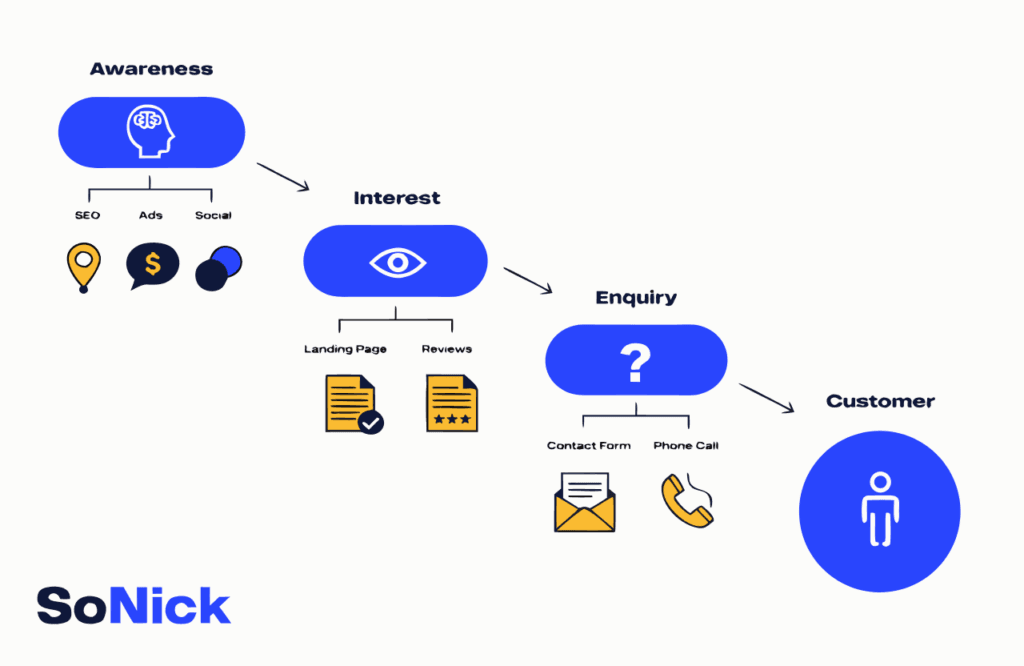
The businesses that generate leads consistently aren't necessarily spending more than their competitors — they're more organised. They treat their marketing channels as a system where each part supports the others, rather than a set of isolated experiments.
A practical starting framework:
- Build the foundation first. Get your website and Google Business Profile in order before spending money on ads. Paid traffic sent to a weak website is wasted money.
- Pick one paid channel and commit to it. Google Ads or Facebook Ads — not both at once if budget is limited. Learn what works, then expand.
- Set up tracking from the start. Every enquiry should be attributed to a source. Without this data, you're guessing which channels to invest in and which to cut.
- Follow up fast. Research suggests that responding to a lead within 15 minutes dramatically increases the chance of converting it. Speed matters.
- Review your numbers weekly. Set aside 30–60 minutes each week to look at cost per lead, conversion rates, and which channels are performing. Adjust based on what the data tells you.
Tools to Support Your Local Lead Generation
Google Search Console
Free and essential. Google Search Console shows you which search terms your website is appearing for, how often it's being clicked, and which pages are performing well or falling short. It also flags technical issues — crawl errors, indexing problems, mobile usability issues — that could be holding your rankings back. If you're not using it already, set it up today.
Google Ads
Google's advertising platform gives you precise control over who sees your ads and when. Location targeting, keyword match types, ad scheduling, and conversion tracking all let you dial in your campaigns over time. The interface can be daunting at first, but even a simple campaign with a modest daily budget can generate meaningful enquiries if it's well-targeted and sends traffic to a proper landing page.
SE Ranking
For the SEO side of local lead generation, SE Ranking is one of the most practical all-in-one tools available. I use it with clients for keyword research, rank tracking, technical site audits, and competitor analysis — all in one platform. Their local marketing tools are particularly useful, helping you track your Google Business Profile performance and identify citation opportunities in your area. They offer a free trial, so it's worth testing before committing.
Measuring What's Working
Local lead generation only improves if you measure it. The metrics worth tracking regularly:
- Cost per lead by channel — which sources produce enquiries most efficiently?
- Lead-to-customer conversion rate — are the leads you're getting actually converting?
- Organic traffic from local searches — is your SEO moving in the right direction?
- Google Business Profile impressions and clicks — are more people finding you in local search?
- Review volume and rating — is your online reputation growing?
Set up Google Analytics 4 on your website with goals configured for contact form submissions and phone call clicks. Without conversion tracking, you're flying blind.
One common mistake: businesses cut campaigns after a month because they don't seem to be working, when in reality the first 30 days of any new campaign are a learning phase. Give paid channels enough time and data before making big decisions — but do review the numbers regularly so you're not just waiting around hoping for the best.
Frequently Asked Questions
How do I generate local leads for my small business? Start with the fundamentals: an optimised website, a complete Google Business Profile, and a review generation process. Add a paid channel (Google Ads or Facebook Ads) to drive faster results while your organic presence builds, and create dedicated landing pages for any campaigns you run.
Is local lead generation worth it for small businesses? Yes — because the leads you generate are geographically relevant and often high-intent. Someone searching "emergency plumber in [town]" is ready to book. That kind of intent is hard to find with broader advertising, and the conversion rates reflect it.
How much does local lead generation cost? It varies considerably by industry, location, and channel. Organic strategies like SEO have upfront costs but produce leads at a low ongoing cost once established. Paid channels like Google Ads are more immediate but require continuous budget. Most small businesses find a combined approach — organic for the long term, paid for steady short-term flow — delivers the best overall return.
How long does it take to see results? Paid advertising can produce enquiries within days of launch. Local SEO typically takes three to six months before you see meaningful organic traction, though the results are more durable once they arrive. Community-building and reviews compound gradually over time. Starting early on all fronts gives you the best coverage.
Conclusion
Local lead generation isn't complicated — but it does require consistency and a bit of structure. Get your website and Google Business Profile right, invest in local SEO for the long term, use paid advertising for faster results, build your review profile, and measure everything.
The businesses that win locally aren't always the biggest or the best-funded. They're the ones that show up consistently in the right places and make it easy for local people to choose them.
If you'd like to see how your site is currently performing, run a free SEO audit — it takes under a minute and gives you a clear picture of where to focus first. Or, if you'd rather talk through a strategy for your business, get in touch and let's work out what's possible.