If you're a plumber thinking about running Facebook ads, there's one thing you need to understand before you spend a penny: Facebook is not Google. When someone's kitchen is flooding at 11pm, they are not scrolling through their News Feed — they are typing "emergency plumber near me" into Google and calling the first number they see. Facebook doesn't work like that, and treating it as though it does is how most plumbers burn their ad budget.
That said, Facebook advertising can absolutely generate leads for your plumbing business — if you understand what it's good at and set it up the right way.
This guide covers everything: whether Facebook ads are right for your business, how to structure your campaigns, what formats work best, how much it costs in the UK, and how to make it all work alongside your other marketing.
Should Plumbers Use Facebook Ads?
The honest answer is: sometimes, and only as part of a wider strategy.
Facebook is an interruption-based platform. Your ad appears in front of someone who was browsing photos, watching videos, or catching up on local news — not actively looking for a plumber. That's fundamentally different from Google Ads, where you reach someone at the exact moment they type "boiler repair [your town]."
Where Facebook excels is in capturing planned work. Think about the homeowner whose water heater is eight years old and making odd noises — they're not in crisis yet, but they know a replacement is coming. A well-targeted Facebook ad offering a free safety check or a financing option can get them on the phone before a competitor does.
Facebook is also excellent for:
- Retargeting — showing ads to people who've already visited your website but didn't enquire
- Brand awareness — building familiarity in your local area so that when a plumbing problem arises, your name comes to mind first
- Promoting specific services — drain cleaning plans, bathroom refits, water softener installs, or annual maintenance packages
My recommendation: if you don't yet have Google Ads running, start there first. Google captures people who are actively searching for you right now. Facebook works best as a complement to that — broadening your reach and keeping your brand visible while Google drives your immediate enquiries.
What Makes a Great Plumber Facebook Ad?
The biggest mistake plumbers make is running vague, generic ads. "We fix pipes. Call us." Nobody stops scrolling for that.
The ads that convert have two things in common: a specific offer and a clear reason to act now.
Here are the types of offers that tend to work well for plumbers:
- Fixed-price entry offers — "£99 drain unblocking, any property" is far more compelling than "discounts available." A clear price removes uncertainty and gets people to click.
- Free inspections — offering a free safety check on a boiler or water heater over eight years old gives homeowners a genuine reason to get in touch before they have a crisis.
- Financing — promoting 0% finance options for larger jobs like bathroom renovations or water heater replacements widens your pool of potential customers.
- Membership or maintenance plans — a low-cost annual service plan is a great acquisition offer that creates recurring income and loyal customers.
Your creative matters too. Stock photos of generic plumbing imagery don't stop the scroll. Before-and-after photos of real jobs, short videos of your team at work, or even a quick clip explaining a common problem — these perform far better because they feel real.
Facebook Ad Formats for Plumbers
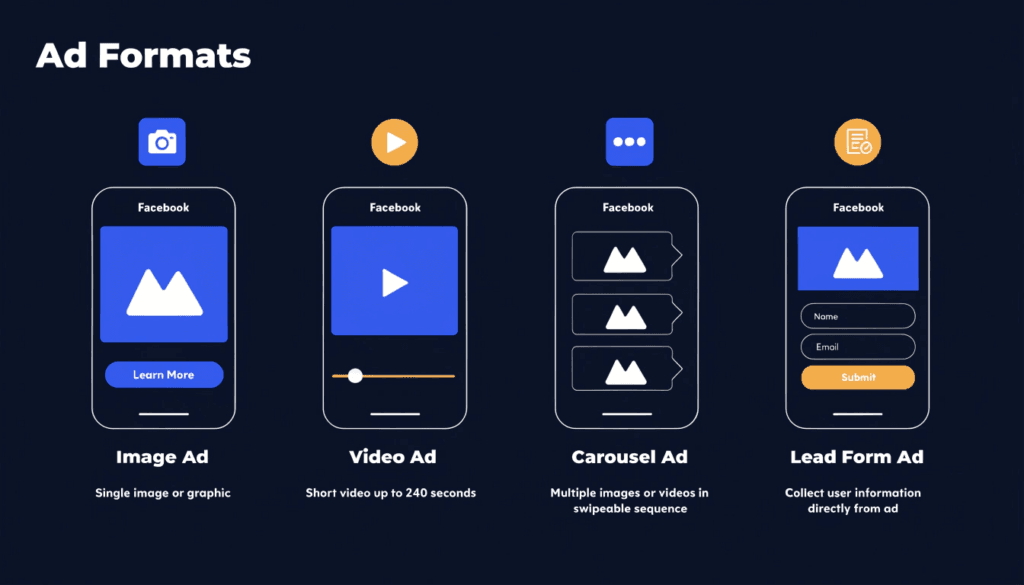
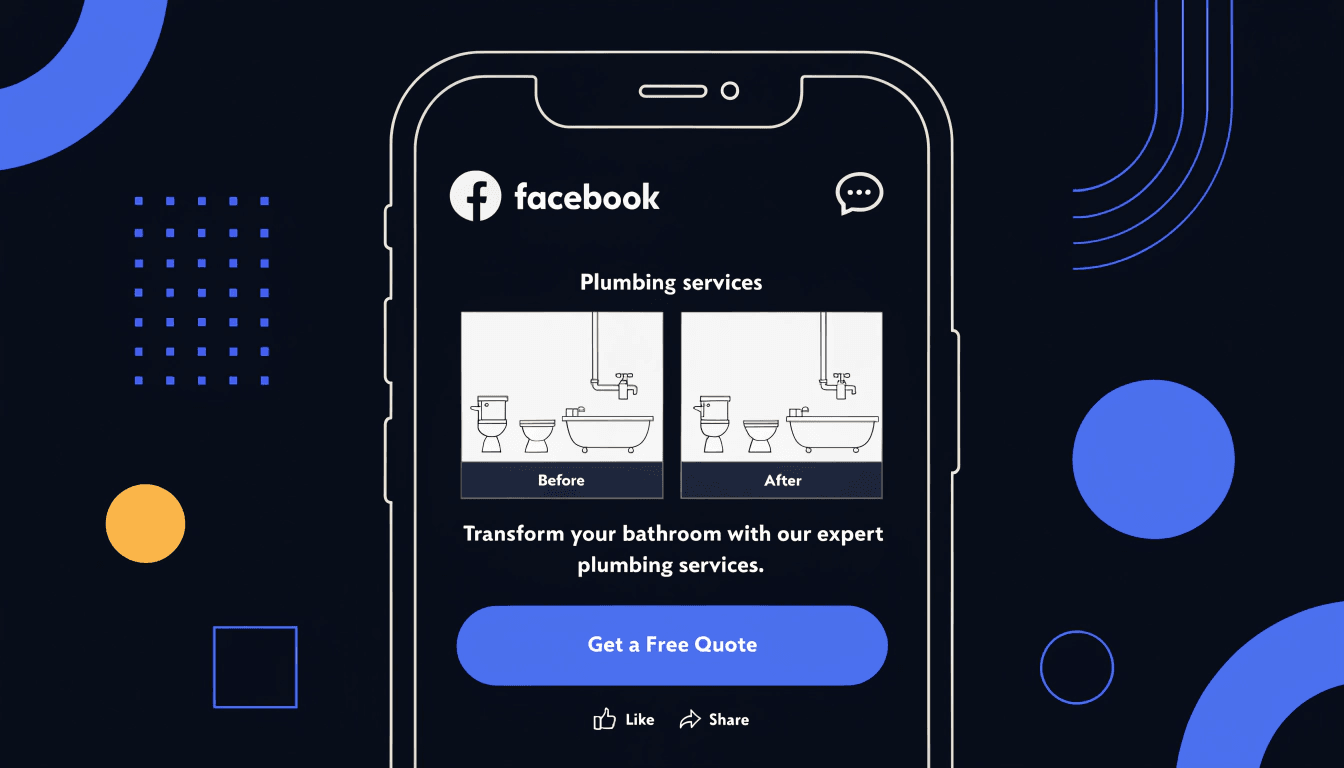
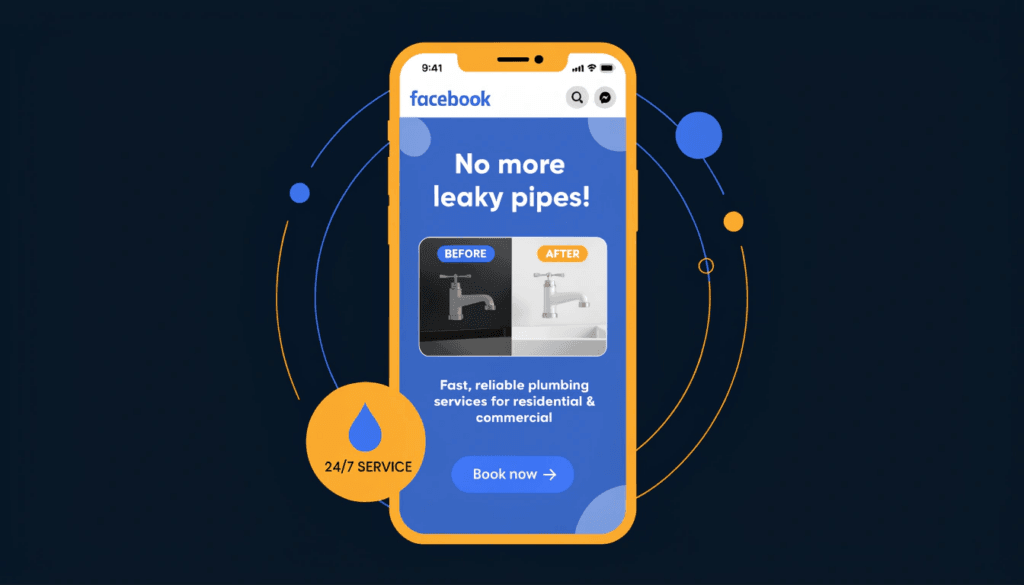
Image ads are the simplest to create and work well for showcasing finished projects. A high-quality before-and-after photo with clear copy and a strong call to action is often all you need to start. Add your logo and contact details directly to the image so it works even if someone doesn't click through.
Video ads let you demonstrate expertise in a way a static image can't. A 30–60 second clip showing a job in progress, a happy customer, or a quick tip for homeowners consistently outperforms generic imagery. Keep videos under two minutes, add subtitles (most people watch on mute), and end with a clear next step.
Carousel ads are ideal if you offer multiple services. You get up to 10 cards, each with its own image and link — so you could show drain cleaning, bathroom fitting, and boiler servicing all in a single ad, each card pointing to its own landing page.
Lead ads are particularly powerful for plumbers. Rather than sending someone to your website, the ad opens a pre-filled form inside Facebook, capturing their name, phone number, and any qualifying questions you add. Because the user's information is pre-populated, the drop-off rate is much lower than with a website form — especially on mobile.
Facebook Ad Objectives Explained
When you create a campaign in Meta Ads Manager, you'll be asked to choose an objective. This tells the algorithm what you're trying to achieve and who to show your ads to.
Awareness is best when you're new to an area or want to build brand recognition. The algorithm prioritises showing your ad to as many relevant people as possible, rather than optimising for clicks or enquiries.
Consideration (specifically the Traffic objective) is useful if you want to drive visitors to a specific page — for example, a landing page promoting your boiler service plan.
Leads (or Conversions) is the objective most plumbers should be working towards. It optimises ad delivery specifically to find people most likely to fill in a form or take a desired action. If you're using lead ads, use the Leads objective. If you're sending traffic to your own website, use Conversions — and you'll need to install the Meta Pixel on your site first.
Targeting Your Audience on Facebook
One of the most significant recent changes to Meta Ads is the rise of Advantage+ targeting. Rather than manually setting demographics, interests, and income levels as you would have done a few years ago, you can now let Meta's AI find your ideal audience automatically based on your ad creative and landing page.
For most local plumbers, this AI-led approach now outperforms manual demographic targeting. Meta's algorithm has access to an enormous amount of behavioural data and is remarkably good at identifying homeowners in your area who are likely to need your services.
That said, you should still use location targeting to keep your ads within your actual service area. There's no point paying to reach someone 40 miles away who'll never book you.
For retargeting — showing ads to people who've visited your website — you'll need the Meta Pixel installed on your site. This is a small snippet of code that tracks visitors and allows you to build custom audiences. Retargeting warm audiences typically delivers a much lower cost per lead than cold prospecting.
How to Set Up Your First Plumbing Facebook Ad Campaign
If you've never run ads before, here's a simplified starting framework:
- Create a Meta Business Account at business.facebook.com and connect your Facebook Business Page.
- Install the Meta Pixel on your website — this is essential for tracking conversions and building retargeting audiences.
- Choose your campaign objective — for most plumbers, start with Leads.
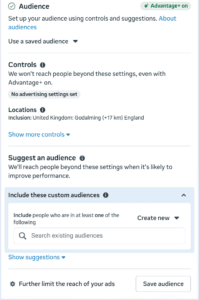
- Set your audience — use Advantage+ targeting with your service area defined by a radius around your town or specific postcodes.
- Set your budget — start with at least £10–£15 per day. Anything lower and the algorithm won't have enough data to optimise effectively.
- Create your ad — lead with a specific offer, use a real photo or short video, and include a clear call to action.
- Build a lead form — if using lead ads, keep it short: name, phone number, and one qualifying question such as "What service do you need?"
- Follow up fast — and I cannot stress this enough. If you wait three hours to call a Facebook lead, that person has already booked someone else. Aim to respond within five minutes. An automated SMS confirmation sent immediately after submission goes a long way.
Facebook Ad Costs in the UK
Costs vary depending on your location, competition, ad quality, and targeting — but here are rough benchmarks to plan around:
| Metric | Approximate UK Range |
|---|---|
| Cost per 1,000 impressions (CPM) | £5–£15 |
| Cost per click (CPC) | £0.80–£2.50 |
| Cost per lead (via lead ads) | £8–£35 |
Emergency plumbing is competitive and expensive to target on any platform. Focus your Facebook budget on planned services and your cost per lead will be significantly lower.
A realistic starting budget for a sole trader or small plumbing business is £300–£500 per month. This gives the algorithm enough data to optimise, lets you test a couple of different offers, and starts building your retargeting pool.
Making Facebook Ads Work Alongside Google Ads
The most effective plumbing marketing strategy I see combines both platforms. Google Ads captures high-intent demand — people who are actively searching for a plumber right now. Facebook builds awareness and generates leads from people who aren't yet searching but will be.
Running both together means you're not just competing at the bottom of the funnel. You're putting your name in front of homeowners before they have a crisis, so that when they do need a plumber urgently, they already know who to call.
If budget is tight, prioritise Google Ads first. If you already have Google running and want to scale, Facebook is the logical next step.
If you'd like to know more about SEO for plumbers as a longer-term strategy that works alongside both, that's worth reading alongside this guide.
Tips to Improve Your Facebook Ad Results
Test one thing at a time. If you change your image, your copy, and your offer simultaneously, you won't know what made the difference. Run A/B tests on individual elements.
Use real photos, not stock imagery. Authentic images of your team and your work consistently outperform generic visuals. Homeowners want to see who they're letting into their house.
Refresh your creative regularly. Facebook audiences see the same ad repeatedly and engagement drops fast. Rotate fresh creative every four to six weeks.
Add a qualifying question to your lead form. Something simple like "What type of job do you need?" or "Is this for a residential or commercial property?" filters out time-wasters and improves the quality of your leads.
Track everything. Make sure your Meta Pixel is installed, your lead forms are connected to your CRM or at minimum an email notification, and you're reviewing performance weekly.
Frequently Asked Questions
Are Facebook ads worth it for plumbers? Yes — but only if you approach them correctly. Facebook works best for planned services, retargeting, and brand awareness rather than emergency callouts. Combined with Google Ads and a solid SEO strategy, it can be a powerful part of your marketing mix.
How much should a plumber spend on Facebook ads? For a small plumbing business in the UK, a starting budget of £300–£500 per month is realistic. Below £10/day and the algorithm struggles to optimise. Scale up once you're seeing a consistent cost per lead.
What type of Facebook ad works best for plumbers? Lead ads are the most effective format for generating direct enquiries, as they remove the friction of sending someone to an external website. Video ads tend to generate the best engagement and are worth investing in once you have a proven offer.
How do I stop Facebook leads from being low quality? Add a qualifying question to your lead form — asking about the type of job, timeframe, or property type filters out tyre-kickers before they reach your inbox. Respond fast too: the quicker you follow up, the better the conversion rate.
Do I need a website to run Facebook ads? Not necessarily. Using Facebook's native lead forms means the user never leaves the platform, so you can generate enquiries without a website. That said, having a strong website improves your retargeting capability and gives leads somewhere to verify your credibility. If you don't have one yet, take a look at our web design service to see what's involved.
Conclusion
Facebook ads can be a genuine lead source for plumbing businesses — but they work best when you approach them with realistic expectations and the right strategy. They're not for capturing emergency callouts. They're for building awareness, promoting planned work, and keeping your pipeline full in the quieter months.
The plumbers who get the best results from Facebook share three things: a specific, compelling offer; authentic creative that shows their work and their team; and a fast, consistent follow-up process.
If you'd like help getting Facebook or Google Ads working for your plumbing business, get in touch and we can talk through what's possible.