Most salon owners I speak to rely on Instagram, word of mouth, and the occasional Facebook post to bring in new clients. These channels work — up to a point. The problem is that they all depend on you being visible to people who are already aware of you. SEO works differently. When someone in your town types "hair salon near me" into Google, they're ready to book right now — and they have no idea who you are yet. That is precisely who you want to reach.
This article is part of my small business guide to SEO and my small business marketing guide.
This guide covers everything you need to know to make your salon visible in Google search, from the fundamentals of keyword research through to optimising your Google Business Profile, building backlinks, and tracking whether any of it is actually working. I've written it for salon owners who want to do this themselves or understand it well enough to work effectively with a professional.

Why SEO Matters More Than Ever for Salons
Local search has changed the way people choose where to spend their money. The vast majority of people searching for a salon on Google never make it past the first page of results — and a significant proportion click one of the top three listings. If your salon isn't appearing prominently, those potential clients are going to a competitor.
The other thing worth understanding is the intent behind salon searches. When someone searches "balayage near me" or "nail salon in [your town]", they aren't browsing for ideas — they're looking to book. This is high-intent traffic, and it converts far better than social media followers who might admire your feed without ever making an appointment.
Unlike paid advertising, SEO compounds over time. The work you put in this month builds on the month before. Once your salon is ranking well for the right terms, that visibility keeps delivering without an ongoing media spend behind it.
Start With the Right Keywords
Keyword research is the foundation of your entire SEO strategy. Before you write a single word of website content or touch your Google Business Profile, you need to know what your potential clients are actually searching for.
The types of keywords that matter for salons
There are broadly two kinds of keywords you should be targeting:
Service keywords. These describe what you offer — "women's haircut", "balayage", "gel nails", "lash extensions", "bridal hair and makeup". These terms should form the basis of your core service pages.
Geographic keywords. These combine your service with your location — "hair salon in Bristol", "nail salon Cheltenham", "wedding hair stylist London". The more specific you can get, the better your chances of ranking, particularly if you're not yet an established site with strong authority.
Long-tail keywords. These are more specific, lower-volume phrases like "best vegan hair salon in Manchester" or "affordable balayage near me". They're less competitive and often signal stronger purchase intent.
How to find the right keywords
Start by brainstorming. Write down every service you offer, every occasion you cater for (weddings, proms, corporate events), and every way someone might describe your salon (eco-friendly, luxury, affordable, specialist in Afro hair, and so on). Then combine these with your location.
From there, use an SEO tool to check search volumes and competition levels. A tool like SE Ranking lets you check what terms your competitors are ranking for, which is one of the fastest ways to identify content opportunities you might be missing. Aim for 10–20 core keywords to build your strategy around.
Build a Website That Google — and Your Clients — Will Love
Your website is the foundation of everything. Without one, you cannot build meaningful visibility in search. A Facebook page is not a substitute.
What your salon website needs
Dedicated service pages. Don't lump all your services onto a single page. Create a separate page for each key service category — hair, nails, beauty treatments, bridal, and so on. Each page can then be optimised for the relevant keywords and gives Google a clear signal about what you offer.
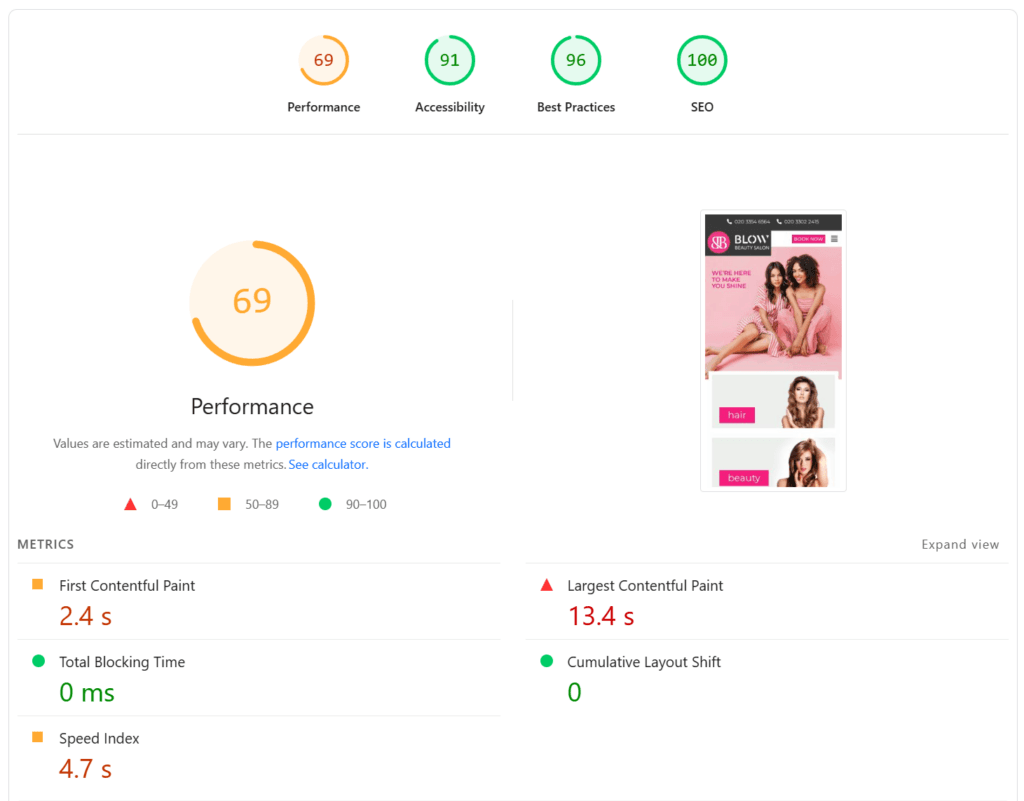
A fast, mobile-friendly design. The majority of local searches happen on mobile. If your website loads slowly or is difficult to navigate on a phone, visitors will leave before they've had a chance to see what you offer. Google also uses mobile performance as a ranking factor. You can check your current speed for free using Google's PageSpeed Insights tool.
An SSL certificate. Your website should load over HTTPS, not HTTP. Most reputable hosting providers include this as standard, but it's worth checking. A site without SSL can be flagged as "Not Secure" in Chrome, which erodes client trust before they've even read a word.
A clear booking pathway. Once someone lands on your site, they should be able to book an appointment in as few clicks as possible. An integrated online booking system is worth investing in — it removes friction and increases the likelihood of converting a visitor into a client.
On-Page SEO: Optimising Each Page
Once your site structure is in place, you need to make sure each page is optimised so that Google understands what it's about and ranks it accordingly.
Page titles and meta descriptions
The title tag is the clickable blue text that appears in search results. It should include your primary keyword for that page and ideally your location — for example: "Balayage Salon in Leeds | [Your Salon Name]". Keep it under 60 characters.
The meta description is the short summary underneath. It doesn't directly affect rankings, but a well-written description improves click-through rates. Write it as an invitation — what will the visitor find when they click, and why should they choose you?
Headers and body content
Use your keywords naturally within the page content. Your main H1 heading (the page title visible on the page itself) should include your target keyword. Sub-headings (H2 and H3) can support related terms. Avoid stuffing keywords in unnaturally — write for people first, and Google will follow.
Image alt text
Every image on your website should have descriptive alt text. This helps with accessibility and gives Google additional context about your page content. Instead of "IMG_4823.jpg", use something like "balayage colour treatment at [Salon Name] in [Location]".
Local SEO: Your Google Business Profile
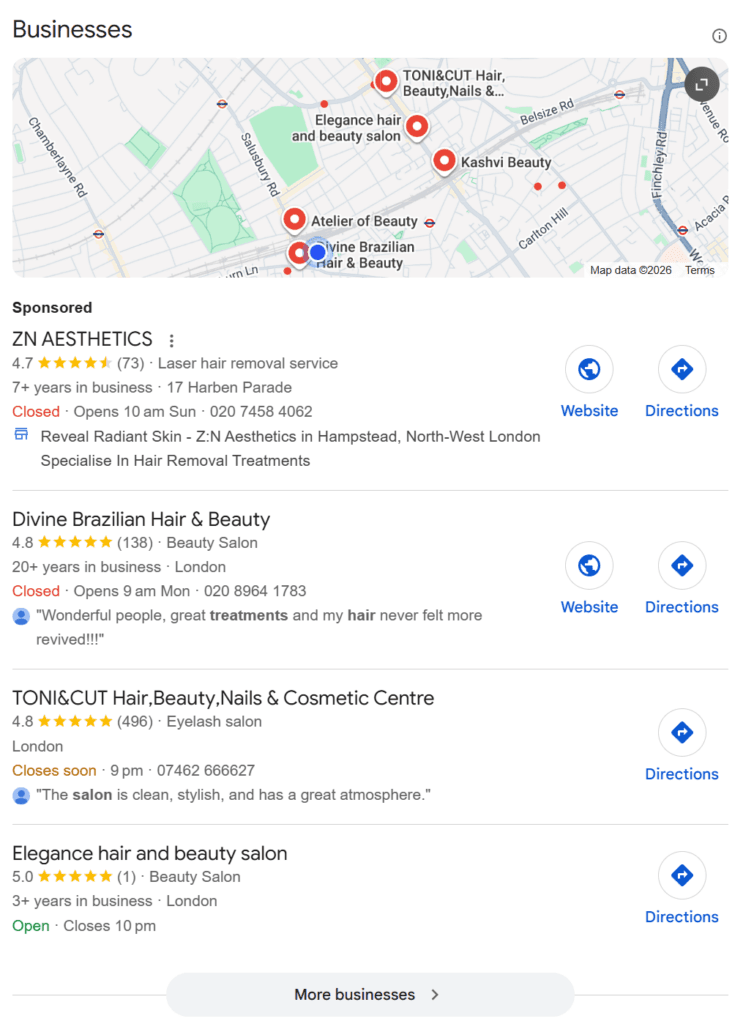
For most salons, your Google Business Profile (GBP) will drive more new client enquiries than any other single SEO action. This is the listing that appears in Google Maps and the "map pack" — the block of three businesses shown prominently at the top of local search results.
How to optimise your Google Business Profile
Claim and verify your listing at business.google.com if you haven't already. Google will verify your business by postcard, phone, or video.
Choose the right categories. Your primary category should be as specific as possible — "Hair Salon", "Beauty Salon", "Nail Salon", etc. — rather than a generic "Health & Beauty Business". You can add secondary categories for additional services.
Complete every section. Add your address, phone number, opening hours, website URL, and a full description of your services. Consistency matters — make sure the name, address, and phone number (NAP) you use here exactly matches what appears on your website and any other online directories.
Add photos regularly. Listings with photos receive significantly more clicks than those without. Add images of your salon interior, your team, and your finished work. Keep adding new photos on a regular basis — it signals to Google that your listing is active.
Get reviews — and respond to them. Reviews are one of the most powerful ranking factors for local search. Make it easy for happy clients to leave a review by sending them a direct link after their appointment. Respond to every review, positive or negative, professionally and warmly. This shows potential clients that you care about their experience.
Use Google Posts. You can publish updates, offers, and event information directly on your profile. These appear in your listing and help signal that your business is active and engaged.
Don't Overlook Bing Places and Apple Maps
Google dominates search, but Bing and Apple Maps together serve a meaningful share of users — particularly iPhone owners, who are often your most valuable demographic.
Register your salon with Bing Places for free. The process is similar to Google Business Profile, and it means you're visible to users on Windows devices and Microsoft Edge, where Bing is the default.
For Apple Maps, register through Apple Business Connect. When iPhone users ask Siri for a salon nearby, Apple Maps is what Siri uses — so being listed there can translate directly into new enquiries.
Both take under an hour to set up and are entirely free. There's no reason not to do them.
Building Authority With Backlinks
Backlinks — links from other websites to yours — are one of Google's most important ranking signals. They function as votes of confidence: when a credible website links to yours, Google interprets this as evidence that your site is trustworthy and valuable.
For salons, some of the most achievable backlink opportunities include:
Local press and directories. Being featured in local newspaper websites, business directories, and community listings all contribute to your authority. Yell, Thomson Local, and FreeIndex are straightforward starting points.
Supplier and brand websites. If you stock or use specific product brands, check whether they list stockists or recommended salons on their website. A link from a well-known hair or beauty brand carries real weight.
Wedding and event directories. If you offer bridal hair and makeup, you're eligible to list on wedding directories like Hitched and Bridebook. These are high-authority sites in relevant niches.
Local blog and influencer collaborations. Working with a local lifestyle blogger or reaching out to a local journalist for a feature can earn you a high-quality link while also raising your profile in the community.
You don't need dozens of backlinks overnight — a steady, consistent approach over time is far more effective (and sustainable) than any shortcut.
Content Marketing: Blogging for Your Salon
A blog isn't essential for every salon, but it's one of the most powerful long-term strategies for building organic traffic. Every piece of content you publish is an opportunity to rank for a new keyword.
The key is to think about the questions your clients actually ask. What are they searching for before, during, and after choosing a salon? Some examples:
- "How long does balayage take?"
- "What's the difference between highlights and balayage?"
- "How to look after your hair between salon visits"
- "What hairstyle suits a round face?"
- "How much does a Brazilian blow-dry cost?"
Each of these is a blog post. Write one comprehensive, genuinely helpful article for each, and over time your site becomes a resource that Google trusts and clients find useful. You can learn more about the principles behind this approach in my guide to why keyword research is so important.
Content marketing also feeds other channels — social media, email newsletters, and client-facing follow-up — so the effort compounds across your whole marketing strategy.
Tracking Your Progress
SEO takes time — typically three to six months before you see meaningful movement in competitive markets, though local signals like your Google Business Profile can respond faster. The important thing is to track what's happening so you know what's working.
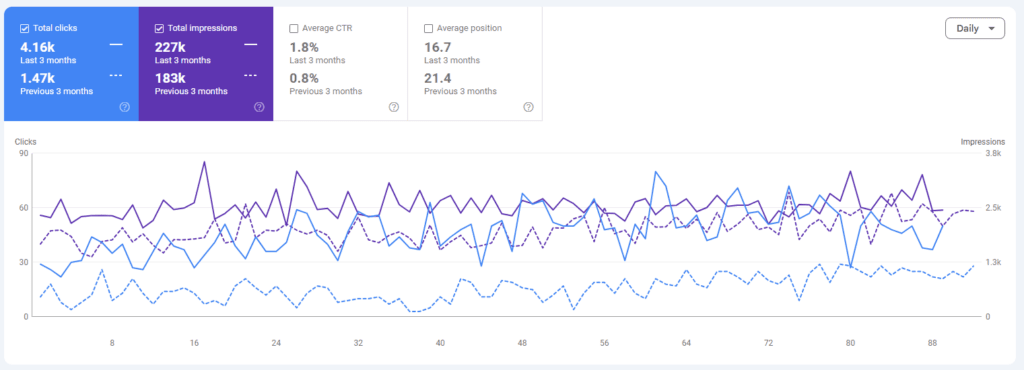
Google Search Console (free) shows you which search terms your website is appearing for, how many clicks you're receiving, and which pages are performing well. Set this up from day one.
Google Analytics 4 (also free) shows you what visitors are doing when they arrive on your site — which pages they visit, how long they stay, and whether they're converting into enquiries or bookings.
Check both monthly. Look for trends rather than individual data points, and be patient — consistent effort over months, not weeks, is what produces lasting results.
Frequently Asked Questions
How long does SEO take for a salon? Most salons start to see meaningful improvements within three to six months of consistent work. Google Business Profile optimisations and reviews can have a faster impact — sometimes within weeks. SEO is a long-term investment, not a quick fix.
Do I need to hire someone to do SEO for my salon? Not necessarily. Many of the fundamentals — setting up your Google Business Profile, optimising your website pages, and generating reviews — can be done by a motivated salon owner. For more technical work, link building, and content strategy at scale, working with an SEO specialist typically accelerates results significantly.
How many keywords should I target? Start with 10–20 core keywords built around your most important services and your location. As your site grows and gains authority, you can expand into longer-tail and supporting keywords.
Does social media help my SEO? Not directly — social media signals are not a Google ranking factor. However, a strong social presence can drive traffic to your website, increase brand awareness, and support review generation, all of which indirectly benefit your SEO.
What's the most important thing I can do first? If you haven't already, claim and optimise your Google Business Profile. For local businesses, it's the single highest-impact action you can take, and it's entirely free.
Conclusion
SEO for salons isn't complicated, but it does require consistency. Start with the foundations — a well-structured website, thorough keyword research, and a fully optimised Google Business Profile — and build from there. Add content over time, earn links, and track your progress. Done properly, it's one of the most cost-effective and durable ways to grow your client base without relying on paid advertising.
If you'd like to see where your salon's website currently stands, run a free SEO audit — it takes under a minute and will highlight the areas most worth your attention first.
Prefer to hand it over to someone who does this every day? Get in touch and let's talk through what's possible for your salon.