Most plumbers I speak to aren't short of demand – they're short of the right demand. The phone rings, but it's the wrong area. Or a homeowner submits a quote request and then goes cold. Or the diary is full in summer but empty in February.
This article is part of my guide to marketing for tradespeople.
Consistent plumbing lead generation isn't about doing one thing brilliantly – it's about building a system where multiple channels work together so you're never relying on a single source. In this guide, I'll walk you through ten strategies that actually move the needle, ranked roughly by impact, with practical steps you can start acting on today.
What Is a Plumbing Lead – and Why Does Quality Matter More Than Quantity?
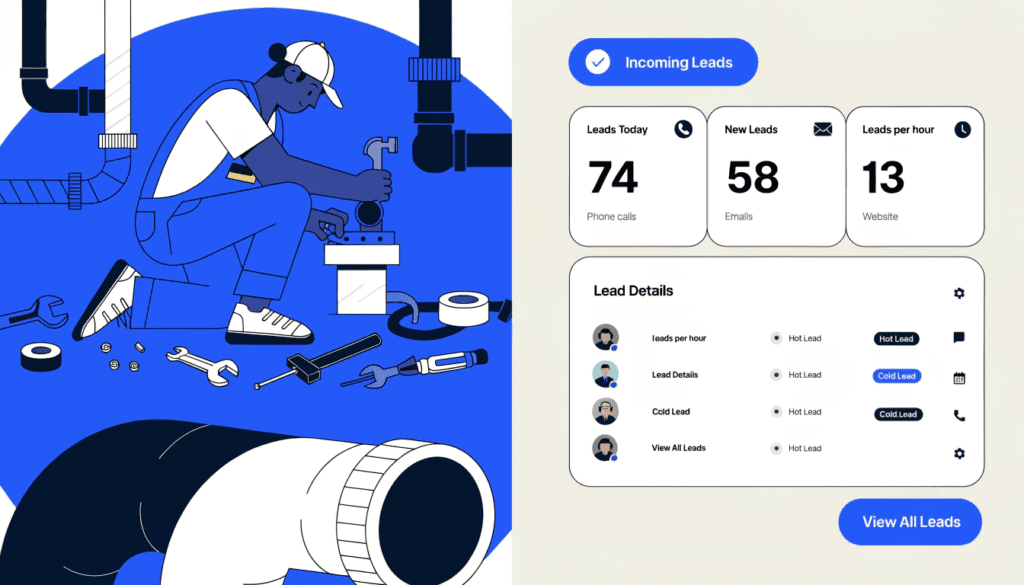
A plumbing lead is any potential customer who has taken a deliberate action to express interest in your services – a phone call, a form submission, a click on an ad, a message through your Google Business Profile. The key word is action. Someone who glanced at your van hasn't become a lead yet.
Not all leads are equal, though. A homeowner with water pouring through their ceiling at 11 PM is worth far more than someone casually shopping around for a bathroom refit starting next year. High-quality leads are:
- In your service area
- Ready to book within hours or days, not weeks
- Looking for a trusted professional, not just the cheapest quote
The best plumbing lead generation strategies focus on attracting high-intent enquiries and converting them efficiently – not just generating raw volume.
1. Dominate Local Search With SEO
If someone in your area searches "plumber near me" or "emergency plumber [town]" and your business doesn't appear in the top results, that lead is going to a competitor. Local SEO is the most important long-term investment a plumbing business can make.
The three areas to focus on:
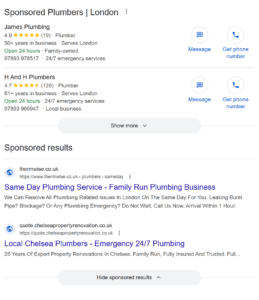
Google Business Profile (GBP) This is what drives the local map pack – the three business listings that appear above organic results. Keep your profile fully completed: accurate address, phone number, opening hours, services, photos, and a steady stream of fresh reviews. Add posts regularly and respond to every question.
On-site local SEO Your website needs to target location-specific keywords. A page titled "Plumber in [Town]" will outperform a generic "Services" page every time. Include your service area in your page titles, H1s, and meta descriptions – and make sure your name, address, and phone number (NAP) match exactly across your site and every directory listing.
Local citations and directory listings Consistent NAP data across Yell, Checkatrade, TrustATrader, Rated People, and other relevant directories reinforces your local authority with Google. I cover this in more detail in point six below.
For a deep dive into everything involved, read our ultimate guide to SEO for plumbers. If you'd prefer expert help handling it, take a look at our SEO services.
2. Run Google Ads and Local Services Ads for Immediate Visibility
SEO is a long game. Google Ads and Local Services Ads (LSAs) are how you generate leads while your organic rankings build.
Google Ads (PPC) Pay-per-click advertising puts your business at the top of search results instantly. The key is targeting the right keywords – high-intent, service-specific terms like "blocked drain repair [town]", "emergency plumber [city]", or "boiler service near me" – and sending traffic to a landing page that's built to convert, not your homepage.
A few tips to avoid wasting budget:
- Use negative keywords to filter out irrelevant clicks (e.g. "plumbing courses", "plumber jobs")
- Geo-target tightly to your actual service area
- Use call extensions so mobile users can call directly from the ad
- Match your landing page message to your ad copy
Most of my trade clients sit comfortably within a £500–£750/month ad spend and see a strong return when the campaigns are set up properly. I've written a full breakdown of Google Ads for trade businesses if you want to go deeper. Or if you'd like someone to manage it for you, see our PPC and Google Ads services.
Google Local Services Ads LSAs sit above standard PPC ads and display a "Google Guaranteed" badge, which significantly increases trust. You only pay per lead, not per click – and leads come directly as phone calls or messages. For plumbers, LSAs are particularly effective for emergency and high-intent searches.
3. Build a Website That Actually Converts
Your website is working around the clock – or it isn't. Most plumber websites I audit fall into two camps: either they don't exist in any meaningful sense, or they exist but do nothing to convert visitors into enquiries.
A high-converting plumbing website needs:
- Fast load speed – aim for under 3 seconds. Slow sites lose mobile visitors instantly.
- Mobile-first design – the majority of local searches happen on smartphones. If your site is awkward to use on mobile, you're losing leads.
- Clear calls to action – "Call Now", "Get a Free Quote", and "Book Online" should be visible without scrolling on every key page.
- Trust signals – Google reviews, trade certifications (Gas Safe, CIPHE), years of experience, and before-and-after photos all increase conversion.
- Service area pages – individual pages targeting each town or borough you cover help you rank locally and give visitors confidence you serve their area.
If your site isn't doing these things, a redesign will often deliver a better return than any amount of ad spend.
We also offer plumber-specific web design if you're looking for a site built with lead generation front and centre.
4. Respond to Every Lead Within 60 Seconds
This one isn't about marketing at all – it's about not losing the leads you've already generated.
When a homeowner has a burst pipe, they're not calling one plumber and waiting patiently. They're calling the first three results on Google and booking whoever picks up first. Research from lead response studies consistently shows that responding within 60 seconds dramatically increases conversion compared to calling back even 5 minutes later.
Practical steps:
- Set up call forwarding to your mobile if you can't always answer the office phone
- Use a missed call text-back tool so anyone who can't get through immediately receives a message
- If you use a contact form, set up an instant automated email acknowledgement so the lead knows you've received their enquiry
Speed to lead is free to implement and often the highest-leverage improvement a plumbing business can make.
5. Stack Google Reviews and Make Them Work for You
Online reviews are one of the most underinvested areas in plumbing marketing. They directly influence both your Google rankings and your conversion rate – a plumber with 4.8 stars and 120 reviews will win enquiries over a competitor with 4.2 stars and 12 reviews, even if the second plumber is objectively better.
How to get more reviews consistently:
- Ask every satisfied customer – most people are happy to leave a review if asked directly, but they won't do it unprompted
- Send a follow-up text or email after every job with a direct link to your Google review page
- Make it as easy as possible: a QR code on your invoice, a link in your email signature, a message from your CRM
How to use reviews to generate more leads:
- Embed your Google reviews on your website
- Respond professionally to every review, positive or negative – your response is as much for future customers reading it as for the reviewer
- Highlight specific reviews on your social media pages
A consistent review strategy compounds over time. Thirty new reviews this year become part of the social proof that makes all your other marketing work harder.
6. Get Listed in the Right Online Directories
Directory listings do two things: they generate direct leads from people browsing those platforms, and they build local citations that strengthen your SEO.
The key directories for UK plumbers:
| Directory | Why It Matters |
|---|---|
| Google Business Profile | Essential – drives the local map pack |
| Checkatrade | High consumer trust; vetted trades |
| TrustATrader | Strong in residential markets |
| Rated People | Good for quote-comparison searches |
| Yell | Strong domain authority; citation value |
| Thomson Local | Older audience demographic; worth including |
| MyBuilder | Job-matching platform with homeowner enquiries |
For every listing, ensure your NAP (name, address, phone number) is identical. Even small inconsistencies – "St." vs "Street", different phone number formats – can dilute your local SEO authority.
7. Set Up a Customer Referral Programme
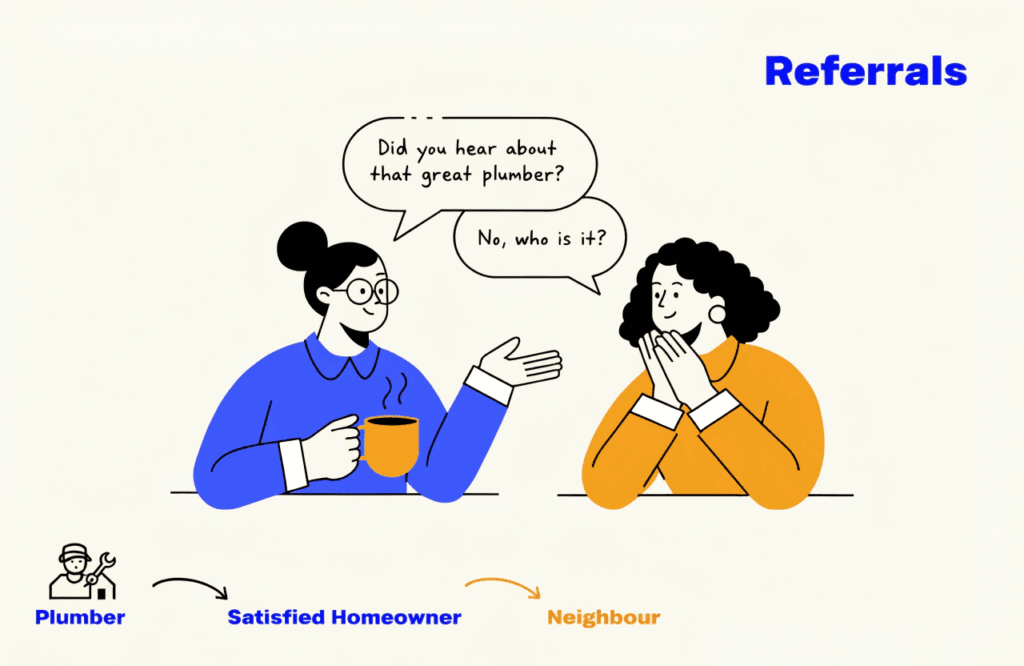
Word of mouth is still one of the most powerful lead sources for local trades – but most plumbers leave it entirely to chance. A structured referral programme turns satisfied customers into an active, consistent lead channel.
Simple structures that work:
- Offer a fixed cash reward (£25–£50) for every referral that results in a booked job
- Offer a discount on the referee's next service call
- Send a handwritten thank-you card after a referral – it's memorable and costs almost nothing
The key is making it easy for customers to refer you. Give them something physical – a business card, a fridge magnet, a QR code on your invoice – and remind them at the end of every job that you'd love to be recommended to their friends and neighbours.
8. Publish Content Your Customers Are Searching For
Content marketing is a long-term play, but it builds something PPC never does: owned visibility you don't pay for every month.
Think about the questions your customers ask before they pick up the phone:
- "How do I know if I need a new boiler?"
- "What are the signs of a burst pipe?"
- "How much does an emergency plumber cost?"
Every one of those is a search query someone types into Google. A well-written, helpful blog post that answers the question positions you as the expert and often converts the reader into an enquiry before they've looked at a single competitor.
Good content topics for plumbers:
- Seasonal guides ("How to Protect Your Pipes This Winter")
- FAQ pages targeting common search queries
- Location-specific service pages ("Boiler Repair in [Town]")
- Cost guides ("How Much Does a Plumber Cost in [City]?")
Content marketing requires patience – posts typically take 3–6 months to rank – but the results compound. A post that ranks for "emergency plumber [town]" generates leads every month indefinitely.
I've written more about this approach in our complete guide to digital marketing for plumbers.
9. Use Email to Re-Engage Past Customers
Every customer whose job you've completed is a warm lead for future work. Most plumbers never follow up with them.
An email list gives you a direct channel to your existing customer base at almost zero cost. You can use it to:
- Send annual service reminders (boiler services, landlord certificates)
- Offer seasonal promotions before winter or summer
- Share useful maintenance tips that keep your name front of mind
- Announce new services or coverage areas
You don't need a sophisticated setup to start. A simple tool like Mailchimp and a habit of collecting email addresses at every job is enough to build a list that generates repeat bookings.
Reactivating a past customer costs a fraction of what it costs to acquire a new one – and they already trust you.
10. Build a Social Media Presence (Without Wasting Time on It)
Social media rarely generates direct plumbing leads in the same volume as SEO or PPC – but it does build the ambient trust that makes your other marketing more effective. When a homeowner sees your Google ad and then checks your Instagram and finds 200 posts of completed jobs and happy customers, their confidence in calling you goes up.
Keep it proportionate:
- Focus on Facebook and Instagram – these are where your residential customers spend their time
- Post job photos, before-and-afters, and short how-to tips a few times a week
- Share your Google reviews as social posts to reinforce trust
- Respond quickly to any messages or comments
Don't build your entire lead generation strategy around social media, but don't ignore it either. It's one part of a balanced system.
Common Plumbing Lead Generation Mistakes to Avoid
Even with the right strategies in place, these mistakes can quietly drain your budget and cost you leads:
Relying on a single source. If all your leads come from one platform – even one that's working well – you're one algorithm update or rate increase away from a quiet month. Diversify.
Buying shared leads. Many lead generation platforms sell the same enquiry to multiple plumbers simultaneously. You end up in a race to call first. Wherever possible, focus on channels where you own the lead – your own SEO, your own Google Ads, your own referral network.
Ignoring your existing customers. New leads cost money. Past customers cost almost nothing to reactivate. If you're not following up, you're leaving significant revenue on the table.
Slow response times. As covered above – speed to lead is often the deciding factor. If you can't answer immediately, have a system that makes contact on your behalf.
Frequently Asked Questions
What is a plumbing lead? A plumbing lead is a potential customer who has taken a specific action to express interest in your services – a phone call, a form submission, a message, or a click on an ad. The key is that they've done something deliberate, not just seen your name somewhere.
What is plumbing lead generation? Plumbing lead generation is the process of attracting, capturing, and converting potential customers into booked jobs. It covers everything from local SEO and Google Ads to referral programmes, directory listings, and content marketing.
How quickly should I respond to a plumbing lead? As quickly as possible – ideally within 60 seconds for calls and within 5 minutes for form submissions. The longer you wait, the more likely the homeowner has already booked a competitor.
Should I buy plumbing leads? Bought leads can fill gaps in your diary, particularly while your SEO and review strategy builds momentum. Be cautious about shared leads – where the same enquiry goes to multiple businesses – and track your cost per booked job carefully to make sure the spend makes sense.
What's the most cost-effective plumbing lead generation strategy? Long-term, local SEO combined with a consistent review strategy delivers the lowest cost-per-lead of any channel. Short-term, Google Ads and Local Services Ads provide the fastest results. A combination of both is where most successful plumbing businesses end up.
Ready to Build a Consistent Pipeline of Plumbing Leads?
Plumbing lead generation works best as a system – multiple channels reinforcing each other, with no single point of failure. Whether you're starting from scratch or looking to grow a business that's already ticking over, the strategies above give you a clear roadmap.
If you'd like to see how your current online presence stacks up, run a free SEO audit – it takes under a minute and gives you an immediate picture of where you stand.
Or if you're ready to have a conversation about what a proper lead generation strategy would look like for your business, get in touch and let's talk it through.