
Picking the wrong SEO agency is an expensive mistake. I've spoken to plenty of small business owners who've been there: months of budget gone, rankings no better than before, and a vague monthly report full of traffic graphs that somehow never translate into enquiries.
This article is part of my small business guide to SEO.
The problem usually isn't that SEO doesn't work. It's that not all agencies are equally capable, and the ones that talk the loudest in a sales call aren't always the ones delivering results once the contract is signed.
This guide walks you through exactly how to choose an SEO agency that's genuinely right for your business. Not a generic checklist but a practical, step-by-step process that helps you ask the right questions, spot the warning signs, and make a confident decision.
Why Choosing the Wrong SEO Agency Costs More Than You Think
Most business owners focus on the upfront cost when evaluating SEO agencies. But the real cost of a bad choice goes much further.
A poor agency can burn through your budget on work that produces no results. A genuinely harmful one can use tactics that get your site penalised by Google, and recovering from a penalty can take months, sometimes longer. Meanwhile, your competitors are pulling further ahead.
There's also the opportunity cost. Every month you spend with an ineffective agency is a month you're not building genuine organic visibility. SEO takes time to compound, so a wasted six months doesn't just cost you six months. It sets your entire trajectory back.
The good news is that there are clear signals that separate good agencies from bad ones. You don't need to be an SEO expert to spot them. You just need to know what to look for.
Step 1: Get Clear on What You Actually Need from SEO
Before you contact a single agency, you need to know what you're trying to achieve. This sounds obvious, but most businesses skip it, and it makes every conversation with an agency harder than it needs to be.
Ask yourself:
- Do you want more organic traffic to your website generally, or are you targeting specific service or product pages?
- Is local SEO the priority? Do you need to appear in the Map Pack when people search for your service in a specific town or city?
- Are you trying to grow an ecommerce store, or generate leads for a service business?
- Is there a specific keyword set you know you're missing out on?
Your answers shape what kind of agency you need. A local plumber looking to rank for "plumber in [town]" has different requirements to an ecommerce retailer targeting national product searches. Some agencies specialise in one area, others cover both. You can only judge fit if you know what you're looking for.
Setting measurable goals is also important: not "rank better on Google" but something you can actually track, like increasing organic traffic from a specific city by 30%, or generating 10 more enquiries per month from the website.
Step 2: Check Whether They Rank Themselves
This is the simplest, most telling test you can run on any SEO agency, and most business owners never think to do it.
Search Google for "SEO agency [your town or city]" or "SEO services for [your industry]". Do they appear? If an agency is selling SEO and can't rank their own website for relevant searches, that tells you something important about the quality of their work.
This isn't a binary pass/fail. A very new agency might not have built enough authority yet, and some agencies get all their clients through referrals rather than organic search. But a well-established agency that claims to be experts in SEO should be demonstrating that expertise on their own site.
Look at the quality of their blog content too. Is it substantive and well-written, or is it thin filler content published purely for the sake of it? The same approach they take to their own content is the approach they'll take to yours.
Step 3: Ask to See Real Case Studies
Any agency worth working with will have evidence of results they've achieved for clients. Ask for case studies, and be specific about what you want to see.
A useful case study should tell you:
- What the client's situation was before the agency got involved
- What work was actually done (not just "we improved their SEO")
- What the measurable results were, and over what timeframe
- Whether the client is in a similar industry or at a similar business size to you
Vague claims like "we increased traffic by 200%" mean very little without context. 200% of what? Over how long? For what kinds of searches? For a site that had barely any traffic to begin with?
Ask whether any of their case study clients would be willing to have a brief conversation. A confident agency will have happy clients who are glad to talk. One that hedges on this might have something to hide.
Also look at client testimonials. Not just the ones displayed on the homepage, but reviews on Google or third-party directories. These are harder to curate and tend to give a more honest picture of what working with the agency is actually like.
Step 4: Understand What They'll Actually Do Each Month
One of the most common complaints I hear from business owners who've had bad experiences with SEO agencies is that they had no idea what was being done on their behalf each month. Invoices arrived, direct debits went out, and a monthly email landed with a PDF full of graphs. Nobody could explain what had actually changed on the website or why.
A good agency will tell you, in plain language, exactly what they're doing and why. This might include:
- Which pages they've optimised and what changes were made
- What new content has been published and what keywords it targets
- What link building activity has taken place and where links have been earned
- Any technical fixes that have been implemented
- What the plan is for the following month
Reporting should show you meaningful metrics: organic traffic trends, keyword ranking improvements, leads generated from organic search. It should not be full of vanity numbers that look impressive but don't connect to business outcomes.
If you want to track your own rankings independently, a tool like SE Ranking lets you monitor your keyword positions affordably, so you can verify whether what an agency is telling you matches what you're actually seeing in the data.
Step 5: Watch Out for These Red Flags
Some warning signs are obvious in hindsight but easy to miss when you're deep in a sales conversation. Here's what to watch out for.
| Red Flag | What It Signals |
|---|---|
| Guaranteed rankings on Google | No one can guarantee specific positions. Google's algorithm isn't within anyone's control. This is either dishonesty or ignorance. |
| Very low monthly pricing | Effective SEO takes real time and skill. Agencies offering it for £150–£200 a month are cutting corners somewhere, often with outsourced or automated work. |
| Black-hat tactics | Keyword stuffing, bulk link buying, or content farms might produce short-term movement but will eventually lead to penalties. |
| No clear reporting structure | If they can't explain what you'll receive each month before you sign, they're unlikely to be transparent once you're a client. |
| Pressure to sign quickly | A good agency has no reason to rush you. Urgency tactics are a sales technique, not a sign of confidence. |
| They outsource everything | Some outsourcing is normal. But if core strategy and execution is being passed to a third party abroad, quality control becomes a serious concern. |
| A separate GEO or AI SEO fee | Being found in ChatGPT and Google's AI Overviews comes from the same work as good SEO. An agency charging you again for it is usually selling a relabelled version of what you're already paying for. I've broken down what GEO agencies are really selling and what a GEO add-on actually buys. |
| They can't explain what they'll do | If a discovery call is full of jargon and short on specifics, that's a problem. You should be able to understand, in plain terms, what they'll be working on. |
Step 6: Ask the Right Questions Before You Sign
A proper agency will welcome questions. These are the ones worth asking in any initial conversation.
About their process:
- How do you approach an SEO campaign in the first 90 days?
- Will you conduct a technical audit of my site before work begins?
- How do you decide which pages to prioritise?
- Is visibility in AI search tools like ChatGPT covered by this package, or charged on top? (If you're unsure what that should involve, read GEO vs SEO: is AI search optimisation really something new?)
About results and timelines:
- What realistic results should I expect in the first six months?
- Can you show me a case study from a business similar to mine?
- What factors might affect the timeline?
About reporting:
- What will my monthly report include?
- Who is my point of contact and how often will we speak?
- How do you measure success beyond just rankings?
About contracts:
- What are the contract terms and notice periods?
- What happens to the work done on my site if I leave?
- Is there a minimum commitment period?
The answers will tell you a lot. Not just about the agency's capabilities, but about how they communicate and whether they're likely to be a good long-term partner.
What Does a Good SEO Agency Actually Cost?
This is the question most business owners want answered before anything else, and the honest answer is: it depends on what you need. That said, there are some reasonable benchmarks for UK small businesses.
For a focused local SEO campaign covering one or two locations, you're realistically looking at £400–£800 per month from a reputable agency. National campaigns targeting multiple keywords across a larger site will typically start from £800–£1,500 per month or more, depending on the competitiveness of the sector.
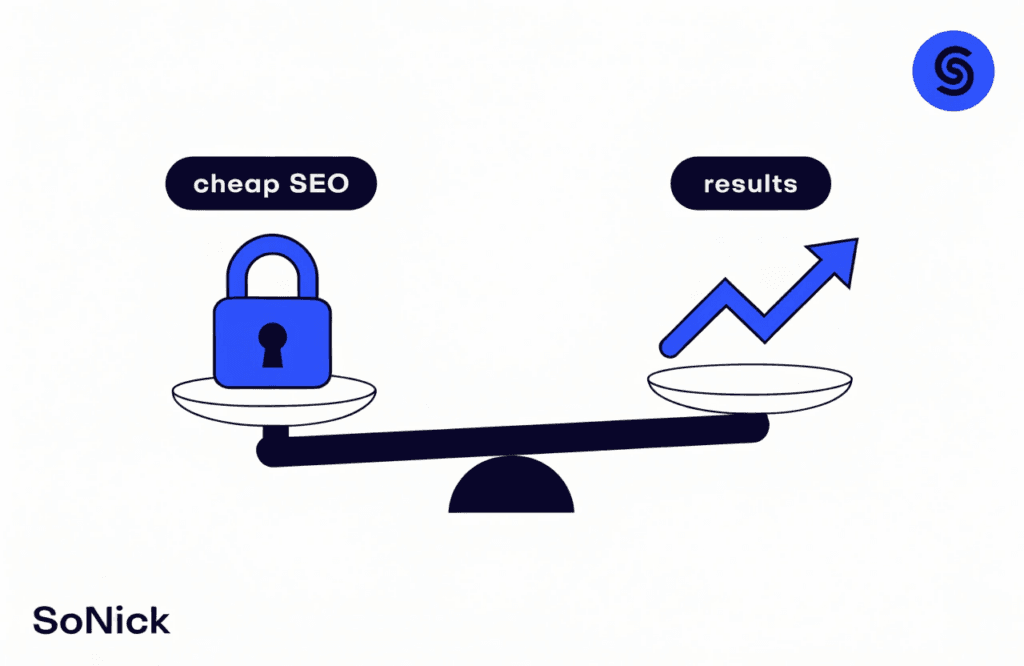
If you're being quoted significantly below these figures, ask what's included in detail. A very low price usually means one of the following: a very limited scope of work, outsourced execution with minimal oversight, or tactics that won't stand up long-term.
Equally, a high price doesn't guarantee quality. The best measure of value isn't the monthly fee. It's the return. An agency charging £700 per month that consistently delivers qualified enquiries is better value than one charging £400 that does very little.
At SoNick Marketing, I offer SEO packages built specifically for small businesses, with transparent pricing and a clear breakdown of what's included every month. There are no long-term lock-in contracts, and I record every action taken on your site so you always know what's been done.
In-House SEO vs. Agency: Which Is Right for Your Business?
For most small business owners, hiring an in-house SEO specialist isn't practical. A competent SEO professional in the UK commands a salary of £35,000–£55,000 per year, plus employment costs, tools, and ongoing training. That's a significant investment for a business that might only need a mid-sized SEO campaign.
Agencies offer access to a broader range of skills under one monthly retainer: technical SEO, content writing, link building, analytics. There are no recruitment costs or training overhead.
That said, working with an agency does require some involvement on your part. You'll need to share login access to your website and analytics tools, review reports, answer questions about your business, and be responsive when changes need sign-off. The more engaged you are, the better the outcomes tend to be.
If you're somewhere in between, perhaps with a member of staff handling some content or social media, a hybrid approach can work well. The agency handles strategy, technical work, and link building while your internal resource handles content production under their guidance.
Frequently Asked Questions
How do I choose a local SEO company? Look for an agency with demonstrable experience in local SEO specifically. This means Google Business Profile optimisation, local citation building, and experience getting businesses into the Map Pack. Ask to see examples of local rankings they've achieved for clients in competitive niches or locations.
How long should I give an SEO agency before I see results? SEO takes time. For most small businesses, you should expect to start seeing meaningful movement in keyword rankings within three to four months, with more significant traffic increases typically coming from month six onwards. Agencies promising results within weeks are either targeting very low-competition terms or using tactics that won't last.
What should I expect in the first three months with a new SEO agency? The first three months are typically foundation-building: a technical audit and fixes, keyword research, on-page optimisation of priority pages, and the start of content or link building activity. You're unlikely to see dramatic ranking shifts this early, but you should see clear activity, transparent reporting, and a defined plan for the months ahead.
What's the difference between white-hat and black-hat SEO? White-hat SEO refers to tactics that comply with Google's guidelines: quality content, earned backlinks, technical optimisation, and a focus on user experience. Black-hat SEO uses shortcuts that manipulate rankings in ways Google explicitly prohibits, such as buying links in bulk or generating AI content purely to game the algorithm. White-hat work is slower but sustainable. Black-hat approaches carry the risk of penalties that can be very difficult to recover from.
Do I need a separate agency for AI search or GEO? For most small businesses, no. The things that get you recommended by ChatGPT and similar tools are the same things that get you found on Google: a well-built site, clear content about your services, a strong Google Business Profile and genuine reviews. When I tested 10 local searches in ChatGPT against Google, most of the businesses ChatGPT recommended were the same ones already showing in Google's map pack. Be wary of anyone selling llms.txt files and other AI SEO quick fixes as a separate service.
Conclusion
Choosing the right SEO agency isn't about finding the one with the most impressive sales pitch. It's about finding one that's transparent about what they'll do, honest about what results to expect, and capable of demonstrating real outcomes for real businesses.
Take your time, ask the right questions, and use the red flags above to filter out anyone who can't give you straight answers. The best agencies won't mind the scrutiny. They'll welcome it.
If you'd like to understand how your site is performing right now before making any decisions, run a free SEO audit. It takes under a minute and gives you a clear picture of where you stand. Or if you'd prefer to have a conversation, get in touch and let's talk through what's realistic for your business.