Most small business owners know that online reviews matter for reputation. What fewer realise is that they also have a measurable impact on how well your business ranks on Google, particularly in local search. If you're putting effort into SEO and ignoring your reviews, you're leaving one of the most accessible ranking signals unused.
This article is part of my small business guide to SEO.
This post explains exactly how online reviews benefit SEO, what Google is actually looking for, and the practical steps you can take to start making reviews work harder for your business.
Do online reviews actually affect your Google rankings?
The short answer is yes, but it is worth being precise about where and how.
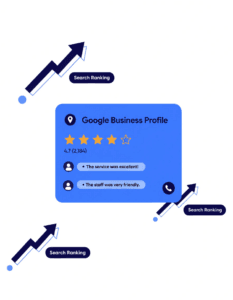
For local SEO, the impact is direct and well-documented. Google has confirmed that reviews are a factor in its local search ranking algorithm. When someone searches "plumber near me" or "hair salon in Fleet," the businesses that appear in the map pack are ranked partly based on review signals: the quantity of reviews, their overall rating, how recent they are, and whether the business responds to them. Review signals account for roughly 9% of local pack ranking factors, according to local SEO research from Moz.
For organic SEO (the standard web results below the map pack), the relationship is more indirect. Reviews themselves are not a direct ranking factor in the same way that links or on-page content are. But they influence several things that do affect rankings: click-through rates, time on site, brand prominence, and the volume of user-generated content associated with your business.
In short: if you serve local customers, reviews are a confirmed local SEO ranking factor. And even beyond local search, they create signals that support your broader visibility.
The four ways reviews support your SEO
1. Local pack ranking signals
Google's local pack algorithm evaluates three things: relevance, distance, and prominence. Distance is fixed and you cannot change where your business is. Prominence is where reviews come in. A steady flow of recent, positive reviews makes your business appear more established and trusted in Google's eyes, which directly improves your prominence score and your chances of appearing in those coveted top three map positions.
Businesses in the top local pack positions average significantly more reviews than those ranking lower. Getting to 50, 80, or 100 reviews does not just look good to potential customers; it genuinely improves where you appear.
2. User-generated content with natural keywords
Every written review your customers leave is fresh content associated with your business. Google categorises this as User Generated Content (UGC), and it values it highly. When a customer writes "excellent boiler service in Basingstoke" or "best Thai massage in Fleet," those are natural, keyword-rich phrases that help Google understand what your business does and where it operates, without you having to do any additional on-page work.
This is particularly useful for picking up long-tail search terms that you might not have thought to target yourself.
3. Higher click-through rates
A listing with a 4.7-star rating and 90 reviews will always attract more clicks than one with no reviews or a mediocre rating, even if the latter ranks slightly higher. Click-through rate is a signal Google uses to evaluate whether a result is serving searchers well. More clicks, all else being equal, is a positive signal. Beyond that, displaying your star rating in search results through review schema markup can make your listing visually stand out and pull more traffic without any change in ranking position.
4. E-E-A-T and brand prominence
Google's quality guidelines now place significant weight on E-E-A-T: Experience, Expertise, Authoritativeness, and Trustworthiness. Reviews contribute to the trust dimension directly. They are third-party evidence from real customers that your business delivers what it claims. A business with a strong and growing review profile appears more established and credible to both Google and the people searching for your services.
Does responding to reviews help SEO?
Yes, and it is one of the easiest things you can do. Responding to reviews signals to Google that your business is actively managed, which is a positive local SEO factor. Businesses that consistently respond to reviews, both positive and negative, tend to perform better in local search than those that leave reviews unanswered.
There is a practical conversion benefit too. Research suggests that for every 25% of reviews a business responds to, conversion rates improve meaningfully. Potential customers read your responses. How you handle a critical review often tells them more about your business than a wall of five-star ratings ever could.
When responding, keep it genuine and timely. Aim to reply within 24 to 48 hours. You can naturally include location or service references in your responses ("glad we could sort your boiler out quickly in Farnham") which adds relevant keyword context without feeling forced.
What Google expects from reviews: quality matters
Google has made clear through several updates to its review systems that it wants reviews to provide genuine, useful information rather than just a star rating. For service businesses, this means encouraging customers to write a few sentences about their experience rather than simply clicking five stars and moving on.
Reviews that describe the specific service, mention the location, or highlight a particular aspect of the experience are more valuable than generic positive comments. The more detail a review contains, the more useful it is as UGC from Google's perspective.
This also means that fake or incentivised reviews are not just against Google's guidelines. They actively undermine the signals that make reviews valuable in the first place. Build your review profile steadily and genuinely, and it will compound over time.
You can also use a tool like SE Ranking to monitor how your local rankings are moving as your review profile grows. It is particularly useful for tracking map pack positions alongside organic rankings.
How to get more Google reviews (and make them count)
The biggest mistake businesses make with reviews is waiting for them to arrive. Most happy customers will not leave a review unless you ask, and the asking needs to be easy.
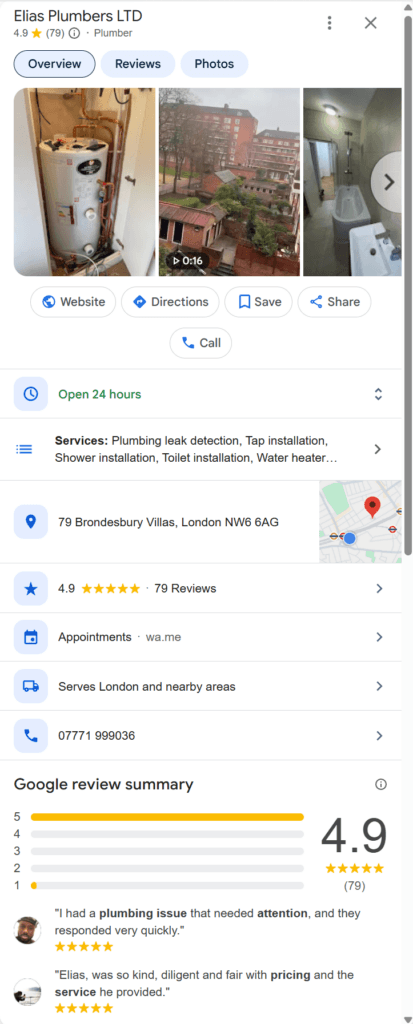
Verify and fully optimise your Google Business Profile. You cannot collect Google reviews without a verified profile. Make sure your profile is complete: services, opening hours, service area, photos, and a direct link to your review page.
Ask at the right moment. The best time to request a review is immediately after a job is complete and the customer has expressed satisfaction. A simple message works well: "It would mean a lot if you left us a quick Google review. Here's the direct link." One tap, no friction.
Use a direct review link. Go to your Google Business Profile, find your review link, and share it directly. Do not ask customers to search for you because every extra step loses people. If you have a physical premises or use printed materials, add a QR code that links straight to your review page.
Respond to every review. Thank positive reviewers by name where possible. Address negative reviews calmly and professionally. Both improve your local SEO and signal to prospective customers that you take your reputation seriously.
Embed reviews on your website. Displaying your Google reviews on your website adds fresh UGC to your pages, reinforces trust with visitors, and gives Google more to crawl. Most website platforms have a reviews widget or plugin that pulls in your Google reviews automatically.
If your business appears across multiple platforms such as Trustpilot, Checkatrade, Yell, or industry-specific directories, the same principles apply. Consistent, genuine reviews across several platforms strengthen your overall online presence and the authority signals Google picks up from across the web.
Your reviews now travel beyond Google too. In my study of 10 local searches in ChatGPT versus Google, where ChatGPT showed star ratings and review counts for businesses that were also in Google's local pack, they matched Google in 66 of 67 cases. In that test, the reviews people saw in ChatGPT were almost always the same ones on the business's Google profile.
Conclusion
Online reviews are one of the most underused assets in local SEO. They are free, they are generated by your customers rather than by you, and they compound in value over time. A business that commits to collecting and responding to reviews consistently will see the benefits not just in reputation but in where it actually appears in search.
The practical to-do list is short: verify your Google Business Profile, create a direct review link, and build a habit of asking every satisfied customer to leave a review. If you already have a decent review profile, make sure you are responding to all of them and displaying them on your website.
For the full picture of how your site is currently performing in local search, run a free SEO audit. It takes under a minute and shows you where the biggest opportunities are. Or if you would like to talk through an SEO strategy for your business, get in touch and let's look at what's possible.