Boiler installation still makes up the bulk of most heating engineers' work, and I've already covered how to generate those leads without paying for shared, resold enquiries in How to Generate High-Quality Boiler Leads. Heat pumps are different. The UK government wants 600,000 heat pump installations a year by 2028, but recent industry reporting shows actual installs running at only a small fraction of that target, which tells you two things at once: demand is going to keep growing for years, and the number of genuinely capable, certified installers is still comparatively small. That gap is a real opportunity for a heating engineer willing to market this properly now, before the market matures and competition catches up.

Why Heat Pump Enquiries Need a Different Approach
A boiler replacement is usually reactive, the old one has failed or is close to it. Heat pump enquiries are almost always planned and researched, often over weeks, because the upfront cost is higher and the technology is still unfamiliar to a lot of homeowners. That means your marketing needs to do more educating than a boiler-focused campaign does. Homeowners researching a heat pump often have genuine questions and some scepticism, will it heat the house properly, is the running cost actually lower, is the installation disruptive, is my house even suitable, and content or ads that answer those questions directly convert better than ones that assume the reader is already sold.
Not Every Enquiry Is Worth Chasing the Same Way
Before getting into channels, it's worth being clear that heat pump enquiries aren't all equal, and treating them the same wastes time you don't have. An early information request from someone who's just started researching needs nurturing, useful content, a follow-up email, not a hard sell. A quote request means genuine intent and deserves a fast, specific response. A booked survey is your highest-value enquiry and worth prioritising above almost everything else on your list that day. And a referral from a past customer, while less frequent, tends to convert best of all and cost the least to win.
Knowing which type you're looking at changes how you respond, and it stops you spending the same effort on a curious browser as you would on someone ready to book next week.
Grants Are Your Strongest Marketing Angle, and There's More Than One
The Boiler Upgrade Scheme currently offers grants of £7,500 towards an air-to-water, ground source or water source heat pump, and £2,500 for an air-to-air heat pump, applied upfront at the point of installation rather than repaid. It's worth also being aware of ECO4, a separate scheme that can fund a heat pump installation more fully for lower-income households or those in less energy-efficient homes, since a homeowner who doesn't qualify for one may well qualify for the other. Being the business that can explain both clearly, and quickly tell someone which one they're likely to qualify for, builds trust before you've even quoted, most homeowners researching heat pumps are unaware there's more than one route to funding.
MCS certification matters more here than for boiler work, in two ways. First, most grant schemes require an MCS-certified installer, so being certified is a genuine gatekeeper, not just a nice-to-have. Second, make sure your MCS listing itself is complete and accurate, homeowners and grant administrators alike can search the MCS installer database directly, so an out-of-date or thin listing is a missed enquiry channel independent of your own website and Google Business Profile.
Content That Addresses the Real Hesitation
Running cost is the most common objection, and it's worth tackling head-on rather than glossing over. A clear, honest breakdown of expected running costs compared with a gas boiler, ideally specific to your local area and typical property types, does more to convert a sceptical homeowner than generic marketing copy ever will.
Suitability is the other big one, and it's worth addressing before someone even enquires. Content explaining what makes a property well-suited to a heat pump, insulation levels, radiator sizing, whether the property needs upgrading first, sets realistic expectations and filters in homeowners who are a genuinely good fit rather than generating enquiries that fall through at the survey stage. Other content worth building out: what installation actually involves and how disruptive it is, and a genuine before-and-after case study from a real installation, complete with actual running cost figures if the homeowner is willing to share them. Real numbers from a real local job carry far more weight than a generic manufacturer's estimate.
Give Homeowners a Reason to Hand Over Their Details
Beyond a straightforward enquiry form, a genuinely useful tool or resource gives a homeowner who isn't quite ready to call a reason to engage anyway, and gives you their details to follow up properly. A simple running cost calculator, even a basic one asking for property size and current heating type, is worth more than it costs to build, since it captures someone at the research stage rather than losing them to a competitor by the time they're ready to enquire. A short "is my property suitable" checklist does the same job from a different angle, and a genuine before-and-after case study with real figures, covered above, doubles as this kind of resource when someone's specifically searching for proof rather than a sales pitch.
None of this needs to be complicated or expensive to build. The point is giving someone a reason to leave their email or phone number before they're ready to book a survey, so you're the business they call when they are.
Referral Partnerships Worth Building
Beyond your own marketing, solar panel installers and architects working on renovations or extensions are both worth a genuine relationship. Solar installers in particular often have customers already thinking about reducing their energy costs and carbon footprint, a natural, warm audience for a heat pump conversation that a cold search ad will never reach as effectively.
Google Ads on Grant and Cost Terms
Google Ads on grant and cost-related terms, "heat pump grant UK," "heat pump running costs," "air source heat pump cost", tends to have lower competition than boiler-focused terms, since fewer heating businesses have built this out properly yet. This is a genuine near-term opportunity while the market is still developing.
Keep campaigns geographically tight and track conversions on calls and form fills rather than clicks, so you can see which terms are actually producing enquiries from homeowners ready to move forward, not just people researching. This kind of tightly targeted setup is what my Google Ads management service does for heating and trade businesses.
Reviews Carry Extra Weight on a Purchase This Size
A heat pump is a bigger, less familiar financial commitment than a boiler swap, which means a hesitant homeowner leans on reviews harder than for almost any other trade job. A handful of generic five-star reviews doesn't do much here. What convinces someone is a review that mentions the specific thing they're worried about, running costs coming down as promised, a smooth survey and install process, a straight answer about grant eligibility. Ask for a review at the point the system is up and running and the customer's had a chance to notice the difference, and if a customer mentions a genuine running cost figure or a grant they received, that's worth asking permission to quote directly in your marketing, it's more convincing coming from a real local customer than from you.
Google Business Profile: List It as a Distinct Service
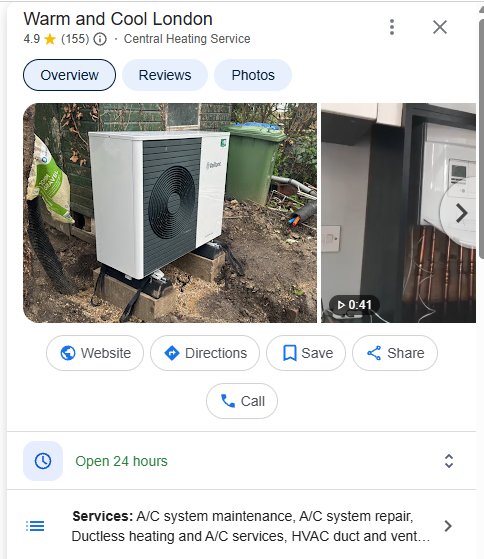
If your business already has an established profile for plumbing or boiler work, don't leave heat pumps as a single vague line in your description. List it as an individual service with its own description, using the specific terms homeowners search, "air source heat pump installation," "ground source heat pump installer", so Google can match your profile to those searches directly rather than only to boiler-related ones.
Bringing It Together
Heat pumps are still a developing market for most heating engineers, which is exactly why they're worth marketing properly now rather than waiting until every competitor has caught up. Lead with the grants, make sure your MCS listing is actually working for you rather than sitting dormant, build the handful of genuinely useful referral relationships available to this trade, and create content that answers the cost and suitability questions homeowners actually have. For air conditioning work, which needs a different certification and a different buyer conversation entirely, see Air Conditioning Leads: A Marketing Guide for Installers.
For the broader picture of how this fits into marketing a heating or trade business, see my trades marketing page. If you'd like help building this out, get in touch and let's talk through what's possible for your business.