Most plumbers who struggle to grow their business aren't bad at plumbing. They're invisible. When a homeowner's boiler fails on a January evening, they open Google and call the first plumber who looks credible. If you're not appearing in that moment — with a professional presence, strong reviews, and a clear way to get in touch — the job goes to someone else.
This article is part of my guide to marketing for tradespeople.
This guide covers the plumber advertising strategies that consistently generate leads in the UK, from the digital channels that should anchor your marketing to the offline methods still worth your time, and the repeat business tactics that most plumbers overlook completely.

Start With the Right Mindset: Emergency vs. Planned Work
Before spending a penny on advertising, it helps to understand that plumbing customers come to you in two very different states of mind.
Emergency mode. A pipe has burst, the boiler's dead, or the toilet is overflowing. These customers search for "emergency plumber near me" and call whoever looks most credible in the next two minutes. Price is secondary. Trust and availability are everything.
Planned mode. These customers are researching a new boiler, a bathroom refit, or a heating system upgrade. They compare options, read reviews, and shortlist two or three plumbers before making a decision.
The advertising strategies that win emergency jobs (Google Ads, Local Services Ads, Google Business Profile) are different from the ones that win planned work (SEO, content, reputation). Effective plumber advertising covers both — and ideally, a separate landing page or approach for each.
Google is Your Most Important Advertising Channel
If you're going to invest in one area of advertising as a plumber, Google is where your money works hardest. Most plumbing enquiries begin with a search. Being visible at the top of those results — whether through paid ads or organic rankings — is the single biggest driver of new leads for most UK plumbing businesses.
Google Ads for Plumbers
Google Ads lets you target specific keywords like "emergency plumber London" or "boiler repair Manchester," showing your ad to customers who are actively looking for a plumber right now in your area. You can set a daily budget, choose exactly which areas to cover, and only pay when someone clicks your ad.
The key to making Google Ads work is targeting the right keywords and sending people to a dedicated, high-converting landing page rather than your homepage. For emergency jobs, that means a page with your phone number front and centre, your service area, response times, and a handful of strong reviews.
I'd recommend starting with a modest daily budget, tracking which keywords produce enquiries, and scaling up the ones that convert. Without tracking, you're guessing.
If you'd like to explore Google Ads for your plumbing business, take a look at our PPC management service.
Google Local Services Ads
Local Services Ads (LSAs) sit above regular Google Ads in search results and are specifically designed for tradespeople. Instead of paying per click, you pay per lead. You also earn a "Google Screened" badge once verified, which provides a credibility signal that standard ads can't match.
For most UK plumbers, LSAs are one of the most cost-effective paid channels available right now. They show your business name, star rating, service area, and phone number — everything a nervous homeowner needs to make a quick decision.
Here's a quick comparison to help you decide where to focus first:
| Feature | Google Ads | Local Services Ads |
|---|---|---|
| Pay model | Per click | Per lead |
| Position in results | Below LSAs | Top of results |
| Google Screened badge | No | Yes |
| Control over targeting | High | Moderate |
| Best for | Specific services, landing page traffic | General local visibility, fast lead volume |
| Setup complexity | Moderate | Straightforward |
Many plumbing businesses run both simultaneously once they have the budget to do so.
Optimise Your Google Business Profile
Your Google Business Profile (formerly Google My Business) is free and directly influences whether you appear in local map results when someone searches "plumber near me." This is some of the highest-intent traffic available — people who are ready to call right now.
To make the most of it:
- Choose the most accurate categories for your services (e.g. "plumber," "heating contractor," "boiler repair")
- Add high-quality photos of your work, your van, and your team
- Keep your opening hours, phone number, and address consistent with every other listing online
- Respond to every review, positive or negative
- Post regular updates — jobs completed, seasonal tips, new services
A complete, well-maintained profile significantly improves your chances of appearing in the "Local Pack," the map and business listings that appear at the top of local search results.
Build a Website That Converts, Not Just Impresses
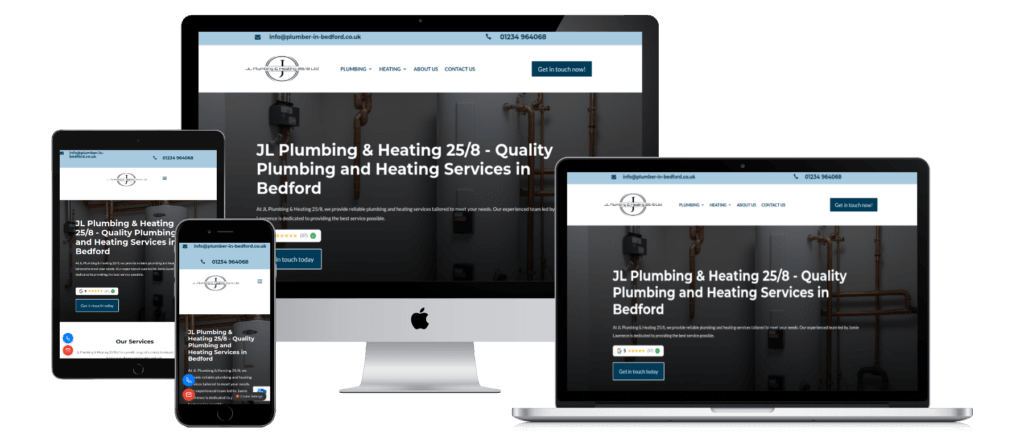
Your website is the foundation of all your digital advertising. If someone clicks your Google Ad or finds your Business Profile and lands on a slow, cluttered, or confusing website, you've lost the lead.
A high-converting plumbing website needs:
- A clear, clickable phone number visible at the top of every page
- A brief, compelling statement of what you do and where you cover
- Separate pages for your key services (boiler repair, emergency plumbing, bathroom installation, etc.)
- Real photos of your work — not stock images
- Genuine customer reviews displayed prominently
- A mobile-friendly layout that loads quickly on any device
For planned work, content matters too. A blog that answers common questions ("how much does a new boiler cost?", "what is a power flush?") establishes you as an expert and helps you rank organically for terms your customers are searching.
Take a look at our web design service if you'd like a site built to generate leads, not just look good.
Local SEO: How to Show Up When It Matters
Local SEO is the process of making your website rank in organic (non-paid) search results for location-based searches. It's a longer-term investment than Google Ads, but once you rank well, you receive a consistent stream of free traffic that compounds over time.
For plumbers, local SEO focuses on a handful of key areas:
Location-specific pages. If you cover multiple towns, create a dedicated page for each one. A page targeting "plumber in Guildford" has a far better chance of ranking for that search than a generic homepage.
Keyword-rich service content. Include phrases like "emergency plumber in [your town]," "boiler installation [your area]," and "bathroom refit [your location]" naturally throughout your page content.
NAP consistency. Your Name, Address, and Phone number must be identical across every online listing — your website, Google Business Profile, directories, and social media. Inconsistencies weaken your local signals.
Local backlinks. Links from other relevant UK websites signal to Google that your business is legitimate and trusted. This includes directory listings, local press mentions, and partnerships with related tradespeople.
A tool like SE Ranking can help you track how your rankings are moving over time and identify which pages need attention.
Online Directories: More Than Just Listings
Directory listings are often dismissed as outdated, but for plumbers they serve two purposes: they generate direct enquiries from homeowners who use platforms like Checkatrade, Rated People, and MyBuilder, and they create backlinks to your website that strengthen your SEO.
The strategy is simple: identify which directories rank at the top of Google for searches like "plumber in [your area]" and make sure you have a listing there, with as many reviews as possible. If Checkatrade appears first for your target area, your priority is getting listed and building reviews until you appear near the top of that platform's results.
Key UK directories worth listing on:
- Checkatrade
- Rated People
- TrustATrader
- MyBuilder
- Yell
- Which? Trusted Traders
For more detail on the best platforms, read our post on directory sites for plumbers.
Social Media for Plumbers: What Actually Works
Social media is not where most emergency plumbing enquiries come from — and that's an important distinction to make before you invest too much time there. That said, it plays a useful role in building local awareness, demonstrating your expertise, and staying in front of past customers.
Facebook is the most practical platform for most UK plumbers. Joining local neighbourhood groups and being genuinely helpful when someone asks for a plumber recommendation (as yourself, not as a business page) builds trust far more effectively than paid posts. Consistency matters more than frequency — showing up regularly over months builds the familiarity that converts to calls.
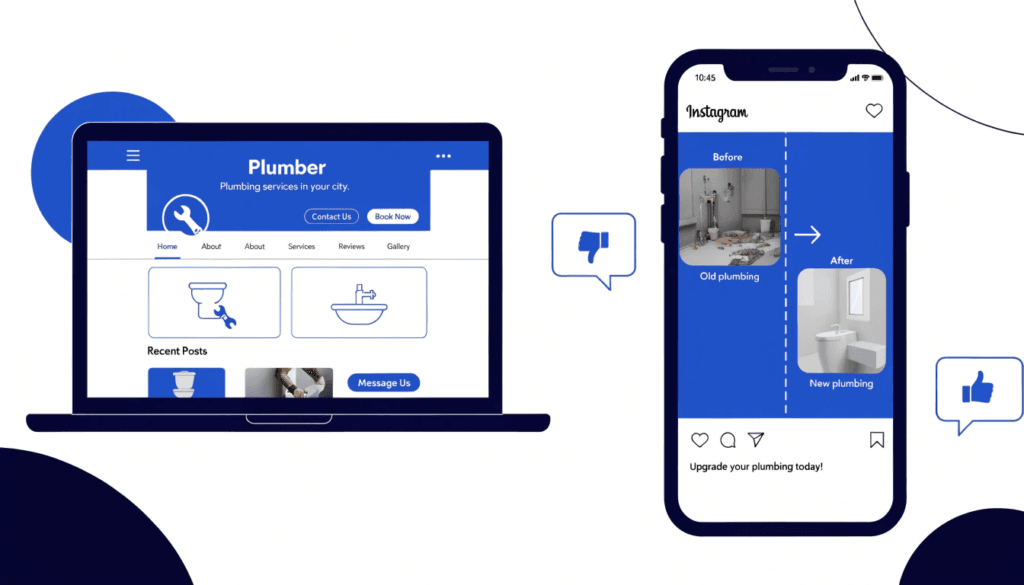
Instagram suits plumbers who do high-quality bathroom or kitchen installations where the visual result is impressive. Before-and-after photos and short videos of completed projects can generate significant engagement.
YouTube and TikTok are worth considering if you're comfortable on camera. A short video answering a common question ("how to tell if your boiler pressure relief valve needs replacing") does two things: it positions you as an expert, and it sits on the internet indefinitely, being found by people searching for that topic long after you've moved on to other work.
The honest answer for most small plumbing businesses is to choose one or two platforms and show up consistently, rather than spreading yourself thin across all of them.
Offline Advertising Still Has a Place
Digital channels dominate modern plumbing marketing, but offline methods haven't become irrelevant — they've just become more targeted.
Site boards and pavement signs. When you're working on a property, a branded sign outside is a direct advert to every neighbour who walks past. These people live in your area, they'll need a plumber at some point, and they've just seen you working locally. Keep your name, phone number, and website prominent.
Van branding. A well-branded van driving around your patch is one of the most cost-effective local awareness tools available. It's visible while you're working, while you're parked, and while you're driving between jobs.
Flyer drops. Targeted flyer campaigns in streets close to where you're already working can be surprisingly effective, particularly for bigger planned jobs like bathroom refits. Offer a first-time customer incentive to increase response rates.
Local print and community publications. Parish magazines, community newsletters, and local papers reach demographics that may not be as active online. They're inexpensive and reinforce your presence in the community.
The key with offline advertising is consistency. One flyer drop or one site board rarely produces dramatic results. A sustained presence in a specific area over time builds the familiarity that drives calls.
Repeat Business: Your Cheapest Source of New Revenue
Most plumbers are so focused on finding new customers that they underestimate how much untapped revenue sits in their existing customer base. A past customer who had a good experience is far more likely to call you again and recommend you to friends than a cold prospect who found you on Google.
Boiler Tags and QR Codes
A magnetic business card or boiler tag left at every job is one of the simplest and most effective ways to secure repeat business. When the boiler needs its annual service or something goes wrong, your number is right there. Add a QR code that links to your booking page or contact form to make it even easier.
You can order magnetic business cards from suppliers like Vistaprint.
Email Marketing
A simple email list of past customers is worth more than most plumbers realise. A short monthly or quarterly email — with a seasonal tip, a reminder about annual boiler servicing, or a maintenance checklist — keeps your name front of mind without being intrusive.
Ideas for useful emails:
- Annual boiler service reminders in September/October
- Winter preparation tips (lagging pipes, checking pressure, etc.)
- Exclusive discounts for returning customers
- Requests for Google reviews after a completed job
You don't need sophisticated software to start. A free plan on Mailchimp or a similar tool is more than sufficient for a small plumbing business.
Referral Relationships
A letting agent who manages 200 properties and recommends you as their trusted plumber is worth more than most advertising budgets. So is a good relationship with a local estate agent, property developer, or landlord. These relationships take time to build — but they deliver consistent, high-quality work.
Reach out proactively, turn up when you say you will, and follow up after every job. That's genuinely all it takes.
Reviews and Reputation: The Currency of Trust
Online reviews are one of the most powerful influences on a potential customer's decision to call you. A plumber with 80 four-star reviews will win more jobs than one with 10 five-star reviews, simply because volume signals reliability.
The most effective way to build reviews is to ask for them immediately after a job, while the customer's satisfaction is at its highest. A simple text message with a link to your Google Business Profile removes every barrier to leaving a review.
Respond to every review — including negative ones. A professional, measured response to a complaint often reassures prospective customers more than a string of perfect reviews, because it shows you take your reputation seriously.
Display your best reviews prominently on your website, not just on Google. Testimonials that name a specific job, location, or outcome carry far more weight than generic praise.
Budgeting and Tracking Your Advertising ROI
Without tracking, it's impossible to know which advertising channels are working and which are wasting your money. The good news is that digital advertising is highly measurable — but you need to set up the tracking before you spend.
At a minimum, monitor:
| Metric | Why It Matters |
|---|---|
| Website traffic by source | Shows which channels drive visitors |
| Leads generated per channel | Reveals where your enquiries actually come from |
| Cost per lead | Tells you which channels are cost-effective |
| Conversion rate | Shows how many leads turn into booked jobs |
Start by installing Google Analytics on your website and using call tracking (a different phone number per channel) to attribute calls accurately. Once you know your cost per lead and average job value, you can make informed decisions about where to increase or reduce your spend.
A sensible starting allocation for most small plumbing businesses would prioritise Google Ads and Google Business Profile optimisation first, with SEO as a medium-term investment running in parallel. Social media and offline advertising can be layered in as the budget allows.
Frequently Asked Questions
How do I advertise my plumbing business? Start with Google — claim your Google Business Profile, run Google Ads targeting your local area, and optimise your website for local SEO. Layer in directory listings, reviews, and social media as your budget and time allow.
What is the best platform to advertise a plumbing business? For immediate leads, Google Ads and Local Services Ads are the most effective. For long-term, lower-cost visibility, local SEO is unbeatable. Social media plays a supporting role in building awareness and reputation.
How do I get more customers for my plumbing business? A combination of online visibility (Google, directories, reviews), offline presence (van branding, site boards), and repeat business strategies (email marketing, boiler tags, referral relationships) produces the most consistent results.
How much should a plumber spend on advertising? There's no universal answer — it depends on your target revenue and local market. A useful rule of thumb is to invest 5–10% of your target revenue in marketing until you have enough data to see which channels produce the best return, then allocate accordingly.
Conclusion
Effective plumbing advertising isn't about doing everything at once. It's about building the right foundations — a professional website, a strong Google Business Profile, a handful of credible reviews — and then layering in paid advertising, SEO, and offline methods as your budget grows.
The businesses that generate consistent, predictable work are the ones that show up at the right moment (Google, directories), look credible when they get there (website, reviews), and stay in touch with past customers (email, boiler tags, referrals). That's the whole system.
If you'd like help putting it into practice, run a free SEO audit to see how your current online presence stacks up — it takes under a minute. Or if you're ready to talk through a full advertising strategy for your plumbing business, get in touch and we'll take it from there.