
Most small business owners I speak to have heard the word "keyword" thrown around — but not all keywords are worth your time equally. Some are so competitive that no amount of good content will crack the first page. Others are too vague to attract anyone ready to buy.
This article is part of my small business guide to SEO.
Long-tail keywords sit in a different category entirely. They're specific, they're actionable, and for local businesses competing against bigger players with bigger budgets, they're often the most reliable route to real, qualified traffic.
Here's everything you need to know.
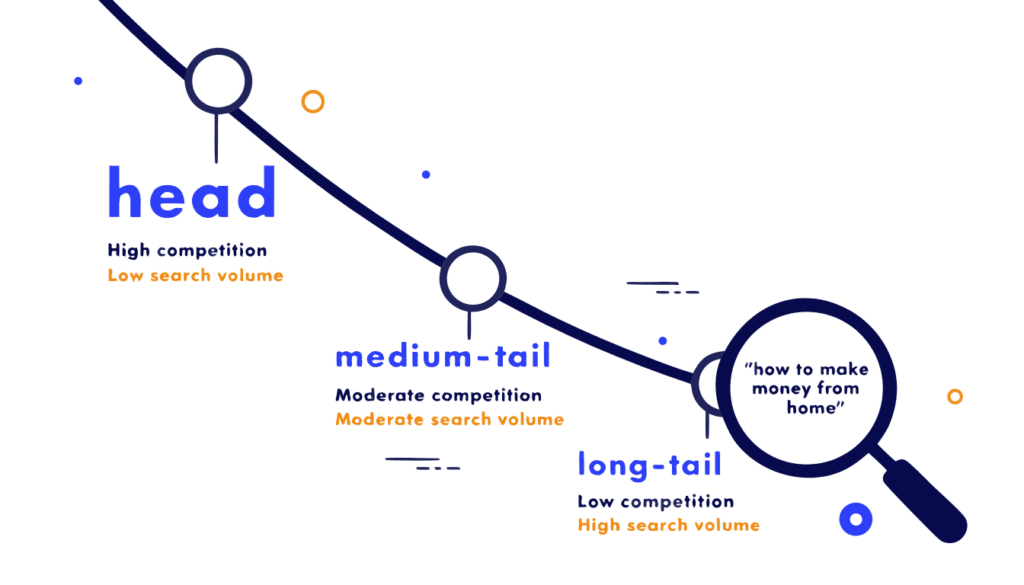
Head Keywords, Mid-Tail, and Long-Tail: What's the Difference?
Before we get into the value of long-tail keywords specifically, it helps to understand where they sit in the broader landscape.
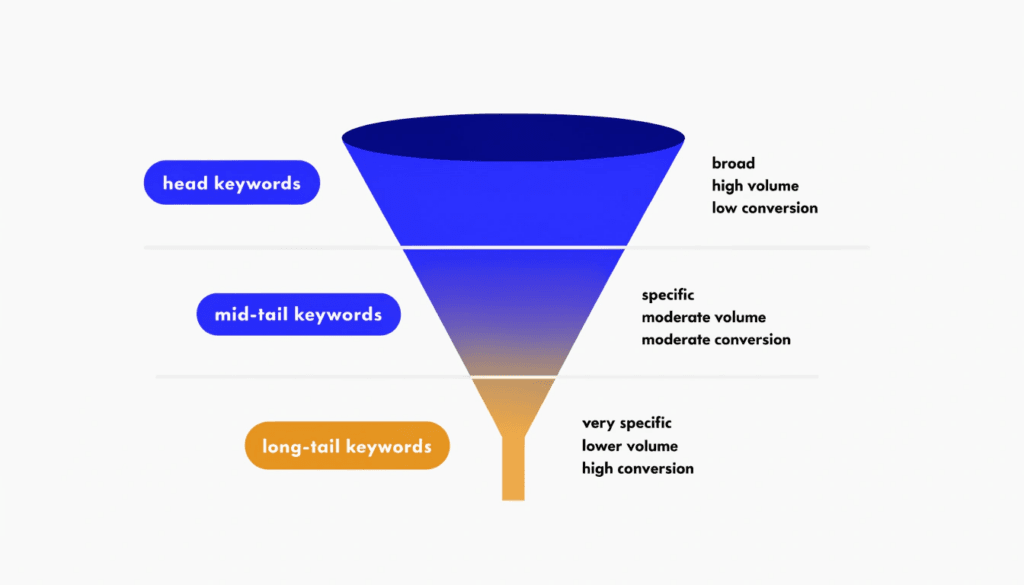
Head keywords are broad, single-word (or two-word) search terms with massive search volumes — think "solicitor," "plumber," or "SEO." These terms attract enormous competition. The top results are typically dominated by major directories, national brands, and sites with years of domain authority behind them.
Mid-tail keywords add a qualifier. "SEO agency London" or "emergency plumber" narrow the field a little, but they're still competitive and often lack enough specificity to attract someone ready to act.
Long-tail keywords go further. They're typically three to six words, highly specific, and they reflect a clear intent. "Conveyancing solicitor in Woking" or "emergency boiler repair in Reading" are long-tail. The person searching those terms isn't browsing. They're looking to make a decision.
The name "long-tail" comes from a graph of search demand. Picture a curve where popular keywords sit at the tall left-hand peak, and as terms get more specific, the curve flattens and extends to the right. That long, flat tail is where the vast majority of searches actually happen. Research consistently shows that long-tail searches collectively account for well over 90% of all Google queries, spread across a huge number of individual phrases.
Why Long-Tail Keywords Matter More Than Ever in 2026
The shift towards longer, more conversational search queries isn't new — but it's accelerated significantly over the past few years.
AI-powered search and voice assistants have changed how people phrase queries. Nobody says "plumber Farnham" to their phone's voice assistant. They say "who's the best emergency plumber in Farnham?" That's a long-tail keyword, and if your website content answers it clearly, you have a much stronger chance of appearing in AI-generated search results and voice responses than you would competing for the head term.
Google's understanding of intent has also matured. Its algorithms are now sophisticated enough to match specific queries with specific answers. Content built around long-tail phrases, written to genuinely answer a real question, can outperform thin pages built around popular keywords.
For small businesses that haven't yet built significant domain authority, this is a genuine advantage. Ranking for "plumber" is almost impossible without years of SEO investment. Ranking for "gas safe plumber for boiler service in Guildford" is entirely achievable, and the person searching it is far more likely to call.
Why Long-Tail Keywords Are Especially Powerful for Local Businesses
If you run a trade business, a salon, a law firm, or any service business with a geographic footprint, long-tail keywords do several things at once.
They filter out the wrong traffic. Someone searching "family solicitor in Guildford" isn't from Edinburgh. The geography built into the phrase does the filtering for you. You only attract people who can actually become clients.
They signal buying intent. A person searching "best salon for balayage near me" or "24/7 boiler repair in Aldershot" is at the bottom of the decision funnel. They're not doing research; they're looking to book. That's a fundamentally different visitor from someone who searches "what is SEO."
They support your local SEO. Google's local algorithm rewards relevance, proximity, and prominence. Using location-specific long-tail keywords in your page content, headings, and meta data sends clear relevance signals that help you appear in local pack results and organic listings for your area.
They let niche services compete. If you specialise in something specific (unvented cylinder installation, commercial conveyancing, sports massage), a broad keyword strategy will drown you out. Long-tail keywords let you speak directly to the people who need exactly what you offer.
Long-Tail Keyword Examples by Industry
To make this concrete, here are examples of how the same service can be expressed across the keyword spectrum:
| Industry | Head Keyword | Mid-Tail | Long-Tail |
|---|---|---|---|
| Plumbing | Plumber | Emergency plumber London | 24/7 emergency plumber in South London |
| Legal | Solicitor | Conveyancing solicitor Surrey | No-win no-fee solicitor in Woking |
| Beauty | Hair salon | Balayage salon near me | Affordable balayage and toning salon in Basingstoke |
| Healthcare | Private clinic | Private GP Surrey | Same-day private GP appointment in Farnborough |
| Trades | Builder | Loft conversion builder | Loft conversion specialist in Winchester |
| Therapy | Therapist | Anxiety therapist London | Somatic therapist for anxiety in North West London |
Notice how each long-tail version is far more specific, far less competitive, and far more likely to reflect the intent of someone ready to act.
How to Find Long-Tail Keywords for Your Business
Finding the right long-tail keywords doesn't require expensive tools — though they help. Here's how I approach it:
Start with your services, not a tool. Before you open any software, write down every service you offer, broken down as specifically as possible. "Boiler repair" becomes "emergency boiler repair," "gas safe boiler service," "boiler replacement in [your town]." Do the same for every service. This gives you a seed list to take into a tool.
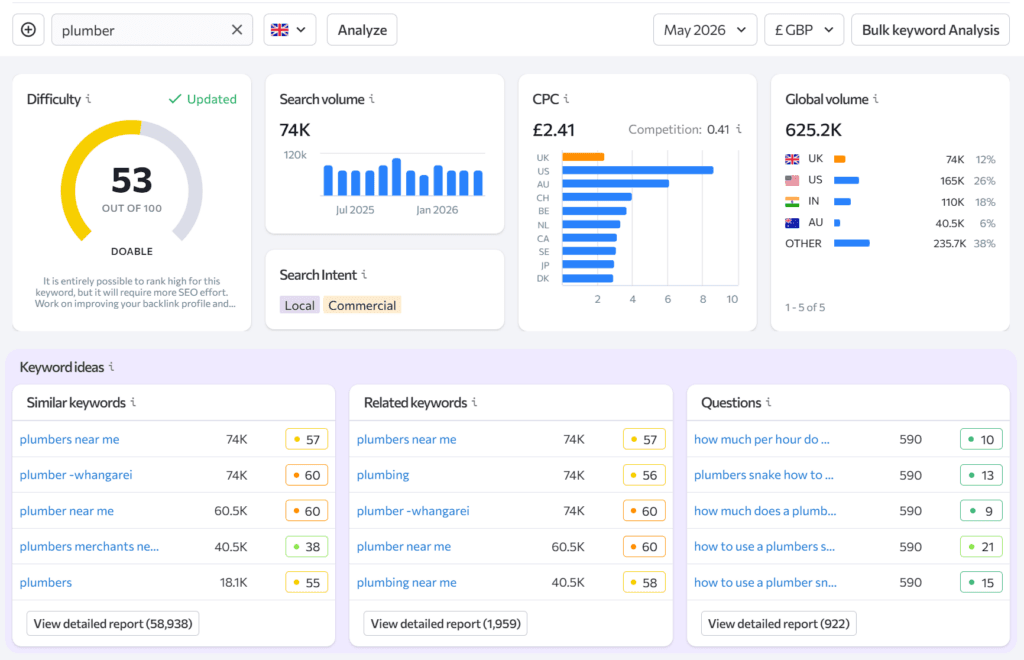
Use keyword research tools to expand and validate. Tools like SE Ranking, Google Keyword Planner, and Ubersuggest will show you search volume, competition, and related phrases for each seed. You're looking for terms with some search volume (even 10 to 50 searches per month can be worth targeting if the intent is strong) and manageable competition. For deeper competitor analysis, understanding why keyword research matters is a good place to start before diving into the tools.
Use Google itself. Type a seed keyword into Google and pay attention to the autocomplete suggestions. These are real searches real people are making. Scroll to the bottom of the results page and look at the "People also search for" and related searches sections. These are goldmines for long-tail ideas.
Mine forums, Reddit, and local Facebook groups. The questions people ask in these spaces are often phrased exactly as they'd type them into Google. If a homeowner asks "how do I know if I need a new boiler or just a repair," that's a long-tail keyword and a blog post topic in one.
Analyse what competitors rank for. Tools like SE Ranking let you enter a competitor's domain and see the keywords driving their traffic. Look specifically for long-tail terms. These are the phrases where a well-written page could displace them.
You can also use our free SEO audit to see which keywords you currently rank for and where there are obvious gaps. It takes under a minute and gives you a useful starting point.
How to Use Long-Tail Keywords Across Your Website
Finding keywords is only half the work. Here's how to put them to use:
Create dedicated service pages for specific services and locations. If you cover multiple towns, a single "plumbing services" page won't cut it. A page titled "Emergency Plumber in Farnham," built around that long-tail phrase, gives you a far better chance of ranking for that specific search.
Use long-tail keywords in blog posts. Not every keyword warrants a service page. Question-based long-tail keywords ("how much does a boiler service cost in Hampshire?") are perfect for blog content that captures people earlier in the decision process and builds trust before they're ready to book.
Work them into headings and meta data naturally. Your H1, H2s, title tag, and meta description should all reflect the target phrase — but written for a human first. Forcing exact-match phrases into awkward sentences does more harm than good.
Don't try to target too many keywords on one page. Each page should have one clear primary target. If you're writing about conveyancing solicitors in Woking, don't also try to rank for family law in London on the same page. Focus wins.
Build internal links between related pages. When you publish a service page for one location, link to it from relevant blog posts and other service pages. This helps Google understand your site structure and passes authority to the pages you most want to rank. If you're building a new site or revising your current one, our web design service ensures all of this is built in from the start.
What Results Can You Realistically Expect?
Long-tail keywords aren't a shortcut to overnight rankings — but they do tend to produce results faster than competing for high-volume head terms.
Because competition is lower, a well-optimised page can start appearing in the top 10 within a few weeks to a few months, depending on your domain's current authority. And when those pages rank, the traffic they bring tends to convert at a higher rate than broad-keyword traffic, because the intent match is so precise.
The aggregate effect is significant. Many individual long-tail keywords may only attract a handful of searches per month, but when you build a content strategy around dozens of them, each targeting a specific service, location, or question, you end up with a site that ranks for hundreds of relevant phrases, covering your target audience at every stage of the decision process.
This is exactly the approach I use when building SEO campaigns for trade and service businesses: start with the specific phrases most likely to convert, then broaden the strategy as authority builds.
Start Targeting the Right Keywords
If there's one thing I'd want you to take away from this guide, it's this: ranking for a very specific phrase and converting that traffic into a real customer is worth far more than ranking vaguely for a broad term that brings in the wrong people.
Long-tail keywords are how smaller businesses compete on Google without needing the budget of a national brand. They reward specificity, local relevance, and useful content. A genuine local business can deliver all three better than any directory or aggregator site.
If you'd like to see how your site is currently performing and where the keyword gaps are, run a free SEO audit. It takes under a minute and gives you an immediate read on where you stand.