Most small business owners have heard they should be "doing digital advertising" — but fewer could give a confident answer if someone asked them to define it. And that matters, because if you don't understand what digital advertising actually is, you can't make smart decisions about whether to invest in it, which channels to use, or how to measure whether it's working.
This article is part of my small business guide to Google Ads and my small business marketing guide.
This guide covers everything you need to know: what digital advertising is, how it differs from digital marketing, the main types available, and the practical benefits it can offer a small business like yours.
What Is Digital Advertising?
Digital advertising is the practice of paying to promote your business, products, or services through online platforms. If you've ever seen a sponsored result at the top of Google, an ad between Instagram Stories, or a banner on a website you were browsing, you've encountered digital advertising in action.
The key word is paid. Unlike blog posts, social media updates, or organic search rankings — which you earn through effort and time — digital advertising involves paying for placement. That means you can get your business in front of the right people quickly, rather than waiting months for organic strategies to build momentum.
Digital advertising covers a wide range of formats and platforms, including:
- Search ads (Google, Bing)
- Social media ads (Facebook, Instagram, LinkedIn, TikTok)
- Display ads (banner ads on websites)
- Video ads (YouTube, connected TV)
- Shopping ads (Google Shopping, Facebook Shops)
- Retargeting ads (ads that follow previous website visitors)
What ties all of these together is that they are bought placements on digital platforms, targeted at specific audiences, and measurable in a way that traditional advertising simply isn't.
Digital Advertising vs Digital Marketing — What's the Difference?
This is where a lot of people get confused, because the two terms are often used interchangeably. They are related, but they're not the same thing.
Digital marketing is the broader umbrella. It covers every online activity designed to promote your business and attract customers — including SEO, content marketing, social media, email marketing, and yes, digital advertising. Think of digital marketing as your overall strategy for growing your business online.
Digital advertising is a specific tactic within that strategy. It refers specifically to paid placements — ads you pay for on platforms like Google or Facebook.
The simplest way to remember the difference: digital marketing is the process; digital advertising is one of the activities within it.
If you're building a digital marketing strategy for your business, digital advertising should be one channel you consider alongside SEO, content, and others — not a replacement for them.
The Main Types of Digital Advertising
The original post glossed over this, but it's arguably the most useful thing to understand. Here's a breakdown of the main types and when each one makes sense for a small business.
Search Advertising (PPC)
Search ads appear at the top of Google (or Bing) results when someone searches for a relevant term. They're also known as pay-per-click (PPC) ads because you pay each time someone clicks your ad.
This is the most powerful form of digital advertising for most small businesses, because you're reaching people who are actively searching for what you offer. Someone Googling "emergency plumber in Manchester" or "hair salon near me" is already in buying mode — they just need to find the right business.
If you want to explore this further, take a look at our guide to Google Ads for trades or our PPC services page.
Social Media Advertising
Social ads run on platforms like Facebook, Instagram, LinkedIn, and TikTok. Unlike search ads, social advertising is primarily about reaching people based on who they are — their age, location, interests, job title, or behaviour — rather than what they're actively searching for.
This makes social advertising excellent for building awareness, reaching new audiences, or retargeting people who've already visited your website but didn't convert.
Display Advertising
Display ads are the banners and image-based ads you see on websites across the internet. They work through networks like Google Display Network, which places your ads on millions of third-party websites.
Display is typically more suited to brand awareness than direct response, and for most small businesses, it works best as a retargeting tool — showing your ads to people who've already shown interest in your business.
Video Advertising
Video ads run on platforms like YouTube and through connected TV. They can be skippable or non-skippable, and they're a powerful format for demonstrating a product, telling your brand story, or building trust with a cold audience.
Shopping Ads
Shopping ads are particularly relevant if you sell products online. They display product images, prices, and your business name directly in search results, making them highly effective for ecommerce businesses.
How Digital Advertising Differs From Traditional Advertising
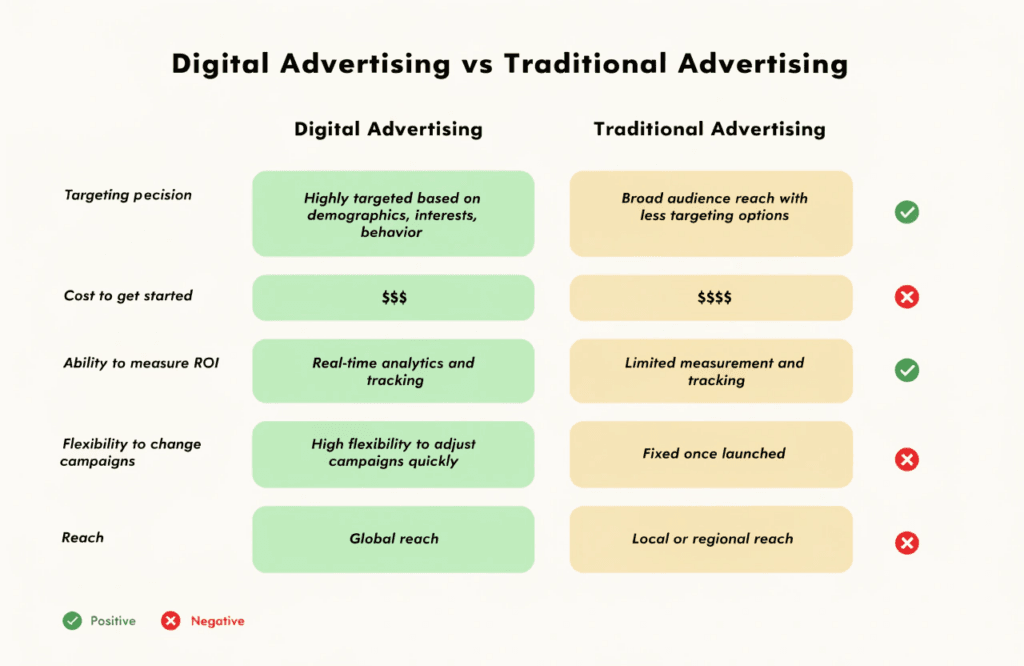
Traditional advertising — TV, radio, print, billboards — still exists, and for some businesses it still has a role. But for most small businesses, it comes with significant drawbacks:
You can't target precisely. A billboard near your business is seen by everyone who drives past, whether they're your target customer or not. Digital advertising lets you show your ad only to people who match specific criteria — location, age, interests, search intent, and more.
You can't measure it accurately. How many people read your newspaper ad? How many came into your shop as a result? With traditional advertising, you're largely guessing. Digital advertising gives you precise data: how many people saw the ad, how many clicked it, how many converted, and what it cost per conversion.
It's harder to change course. Once your print ad or radio spot is booked and live, you're locked in. With digital advertising, you can pause, adjust, or stop a campaign at any moment — making it far more responsive to what's actually working.
The cost of entry is much lower. A TV campaign or print run can cost thousands before you've reached a single customer. Digital campaigns can start for as little as a few pounds a day, making them far more accessible for small businesses with limited budgets.
Why Digital Advertising Makes Sense for Small Businesses
Here's why I recommend digital advertising as part of most small business marketing plans:
Speed. Unlike SEO, which can take months to show results, a well-set-up PPC campaign can put you in front of customers the same day it launches. If you need leads quickly, paid advertising is the fastest route.
Budget control. You set your own daily or monthly budget, and you only pay when someone clicks your ad (in the case of PPC). You're not locked into long contracts or minimum spends.
Targeting. You can reach exactly the type of customer you want — by location, by what they're searching for, by their demographics, by their interests, or even by whether they've already visited your website.
Measurable returns. You can see precisely what each campaign costs and what it delivers. That means you can make data-driven decisions about where to invest more and where to cut back.
Scalability. Once you've found a campaign that works, you can increase your budget and scale your results. That's much harder to do with traditional advertising.
Getting Started With Digital Advertising
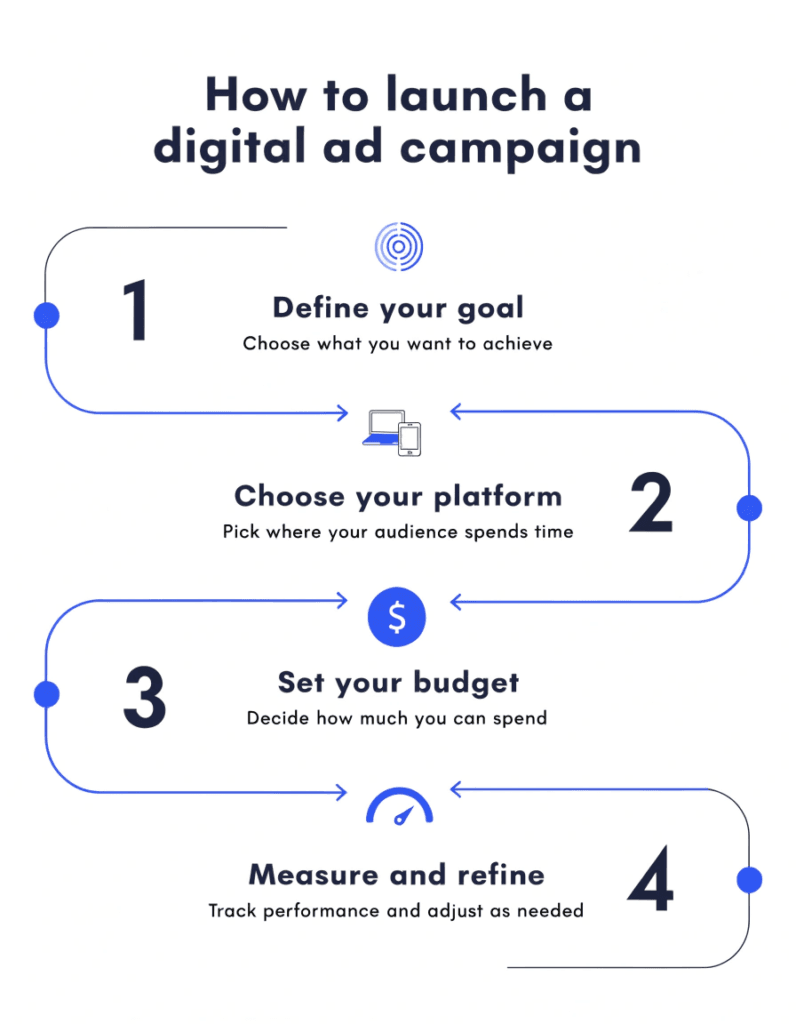
If you're new to digital advertising, here's how I'd suggest approaching it:
Start with a clear goal. Do you want more phone calls, more website visits, more form enquiries, or more product sales? Your goal shapes everything — the platform you use, the ad format, the audience you target, and how you measure success.
Choose one channel first. Trying to run Google Ads, Facebook Ads, and Instagram Ads simultaneously when you're just starting out is a recipe for confusion and wasted budget. Pick the channel most likely to reach your customers and do it well before expanding.
Set a realistic budget. You don't need a huge budget to get started, but you do need enough to generate meaningful data. For Google Ads, I'd typically recommend at least £300–£500 per month to get results worth learning from.
Test, measure, and refine. Digital advertising is rarely perfect out of the gate. The advantage is that the data tells you exactly what's working and what isn't, so you can improve continuously.
Track your conversions. Make sure you've set up conversion tracking before you spend a penny. Without it, you're flying blind — you'll know how many clicks you got, but not whether any of them turned into actual customers.
If managing all of this sounds like a lot alongside running your business, that's exactly what we help small businesses with at SoNick Marketing. Our PPC management services handle everything from campaign setup to ongoing optimisation, so you get the results without the headache.
Final Thoughts
Digital advertising is one of the most powerful tools available to small businesses today — not because it's complicated, but because it puts you in control. You choose who sees your ads, how much you spend, and exactly what you want people to do when they see them. And unlike almost every other form of marketing, you can measure exactly what you're getting back.
Whether you're a plumber looking for more emergency call-outs, a salon wanting to fill appointment slots, or a builder trying to reach homeowners in your area, digital advertising gives you a targeted, scalable way to grow.
Ready to take this further? Get in touch and let's talk through what's possible for your business.