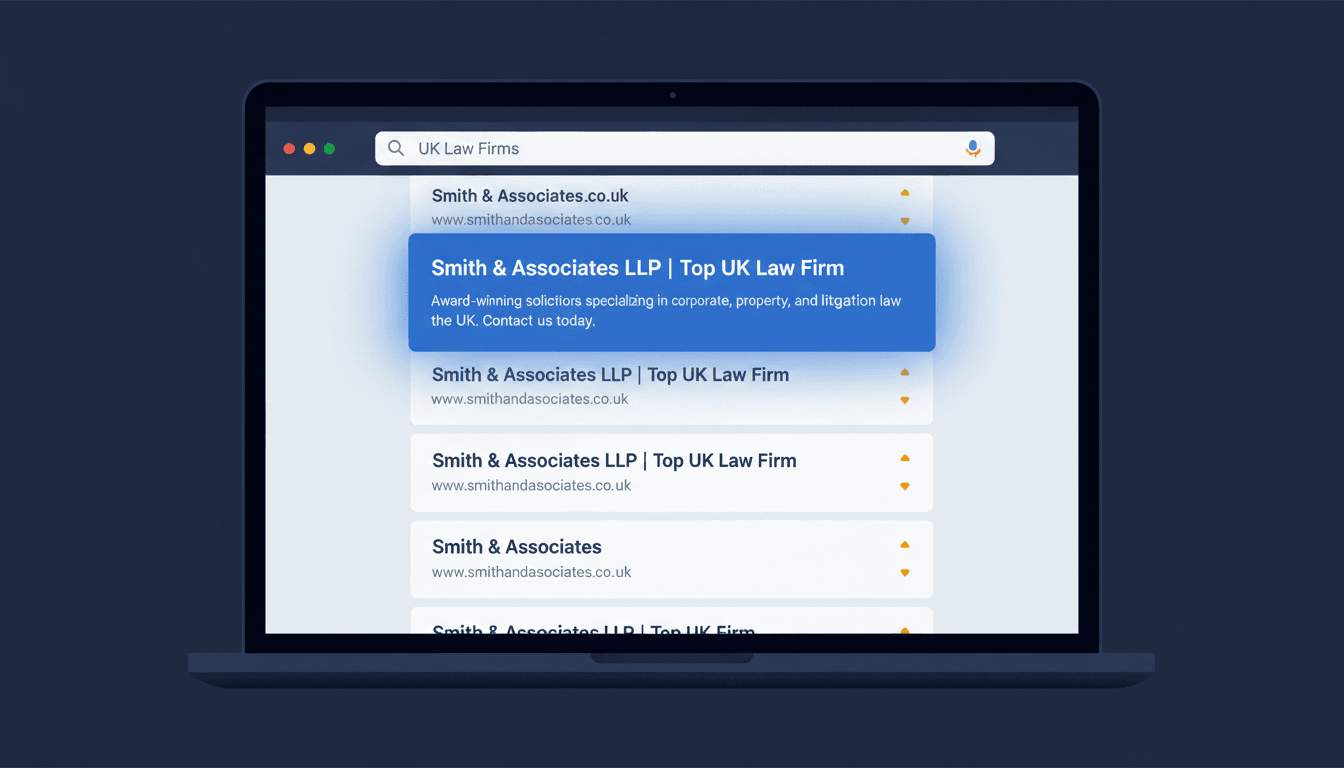
Ninety-six per cent of people searching for legal services start with Google. Not a recommendation from a friend. Not the Yellow Pages. Google.
This article is part of my small business marketing guide.
That single fact should shape everything about how your firm approaches client acquisition. And yet, according to research from the Law Society's 2025 Digital Economy Survey, only 63% of UK law firms have a formal digital marketing strategy in place – meaning more than a third are still largely invisible to the people who need them most.
If you're a solicitor, conveyancer, or legal professional looking to grow your client base, this guide covers everything you need to know: from building a website that actually converts visitors into enquiries, to running Google Ads, ranking on local search, and staying on the right side of the SRA.
Why Digital Marketing Is No Longer Optional for Law Firms
Referrals have always been the lifeblood of legal practice. And they still matter. But relying solely on word of mouth creates a ceiling – one that's increasingly hard to break through as more firms invest in digital visibility.
The landscape has shifted. Potential clients now research solicitors online before they pick up the phone. They read Google reviews. They check your website. They compare you against three or four other firms before they contact anyone. If you're not showing up at that research stage, you simply won't make the shortlist.
The business case for investing in digital marketing is compelling. UK law firms that invest between 1.5% and 2.8% of revenue in digital marketing typically see returns of three to five times that investment within 18 to 24 months. Organic search alone accounts for 41–58% of all law firm website traffic – and that traffic costs nothing per click once you've earned it.
The firms winning online aren't necessarily the biggest. They're the ones that have built a consistent, credible digital presence and committed to it.
Step 1: Build a Website That Converts Enquiries, Not Just Visitors
Your website is the hub of every digital marketing activity you do. SEO, PPC, directories – they all point back to it. A slow, confusing, or unconvincing website will undermine everything else you invest in.
The 2024 LexisNexis Bellwether Report found that 42% of small law firms believe their website is their most important marketing tool – yet many admit it is significantly underutilised.
What a high-converting legal website needs:
- Mobile-first design – the majority of legal searches happen on mobile. If your site isn't fast and readable on a phone, you're losing enquiries before they begin.
- Clear service pages – one page per practice area, each optimised for a specific search term (e.g. "family law solicitor in [town]" or "commercial conveyancing London").
- Prominent calls to action – "Request a Callback", "Book a Free Consultation", "Get in Touch". These should appear above the fold and at the end of every page.
- Social proof – client testimonials, review scores, and case studies. 78% of potential legal clients read reviews before making contact.
- Fast load times – Google penalises slow sites and users abandon them. Aim for under three seconds on mobile.
- Clear fee transparency – since October 2024, the SRA has tightened requirements around fee information in digital marketing materials. Make sure key cost information is accessible.
If your current website doesn't tick these boxes, it's worth investing in a proper rebuild before spending anything on advertising. Take a look at my web design services to see how I approach this for professional service clients.
Step 2: Local SEO – How to Dominate the Map Pack
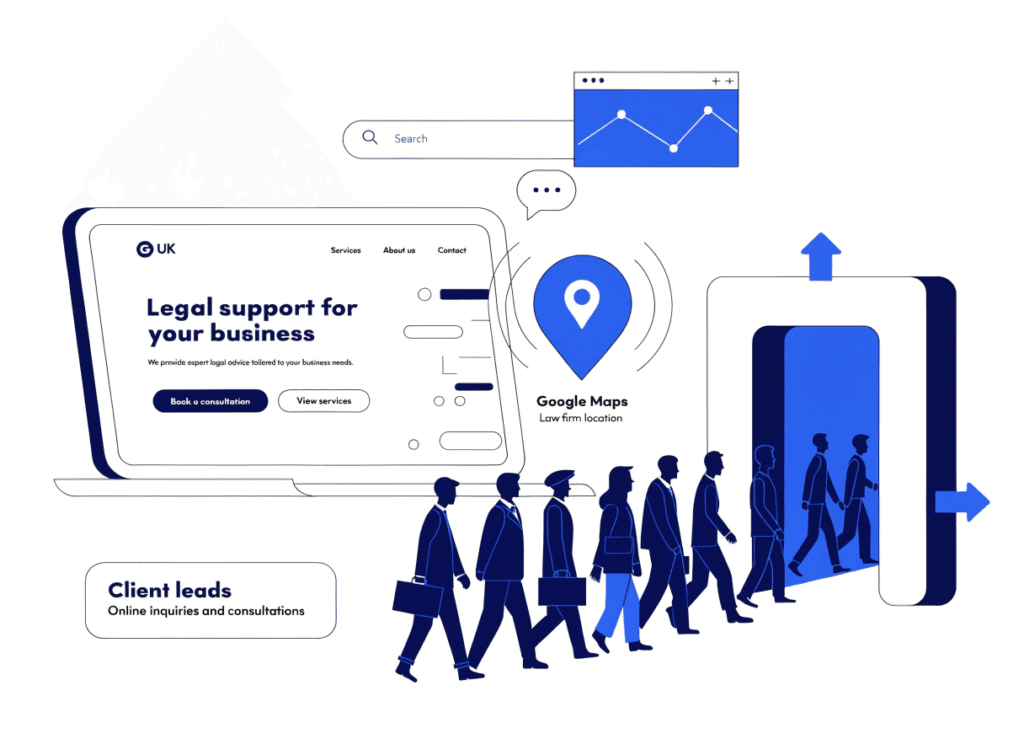
For most solicitors and high-street law firms, local SEO is the single highest-return digital marketing activity available. The Google Local Pack – the three listings that appear on maps at the top of local search results – drives between 19% and 31% of all enquiries for regional firms.
Despite this, only 52% of UK law firms maintain an active, verified Google Business Profile. That's a remarkable gap – and an opportunity.
How to improve your local SEO:
- Claim and fully complete your Google Business Profile – add your services, opening hours, photos of your office and team, and a detailed description. Choose the most accurate primary category (e.g. "Family Law Attorney", "Conveyancer", "Employment Solicitor").
- Gather and respond to reviews – ask satisfied clients to leave a Google review. Respond professionally to every review, positive or negative. Volume and recency both affect your ranking.
- Build consistent NAP citations – your Name, Address, and Phone Number must be identical across your website, Google Business Profile, legal directories, and anywhere else you're listed online.
- Create location-specific service pages – if you serve multiple towns or boroughs, build a dedicated page for each (e.g. "Divorce Solicitor in Woking"). These pages can rank individually in local searches.
- Earn local backlinks – links from local newspapers, business associations, and chamber of commerce websites all strengthen local authority.
For a broader look at how to improve your rankings, read my guide on how to rank higher on Google.
Step 3: Organic SEO – Ranking for the Searches That Matter
Beyond the map pack, ranking in the organic blue-link results requires a longer-term SEO strategy. This is where your service pages, blog content, and technical site health all come together.
Organic search is worth investing in because the results compound over time. A page that ranks well in month 12 continues generating leads in month 24 – without an ongoing cost per click.
The core pillars of SEO for law firms:
- Keyword research – identify the specific phrases your ideal clients are searching for. "Solicitor near me" is a starting point; "employment solicitor unfair dismissal London" is what converts.
- On-page optimisation – each service page should have a clear target keyword in the title tag, H1, first paragraph, and meta description. Don't stuff keywords; write naturally for the reader first.
- Technical SEO – ensure your site is crawlable, loads quickly, uses HTTPS, has a clean sitemap, and doesn't have duplicate content issues.
- Link building – earning links from reputable legal directories, industry publications, and local sources signals authority to Google. My SEO services include structured link building as a core component.
- Content – firms publishing two or more blog articles per week rank for nearly three times more keywords than those publishing monthly. Consistency beats sporadic effort.
New content typically takes 4–8 months to appear in the top 10 for mid-competition terms, and up to 14 months for highly contested head terms. SEO is a medium-term investment – but one with the strongest long-term return of any digital channel.
Step 4: Google Ads – Immediate Leads While Your SEO Matures
Google Ads puts your firm at the top of search results from day one. It's the fastest way to generate enquiries, and it works well for law firms because legal searches have very high purchase intent – when someone searches "personal injury solicitor Manchester", they're ready to talk.
What to expect from PPC as a law firm:
Legal keywords are some of the most competitive – and expensive – in any sector. Cost per click typically ranges from £6–£13 for conveyancing and property searches, up to £32–£45 for personal injury terms. That said, well-managed campaigns achieve average ROI of 250–400% over 12 months.
The difference between a profitable campaign and a wasted budget usually comes down to three things:
- Dedicated landing pages – sending ad traffic to your homepage costs you conversions. Custom landing pages built around a single service increase conversion rates by 35–52%.
- Negative keyword lists – you need to exclude irrelevant searches (e.g. "free legal advice", "law firm jobs") to avoid paying for clicks that will never convert.
- Ongoing optimisation – Google Ads isn't a set-and-forget channel. Bids, copy, and keywords need regular review to maintain efficiency.
I offer PPC management tailored for professional service businesses, including law firms that want to compete on local search without burning through their budget.
Step 5: Content Marketing – Building Trust Before the First Call
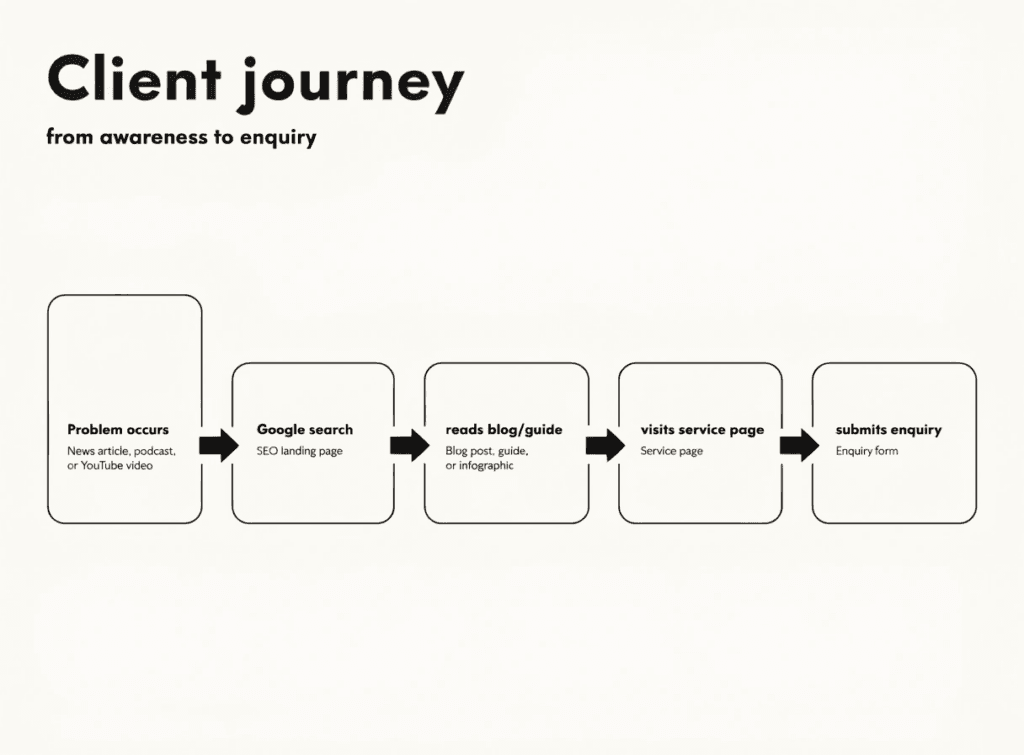
Legal decisions are high-stakes. People don't just choose a solicitor – they research, compare, and validate. A blog that answers the questions your clients are already asking puts your firm in front of them at exactly the right moment.
What content should law firms publish?
- FAQ-led blog posts – "What happens if I'm made redundant?" or "How long does conveyancing take?" These long-tail queries have lower competition and very high intent.
- Practical guides – free downloadable guides (e.g. "Your Guide to Divorce in England and Wales") can act as lead magnets and grow your email list.
- Case studies – anonymised success stories demonstrate real-world capability and build confidence. Check SRA guidance on testimonials before publishing.
- Legal updates – comment on relevant law changes as they happen. This positions you as a credible, current source and earns links from other sites covering the same news.
For more on this topic, my post on content marketing for law firms goes into more detail on strategy and structure.
Step 6: Legal Directories – Easy Wins Most Firms Ignore
Legal directories are trusted by both prospective clients and Google. Being listed adds credibility, provides a backlink to your site, and often shows up in Google's knowledge panels.
The key directories for UK law firms:
| Directory | Type | Notes |
|---|---|---|
| The Law Society Find a Solicitor | Free | Essential – clients actively search here |
| Legal 500 | Paid (editorial) | Prestigious; useful for commercial and corporate firms |
| Chambers and Partners | Paid (editorial) | Similar to Legal 500 – better for larger firms |
| Trustpilot | Free/Paid | Aggregates client reviews; boosts credibility |
| Yell.com | Free/Paid | Useful for local consumer-facing services |
| Thomson Local | Free | Strengthens local citation footprint |
| Checkatrade / TrustATrader | Free/Paid | Less relevant for legal but aids NAP consistency |
The most important thing is consistency. Your name, address, and phone number must be identical across every listing. Inconsistencies confuse both Google and potential clients.
Step 7: Social Media – Where Law Firms Are Wasting Time (and Where They're Not)
Social media is where many law firms invest effort without ever seeing a return. The channel matters – but the platform choice and content type matter far more.
LinkedIn is the dominant platform for law firms, with 67% adoption among mid-tier UK practices. Legal content on LinkedIn achieves engagement rates of 2.1–3.4%, well above the platform average of 0.5%. Employee spotlights, case commentary, and thought leadership posts consistently outperform promotional content.
Facebook's adoption among law firms has actually declined, and Instagram and Twitter/X are gaining very little traction in the legal sector. YouTube is growing – particularly for firms producing video explainers – but requires a significant time investment to do well.
The practical approach: focus LinkedIn activity on thought leadership, team content, and local community engagement. Don't spread yourself across every platform. Two posts a week on LinkedIn, done consistently, will outperform daily posting spread thin across five channels.
SRA Compliance and Digital Marketing – What You Need to Know
The Solicitors Regulation Authority (SRA) applies to all your marketing activity, online included. Enforcement has increased significantly – actions related to digital marketing breaches rose 34% year-on-year in 2024–2025.
Key compliance rules for law firm digital marketing:
- No misleading claims – you cannot describe yourself as a "specialist" in a particular area without Law Society accreditation in that specialism.
- Testimonials must be genuine and representative – cherry-picking only five-star reviews without disclosing the broader picture can be a breach.
- Fee transparency – PPC ads and landing pages must include clear fee information for the services being advertised.
- AI-generated content – 34% of mid-sized UK law firms now use AI to draft content, but only 18% have formal review processes in place. All published content should be reviewed by a qualified solicitor before going live.
When working with a marketing agency, make sure they understand these requirements. An agency that doesn't know the SRA Code will, at best, create compliance headaches – and at worst, create regulatory risk.
In-House vs Agency: Which Is Right for Your Firm?
| Factor | In-House | Agency |
|---|---|---|
| Cost | £3,000–£6,000/month (salary + tools) | £500–£3,000/month depending on scope |
| Specialist knowledge | Requires hiring across SEO, PPC, content | Multi-specialist teams included |
| Regulatory knowledge | Needs training | Agency should already know SRA rules |
| Scalability | Fixed headcount | Flexible as needs change |
| Best for | 100+ lawyer firms with sustained budget | Small to mid-sized firms wanting results without in-house complexity |
Research consistently shows that the majority of law firms now outsource their marketing to dedicated agencies. For most small and regional practices, a good agency partnership delivers better results at lower cost than building an internal team.
When evaluating agencies, look for:
- Demonstrated experience working with legal clients specifically
- Evidence-based reporting (not just vanity metrics)
- A clear understanding of SRA marketing rules
- Transparent pricing and no lock-in contracts
If you'd like to understand how your current site is performing before committing to anything, run a free SEO audit – it takes under a minute and gives you an immediate picture of where you stand.
Conclusion: Your Future Clients Are Already Searching
Digital marketing for law firms isn't about chasing trends. It's about being visible, credible, and easy to contact at the moment someone needs legal help.
The firms growing fastest right now are the ones that have built a solid website, invested in local SEO, created useful content, and used PPC to accelerate results while organic rankings develop. They've done it systematically – not all at once, but consistently.
If you're starting from scratch, focus on your Google Business Profile and website first. If you already have those in place, SEO and content marketing should be your next priority. PPC makes sense once you have a converting landing page to send traffic to.
Ready to take this further? Get in touch and let's talk through what's possible for your firm.