
If you've been quoted anything from £300 to £8,000 for a plumber's website and have no idea what's fair, you're not alone. The range is genuinely that wide — and most of the guides out there either cherry-pick the cheap end to get your attention, or the expensive end to justify their own prices.
This article is part of my guide to marketing for tradespeople and my small business website guide.
This guide gives you the honest numbers across every route, what you actually get for each, and the one question that matters more than the upfront cost.

Think of Your Website as a Lead-Generation Asset, Not a Purchase
Before we get into pricing, it's worth reframing how you think about your website — because most plumbers don't.
A website isn't like a van wrap or a Yellow Pages listing. It isn't something you pay for once and then leave alone. Google updates its ranking algorithm roughly every six weeks. Your services change. Your Gas Safe registration needs to stay current. Your service area grows. A website that isn't maintained gradually stops doing its job.
The other thing most plumbers don't sit down and work out is the return. One boiler installation is worth around £2,500–£3,500 in revenue. A bathroom refit is worth £4,000–£12,000. If your website generates a single additional job per year — just one — it pays for almost every option on this page, many times over.
So the question isn't "what's the cheapest website I can get away with?" It's "which option is most likely to actually generate that job?"
With that in mind, here's what each route realistically costs.
The Four Main Routes to a Plumber's Website
Route 1: DIY Website Builders (£200–£400/year)
Platforms like Wix, Squarespace, and GoDaddy Website Builder let you put together a basic site yourself. Squarespace Business is around £17 per month; Wix Business Basic is about £21 per month. Add a domain and you're under £400 a year.
The obvious upside is cost. The downsides are time and quality. You'll spend hours learning a platform instead of working. The results tend to look templated, and in competitive local search results — where another plumber in your town has a properly built, SEO-optimised site — a DIY build is rarely enough to get you to page one.
Best for: sole traders who just need something online while they get started, with very little local competition.
Route 2: Freelancers (£400–£3,000 one-off)
Freelancers via platforms like Upwork or PeoplePerHour will typically build a five-page plumbing site for £400–£1,500. A local freelancer or small studio usually charges £1,500–£3,000, with delivery in four to eight weeks.
The results vary enormously. Some freelancers produce excellent work; others disappear after launch. Either way, ongoing support usually isn't included — any changes after delivery are charged at £50–£100 per hour. Hosting is a separate bill of £15–£40 per month. SEO is either quoted on top or not offered at all.
Best for: plumbers who want a clean, professional site and are happy to manage hosting and future updates themselves.
Route 3: General Web Design Agencies (£3,000–£8,000+)
A generalist web design agency will build you a fully bespoke site with proper branding, technical SEO foundations, and custom functionality. Expect to pay £3,000–£8,000 upfront, with an ongoing retainer of £300–£800 per month for hosting, updates, and SEO.
The quality is typically high, but the price reflects it — and many general agencies don't specialise in trades businesses, so you may find yourself explaining what a Gas Safe certificate is.
Best for: established plumbing businesses with a larger marketing budget and complex requirements (multiple engineers, e-commerce for parts, etc.).
Route 4: Specialist Trades or Local Digital Marketing Agencies (£895–£3,995+)
Agencies that focus specifically on trades businesses and small business digital marketing — like us at SoNick Marketing — understand what a plumber's website actually needs to do. That means the right page structure for local SEO, clear calls to action for emergency callouts, and content written for the way customers search.
At SoNick Marketing, our web design packages start at £895 for a clean, conversion-focused starter site and go up to £3,995 for a fully custom build. We also offer a Website Refresh at £1,495 if your current site just needs modernising rather than replacing. Every site is built on WordPress — the most widely supported CMS in the world — and comes with SEO best practices baked in from the start.
Best for: plumbers who want a site built by people who already understand the trades market, without paying agency-generalist prices.
Here's a summary to make comparison straightforward:
| Route | Upfront cost | Ongoing cost | Build time | SEO included? |
|---|---|---|---|---|
| DIY (Wix/Squarespace) | £0 | £200–£400/year | 1–4 weeks (your time) | Basic only |
| Freelancer (marketplace) | £400–£1,500 | £15–£40/mo hosting | 2–4 weeks | Rarely |
| Freelancer (local) | £1,500–£3,000 | £15–£40/mo + changes | 4–8 weeks | Sometimes |
| General agency | £3,000–£8,000+ | £300–£800/mo retainer | 8–16 weeks | Usually |
| SoNick Marketing | £895–£3,995 | Monthly SEO/PPC optional | 4–6 weeks | Yes (foundations) |
What Drives the Cost Up (or Down)?
Whether you're getting quotes from freelancers or agencies, the same factors push the price in either direction.
Number of pages. A five-page brochure site (home, services, about, areas covered, contact) costs far less than a site with individual service pages for boiler installation, central heating, bathroom fitting, emergency callouts, and a separate page for every town you cover. More pages mean more design time and more content — but they also mean more SEO opportunity.
Design complexity. A clean template-based design costs less than a fully bespoke layout built around your brand. If you want custom illustrations, animations, or a distinctive look that sets you apart from every other plumber in your area, expect to pay for the additional design time.
Content writing. Many quotes don't include copywriting. Writing proper service pages — ones that actually rank on Google and convert visitors into enquiries — takes time and expertise. If you're supplying your own content, your quote will be lower. If you need it written for you, factor in an additional £75–£200 per page, or choose a provider who includes it.
Booking and enquiry systems. A simple contact form costs nothing to add. An integrated booking system — where customers can choose a date and time, receive confirmation emails, and manage their appointment — adds complexity and cost. At SoNick Marketing, a simple booking integration is available from £45 + VAT; a more advanced setup with full calendar management is from £395 + VAT.
SEO foundations. This is where cheap sites often fall short. A site that's never had proper on-page SEO — correct title tags, meta descriptions, structured headings, schema markup, Google Business Profile integration, and page speed optimisation — won't rank well no matter how good it looks. Always ask whether SEO is included, and what specifically that means.
What to Budget for After Launch
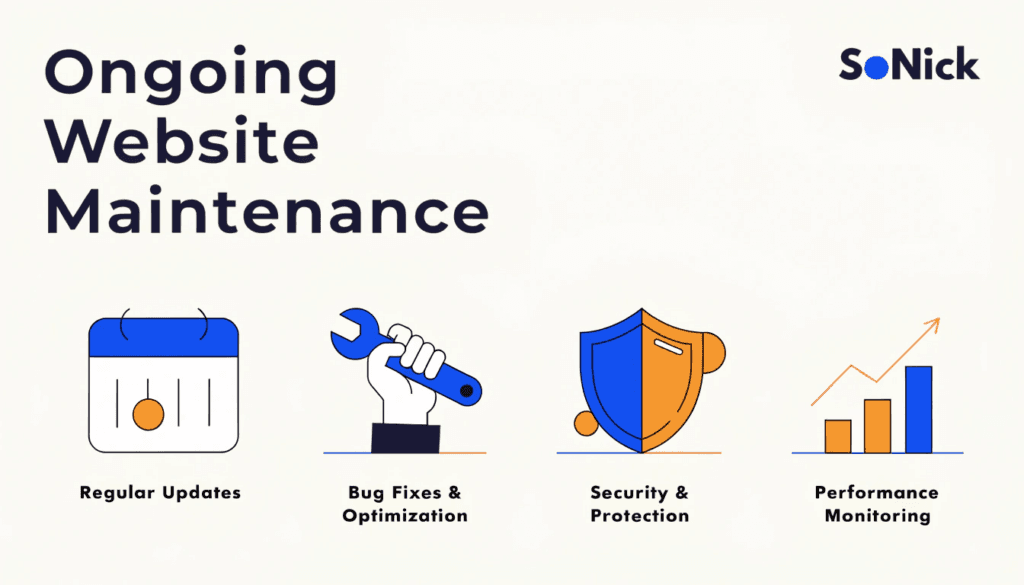
The upfront build cost is only part of the picture. Here's what to expect once your site is live.
Hosting. Your website needs to live somewhere. Decent managed WordPress hosting costs £15–£40 per month from a reputable UK provider. Cheap shared hosting is available for less, but slower servers hurt your rankings and your visitor experience.
Domain renewal. A .co.uk domain renews at around £10–£15 per year. A .com is slightly more.
SSL certificate. This is the padlock in the browser bar that tells visitors your site is secure. Most decent hosting providers include this — but always check.
Maintenance and updates. WordPress and its plugins require regular updates to stay secure. If your developer or agency isn't handling this, you either need to do it yourself or pay for a maintenance plan, typically £30–£100 per month depending on the provider.
SEO. A website without ongoing SEO is a static brochure. Getting your plumbing business to rank consistently for the keywords that bring in real jobs requires regular work — new content, local citation building, link acquisition, and ongoing technical monitoring. Our SEO packages for plumbers start at £449 per month and are designed around the specific terms plumbers need to rank for, from "emergency plumber [town]" to "boiler installation [area]".
If budget is tight, at minimum make sure your Google Business Profile is fully optimised — it's free and has a significant impact on local visibility.
What Actually Makes a Plumber's Website Generate Leads?
A good-looking website that doesn't convert visitors into enquiries is just an expensive brochure. These are the elements that make the difference.
Mobile performance. More than 60% of searches for local trades businesses happen on a smartphone. If your site is slow to load or difficult to navigate on mobile, visitors leave — and they call your competitor instead. Always check how a site looks on a phone before signing off on it.
Clear calls to action. Every page should make it obvious what the visitor should do next. That means a phone number in the header (clickable on mobile), a prominent contact form, and ideally a direct booking option for non-emergency work.
Emergency callout visibility. If you take emergency jobs, this needs to be front and centre. "24/7 Emergency Plumber — Call Now" should be impossible to miss, with your number prominently displayed.
Local SEO signals. Your site needs to be specific about where you work. Service area pages, location-specific content, and proper integration with your Google Business Profile all help Google connect you with searches in your area. For a deeper look at this, my guide to SEO for plumbers covers the full approach.
Trust signals. Gas Safe registration, reviews, accreditations, and before/after photos all build credibility quickly. A plumber with a professional site, clear credentials, and visible reviews will win the enquiry over an equally good plumber with a rough, outdated site.
For more on what separates a site that ranks from one that doesn't, take a look at my post on the 10 best plumbing website designs for practical examples.
Frequently Asked Questions
Do I need a website if I'm already getting work through Checkatrade or MyBuilder?
Those platforms are useful, but they put you in direct price competition with every other plumber listed. A strong website lets customers find you directly through Google — no comparison, no race to the bottom on price, and no commission or subscription fee on every job.
Can I get a website built for under £500?
You can, but be cautious. At that price point you're typically looking at a basic template with minimal customisation, no SEO work, and limited ongoing support. It might be enough to get started, but in most towns it won't be enough to outrank established local competitors.
How long does it take to get a plumber's website built?
Timelines vary significantly. A DIY build can be live in days. A freelancer typically takes two to six weeks. An agency build is usually six to sixteen weeks depending on complexity and their current workload. At SoNick Marketing, most plumber websites are completed within four to six weeks from briefing.
Should I pay for ongoing SEO from the start?
Ideally, yes — or at the very least, make sure your site is built with proper SEO foundations so that adding SEO later isn't starting from scratch. A new site with no SEO history will take three to six months to start showing meaningful organic results, so the sooner you start, the sooner you see the return.
What's included in SoNick Marketing's web design packages?
Our packages cover design, development, copywriting, on-page SEO foundations, contact form setup, mobile optimisation, and Google Analytics configuration. Booking system integration, additional pages, and ongoing SEO or PPC are available as add-ons. You can see the full breakdown on our web design page.
The Bottom Line
A plumber's website can cost anywhere from £200 a year to £8,000 upfront — but the right question isn't how little you can spend. It's which option is most likely to bring in the jobs that pay for it.
A well-built, properly optimised website from a digital marketing agency that understands the trades market will consistently outperform a cheap template. And given that a single bathroom refit or boiler installation covers the cost of almost any option on this page, the return on a good website is one of the clearest in small business marketing.
If you'd like to see how your current site is performing — or get a sense of what a new one could achieve for your business — run a free SEO audit. It takes under a minute and gives you an honest picture of where you stand.