Most small business owners have a rough idea of what they want to rank for. A plumber in Reading might say "I want to come up for plumber Reading." A solicitor in Bristol might aim for "solicitor Bristol." Sensible enough — but without keyword research, there's a good chance you're targeting the wrong terms, missing the searches your customers are actually typing, or walking straight into a wall of competition you can't realistically climb.
Keyword research is what separates an SEO strategy built on assumptions from one built on evidence. It's the difference between creating content that sits quietly on page four and content that generates real enquiries. Whether you're running a local trade business, a professional services firm, or a wellness brand, getting your keywords right is the single most important thing you can do before writing a word of website copy or spending a penny on ads.
Here's everything you need to know.
What Is Keyword Research?
Keyword research is the process of finding the exact words and phrases your potential customers type into Google when they're looking for what you offer. It sounds simple, but the insight it produces goes far beyond a list of search terms.
Done properly, it tells you:
- What your audience actually wants (which is often different from what you assume)
- How many people are searching for a given term each month
- How competitive it is to rank for that term
- What intent sits behind the search — are they researching, comparing, or ready to buy?
Think of it as market research for search engines. Instead of guessing what your customers care about, you're reading the data directly. That data then shapes your website content, your blog strategy, and your Google Ads campaigns.
Types of Keywords (And Why Each One Matters)
Not all keywords are created equal. Understanding the different types helps you target the right terms at the right time — and build a strategy that works across the entire customer journey.
Informational keywords are used by people who want to learn something. They're not ready to buy yet, but they're gathering knowledge. A plumber might target "why does my boiler keep cutting out" — someone searching that isn't calling anyone today, but they're forming opinions about who knows their stuff.
Navigational keywords are brand or business searches. Someone typing "SoNick Marketing" wants a specific website. Less useful for new customer acquisition, but important for brand protection.
Commercial investigation keywords come from people actively comparing their options. Searches like "best SEO agency for small businesses" or "Ahrefs vs SEMrush" sit here. These people are close to making a decision, so ranking for them is valuable.
Transactional keywords signal buying intent. "Emergency plumber in Guildford," "book a deep tissue massage London," "hire a solicitor near me" — these searchers want to take action now. They tend to be lower in volume but higher in conversion rate, which makes them particularly important for service businesses.
Local keywords combine a service with a location. For most of the clients I work with — plumbers, builders, therapists, solicitors, salon owners — these are the goldmine. "Electrician in Farnborough," "family solicitor Southampton," "hair salon Basingstoke" all indicate clear local intent. If you're not targeting these, you're invisible to the very people most likely to call you.
Long-tail keywords are longer, more specific phrases. They typically attract lower search volume but face less competition and often convert better because the intent is more precise. "Affordable boiler installation for a 3-bedroom house in Surrey" is a long-tail keyword — and someone typing that is probably ready to get quotes.
For a deeper look at long-tail strategy, read what are long-tail keywords and why do they matter.
Six Reasons Keyword Research Is So Important for SEO
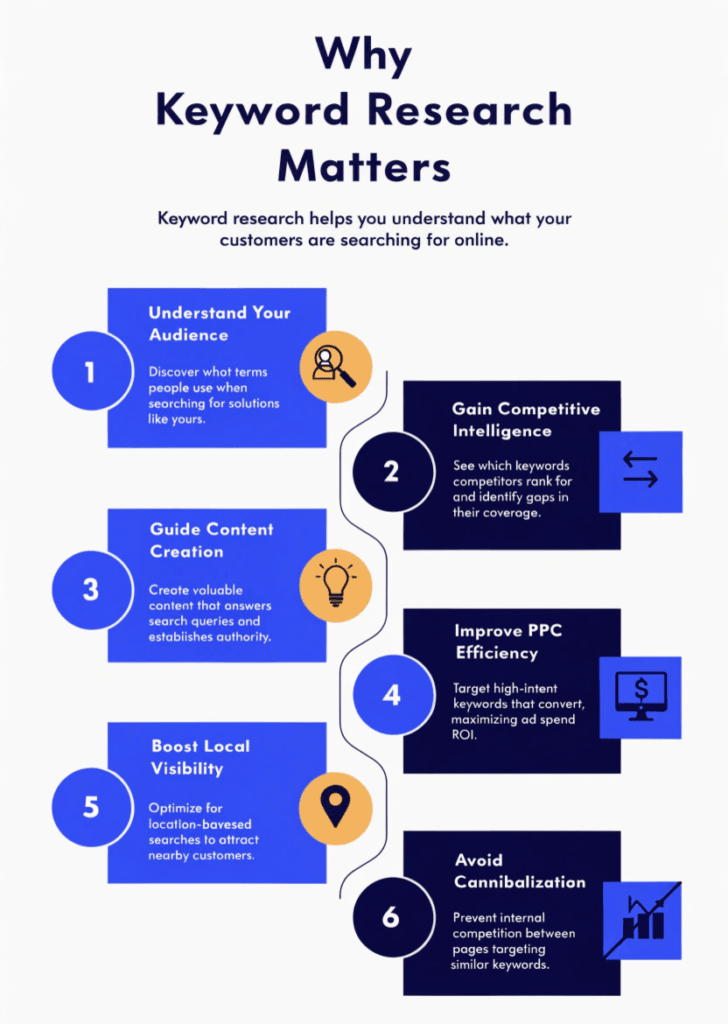
1. It Shows You What Your Audience Actually Wants
Your instinct about what customers search for is often wrong — not through any fault of your own, but because people don't search the way businesses talk. A therapist might describe their service as "psychotherapy." Their clients might search "anxiety counselling" or "talking therapy near me." Keyword research closes that gap.
2. It Helps You Compete Smarter
Knowing a keyword's difficulty score means you can make informed decisions about where to invest. Trying to rank a new website for "SEO agency" is a five-year project. Ranking for "SEO agency for plumbers in Hampshire" is achievable in months. Research tells you where the realistic opportunities are.
3. It Directs Your Content Strategy
Every piece of content on your site should be built around a keyword with genuine search demand. Without research, you're writing for yourself. With it, you're writing for the people actively looking for your services. This applies to service pages, blog posts, FAQs — everything. If you're unsure how to connect content to search demand, read why keyword research matters for your content marketing.
4. It Makes Your PPC More Efficient
The same logic that governs organic search governs paid search. Bidding on vague, high-volume keywords wastes budget. Targeting specific, high-intent keywords aligned with your service pages brings in qualified clicks. If you're running Google Ads, your keyword list is the foundation everything else is built on.
5. It Unlocks Local Visibility
For trade and service businesses, local keyword research is everything. It identifies the specific area-plus-service combinations that people in your target geography are searching for, so you can build pages that capture that intent. This feeds directly into your local SEO strategy and Google Business Profile visibility.
6. It Prevents Keyword Cannibalisation
When multiple pages on your site target the same keyword, they compete against each other — which usually results in neither ranking well. Proper keyword mapping during the research phase prevents this by assigning one primary keyword to each page before you build or write anything.
How to Choose the Right Keywords for Your Business
Here's the process I use when starting keyword research for a new client:
Step 1: Brainstorm seed terms. Start with the services you offer and the locations you serve. "Boiler repair Woking," "legal advice for landlords Surrey," "sports massage Farnham." These become the foundation of your research.
Step 2: Use the right tools. For most small businesses, a combination of tools works best:
- Google Keyword Planner — free, directly from Google, useful for volume and PPC bid estimates
- SE Ranking — excellent for local SEO research and affordable for small agencies and businesses
- Ahrefs or Semrush — more expensive, but powerful for competitor analysis and keyword gap identification
For each keyword, look at search volume (how many people search it monthly), keyword difficulty (how hard it is to rank), and search intent (what the searcher actually wants to find).
Step 3: Add location modifiers. For local businesses, layer in your service areas. Don't just research "plumber" — research "plumber Guildford," "emergency plumber Woking," "boiler service Farnham." Each of these is a distinct opportunity.
Step 4: Research your competitors. Plug competitor domains into a tool like SE Ranking or Ahrefs to see which keywords they're ranking for that you aren't. This surfaces gaps you can target with new content or optimised service pages.
Step 5: Map keywords to pages. Once you have a list, assign each keyword to a specific page on your site. One primary keyword per page, with a handful of related secondary terms to support it. This structure prevents cannibalisation and keeps each page focused.
Where to Use Your Keywords
Having a keyword list is only half the job. Here's where to put them to work:
Service pages should each target a specific service and location combination. "Bathroom installation Southampton" deserves its own page — not a mention buried on a general plumbing services page.
Blog posts address informational queries that build topical authority and capture people earlier in the buying journey.
Title tags and meta descriptions should include the target keyword near the front. This directly influences click-through rates from search results. Read what is a title tag for a practical guide.
Headings (H1 and H2s) signal to Google what each section of the page is about.
URLs should be clean and keyword-focused — /boiler-repair-guildford/ rather than /services/page-3/.
Google Ads campaigns should mirror your organic keyword strategy for high-intent terms, using the same research to inform ad groups, match types, and negative keywords.
Does Keyword Research Still Matter in the Age of AI Overviews?
It's a fair question. Google's AI Overviews now answer many queries directly in the search results, and voice search has changed the way people phrase their queries. So is traditional keyword research still relevant?
Yes — but it needs to evolve slightly. A few things worth knowing:
Conversational, question-based queries are more important than ever for voice search. "What's the best way to fix a leaky radiator?" is now as valid a keyword target as "radiator repair." Building content that directly answers specific questions increases the chance of appearing in AI Overviews and featured snippets.
Long-tail keywords have become more valuable, not less. As AI search gets better at understanding context, highly specific queries are better served — which means there's more opportunity to rank for them if you've done the research.
Fundamentally, search engines still need to match queries to content, and keywords are the language that connection is made in. The practice has matured, but it hasn't been replaced.
Common Keyword Research Mistakes to Avoid

Targeting keywords that are too broad. "Plumber" has enormous search volume but is dominated by national directories and aggregators. You won't rank for it. Target service-plus-location terms you can realistically win.
Ignoring local intent. If you serve specific towns or regions, your keyword list must reflect that. Generic terms without location modifiers will bring traffic from the wrong areas — or no traffic at all.
Guessing instead of researching. Even if a keyword feels right, check the data. Search volumes and competition levels are often counterintuitive.
Targeting the same keyword across multiple pages. This causes cannibalisation. One page, one primary keyword — every time.
Stuffing keywords into content. Google's algorithm is sophisticated enough to spot this, and it makes for a worse reading experience. Use keywords naturally and focus on genuinely answering the searcher's question.
Doing research once and never revisiting it. Search behaviour changes. New competitors appear. Seasonal trends shift. Keyword research should be revisited at least every six to twelve months.
Start With the Right Foundation
Getting keyword research right isn't about chasing the highest search volumes. It's about finding the terms your ideal customers are using, understanding what they want when they search, and building content that answers that need better than anything else on the first page.
For local and trade businesses especially, a well-researched keyword strategy is often the single biggest lever for sustainable growth. It informs everything — your site structure, your content plan, your SEO strategy, and your paid campaigns.
If you'd like to see how your site is currently performing and where the biggest keyword opportunities lie, run a free SEO audit — it takes under a minute and gives you an immediate picture of where you stand.