Picture this: a homeowner wakes up at 7am to find water pouring through their kitchen ceiling. Within 30 seconds, they have their phone in their hand and they're typing "emergency plumber near me" into Google. They're not scrolling through Facebook, asking a neighbour, or flicking through a directory. They want a plumber, right now, and they're going to call whoever shows up first and looks trustworthy.
That moment — repeated thousands of times a day across the UK — is why digital marketing is more important for plumbers than almost any other trade. The intent is urgent, the decision is fast, and the business goes to whoever is visible at the right time.
This guide walks you through every channel worth your attention: your website, SEO, local search, Google Ads, social media, email, and how to measure whether any of it is actually working. I've written it for plumbers and heating engineers who want to understand what each channel does and how to prioritise where to start — without the jargon.

Why Digital Marketing Matters More for Plumbers Than Most Trades
Plumbing has one of the strongest search intent profiles of any local service. When someone searches for a plumber, they almost always need one — urgently. They're not browsing for inspiration or comparing options over a few weeks. They want a response today, and often within the hour.
That makes Google the most important place your business can be. Research consistently shows that the vast majority of people search online before hiring a local tradesperson. If your business isn't appearing at the top of local results, those calls are going to your competitors — regardless of how good your work is.
Word of mouth is still valuable, but it can only take you so far. Referrals are unpredictable, and they don't scale. Digital marketing gives you a consistent, controllable pipeline of new enquiries — and unlike a van sign or a Yellow Pages listing, you can track exactly what's working.
Your Website — The Foundation Everything Else Is Built On
Before you spend a penny on advertising or SEO, you need a website that actually converts visitors into enquiries. Everything else you do online — Google Ads, social media, local listings — points back to your website. If it's slow, outdated, or hard to navigate, you'll lose leads even when people find you.
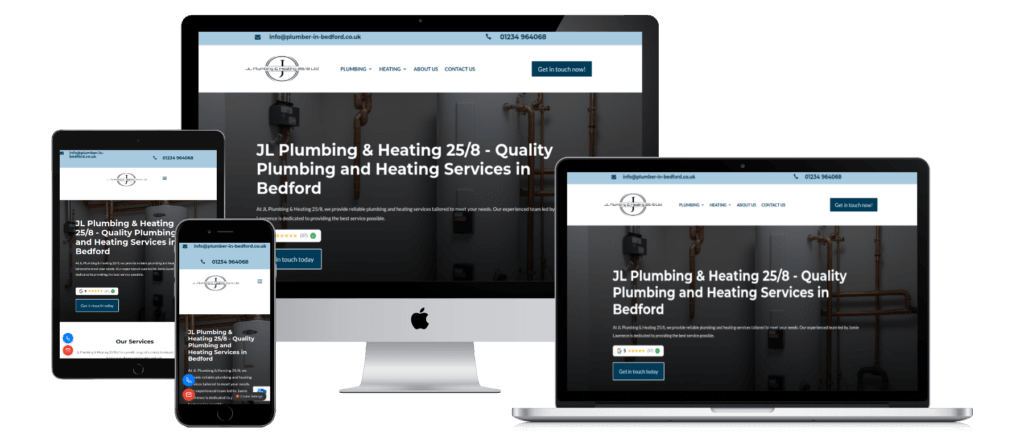
Here's what a high-performing plumber website needs to include:
The essential pages:
- Homepage — your key services, areas covered, trust signals (accreditations, years of experience, reviews), and a clear call to action
- Service pages — one dedicated page for each main service (boiler installation, boiler repair, bathroom fitting, emergency plumbing, etc.)
- Areas covered — a page listing the locations and towns you serve, ideally with individual location-specific pages for your main areas
- About page — who you are, your qualifications, and why customers should trust you
- Contact page — phone number, email, a simple enquiry form, and your service area
Performance basics:
- Load speed under 3 seconds. Google uses page speed as a ranking factor, and slow sites lose enquiries. Test yours with Google PageSpeed Insights.
- Fully mobile-responsive. Most local searches for plumbers happen on a smartphone, so your site needs to look and work perfectly on every screen size.
- Your phone number visible on every page — ideally clickable in the header, so mobile visitors can call you in one tap.
Trust signals that convert visitors:
- Customer reviews and testimonials — pull these from your Google Business Profile and display them prominently
- Accreditations and trade body logos (Gas Safe Register, CIPHE, WIAPS, etc.) — these immediately signal credibility
- Before and after photos of your work — especially for bathrooms and boiler installations
- An online booking or quote request form — a significant proportion of people prefer to enquire online rather than call, and they may be doing so outside of your working hours
If you're building a new site or looking to understand what makes a great plumbing website, take a look at our web design service — we build lead-generating websites for trades businesses across the UK.
SEO and Local SEO for Plumbers
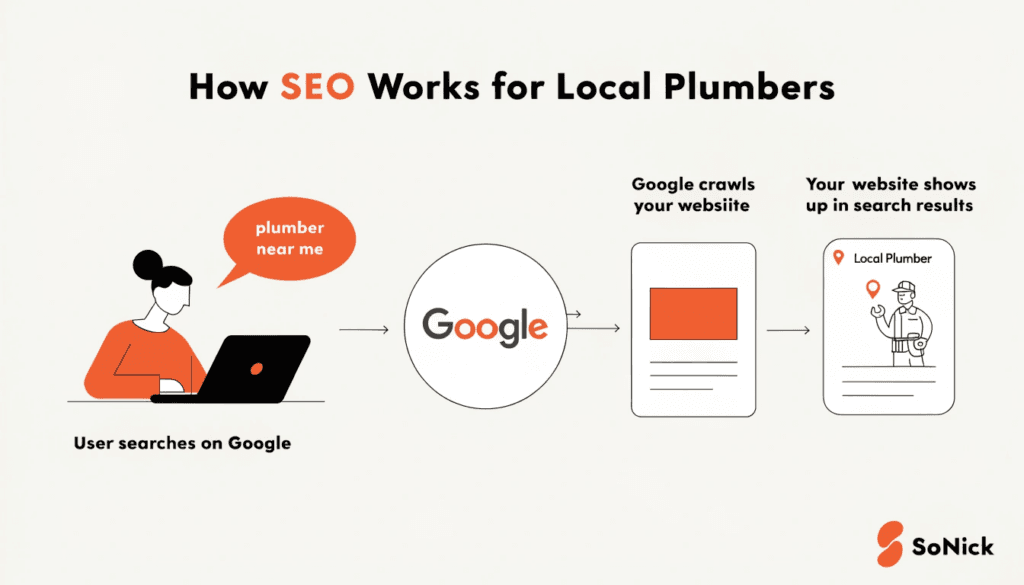
SEO (search engine optimisation) is the process of improving your website so that it appears higher in Google's organic search results. For plumbers, the goal is to rank for the specific searches your potential customers are making — things like "plumber in [your town]", "boiler repair [location]", or "emergency plumber [area]".
Done well, SEO delivers a consistent stream of free, qualified traffic to your website month after month. Unlike paid ads, you're not paying for every click.
Keyword strategy for plumbers
The biggest mistake plumbers make with SEO is trying to rank for broad terms like "plumber" or "heating engineer." These terms are highly competitive and don't tell Google where you work or what you specialise in.
Instead, focus on long-tail, location-specific keywords:
- "Emergency plumber [town]"
- "Boiler service [town]"
- "Bathroom installation [town]"
- "Gas Safe plumber [area]"
- "24 hour plumber [town]"
These are more specific, easier to rank for, and have higher conversion rates — because the person searching knows exactly what they want.
I've put together a detailed breakdown of the best keywords for plumbers which is worth reading alongside this guide.
Local SEO and your Google Business Profile
Local SEO is a specific branch of SEO focused on appearing in Google Maps results and the "local pack" — the three businesses that appear in a box at the top of local search results. For most plumbers, this is the highest-value real estate on Google.
Your Google Business Profile (formerly Google My Business) is the engine that drives your local visibility. Setting it up properly is one of the single most impactful things you can do for your plumbing business.
Here's what a fully optimised Google Business Profile looks like:
- Business name — use your actual trading name, exactly as it appears on your website. Don't stuff keywords into your business name.
- Category — set your primary category to "Plumber." Add secondary categories for heating, boiler installation, or bathroom fitting where relevant.
- Address and service area — add your address if you have a physical premises, and set your service area to the towns and postcodes you cover.
- Phone number — use a local number where possible, and make sure it matches what's on your website.
- Website link — link directly to your homepage.
- Opening hours — keep these accurate and update them for bank holidays. If you offer emergency call-outs, note this.
- Services — list every service you offer using Google's service fields.
- Photos — add photos of your team, your van, your work (especially before and afters), and any accreditation certificates. Profiles with photos consistently outperform those without.
- Reviews — actively ask every happy customer to leave a Google review. Reviews are one of the most important local ranking factors, and they directly influence whether potential customers call you. Always respond to reviews, positive and negative.
- Posts — use Google Business Profile posts to share offers, seasonal reminders, and recent jobs. It keeps your profile active and signals to Google that your business is current.
Local citations
A local citation is any mention of your business name, address, and phone number on another website — directories, trade platforms, local listings sites. Consistent citations across the web help Google trust that your business is legitimate and established.
Key directories for UK plumbers include Checkatrade, Which? Trusted Traders, Rated People, TrustATrader, Yell, and your local council website. Make sure your details are consistent across all of them — any discrepancies in your address or phone number can undermine your local SEO.
For a full breakdown of what's involved, our SEO for plumbers guide covers every aspect of this in depth.
Google Ads (PPC) for Plumbers
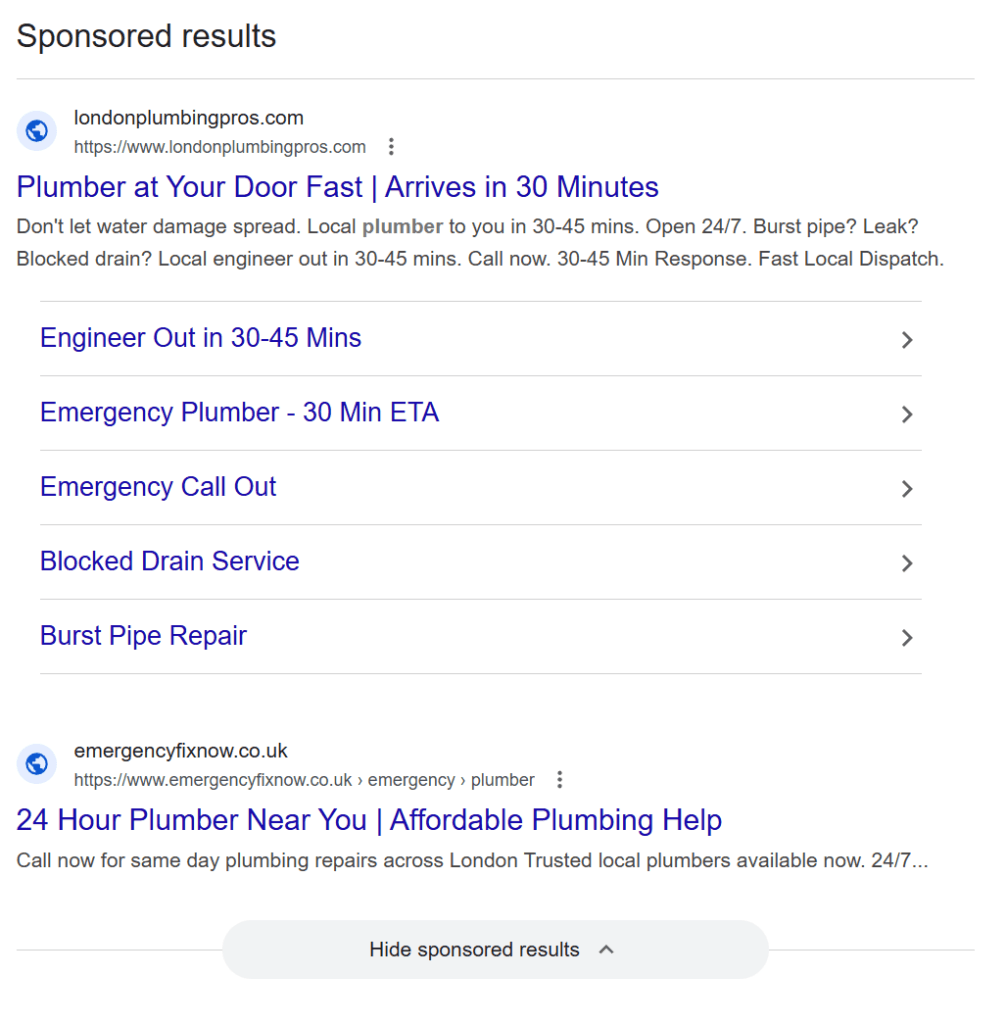
If SEO is the long game, Google Ads is the fast track. Pay-per-click advertising puts your business at the very top of Google's search results — above the organic listings — and you only pay when someone clicks your ad.
For plumbers, Google Ads is particularly effective because of the high-intent nature of plumbing searches. Someone searching "emergency boiler repair [town]" is not browsing — they need help today. Getting your ad in front of them at that moment, with a clear phone number and a compelling offer, can deliver leads within hours of launching a campaign.
Google Search Ads
Search ads appear when someone types a relevant query into Google. You bid on keywords (e.g. "plumber [location]", "boiler repair [location]"), set a budget, and your ad shows to people actively searching for your services.
The key advantages for plumbers:
- Speed. A new website can take months to rank organically. Google Ads can get you to the top of results almost immediately.
- Targeting. You can restrict your ads to specific postcodes or a radius around your location, so you're only paying to reach people you can actually serve.
- Control. You set your daily budget, choose your keywords, and can pause or adjust campaigns at any time.
The main cost for plumbers to be aware of is that keywords like "emergency plumber" can have a high cost-per-click. The key to making Google Ads profitable is tight targeting, well-written ad copy, and sending traffic to a landing page designed to convert. A poorly managed campaign burns budget quickly.
Local Services Ads
Local Services Ads (LSAs) are a newer Google product that sits above standard search ads. Rather than paying per click, you pay per lead — meaning you only pay when a potential customer contacts you directly through the ad.
LSAs display your business name, rating, number of reviews, and a "Google Guaranteed" or "Google Screened" badge. For trades businesses, they're highly visible and generate strong trust signals. If you're Gas Safe registered and have a good review profile, LSAs are worth exploring as part of your Google Ads strategy.
Our Google Ads for trades guide covers how to set up and manage campaigns effectively.
Social Media for Plumbers
I'll be honest with you: social media is rarely where plumbers should focus their early marketing effort. When someone has a burst pipe, they're not scrolling Instagram — they're going straight to Google. Social media works best as a supporting channel once your core SEO and PPC foundations are in place.
That said, it's not worthless. Here's a realistic take on each platform:
Facebook is the most useful social platform for most plumbers. Your potential customers — homeowners, landlords, property managers — are there. A business page with regular posts, customer reviews, and before-and-after photos builds local brand recognition over time. Facebook Ads can also work well for planned services (bathroom renovations, boiler replacements) where the purchase decision takes longer.
Instagram suits plumbers who do visually impressive work — bathroom installations, tiling, high-end fittings. Before-and-after transformations perform particularly well. If you don't have the kind of finished work that photographs well, Instagram is lower priority.
LinkedIn is worth maintaining if you want to target landlords, letting agents, or commercial property managers. For domestic plumbers, it's less relevant.
Next Door and local Facebook groups are underused but genuinely effective. Posting in local community groups (where allowed) and being active in neighbourhood apps puts you in front of homeowners who prefer local, trusted tradespeople over big national directories.
The honest priority for social media: maintain a tidy Facebook page, collect reviews there as well as on Google, and post a few times a month. Don't let it consume time that would be better spent on your Google Business Profile or asking for reviews.
Email Marketing for Plumbers
Email is often overlooked by trades businesses, but it has one of the highest returns on investment of any digital marketing channel. The reason most plumbers don't use it is simple: they don't collect email addresses. Start doing that from day one.
Here's where email genuinely earns its keep for a plumbing business:
Seasonal maintenance reminders. Send an email to your customer list each autumn reminding them to book a boiler service before winter. Send one in spring about outdoor tap and garden plumbing checks. These prompt repeat bookings from people who've used you before and are delighted to be reminded.
Post-job follow-up. An automated email sent two or three days after every completed job can do several things at once: thank the customer, ask for a Google review, and remind them of any other services you offer. This single automation builds your review profile and keeps your business front of mind.
Annual boiler service reminders. If you service boilers, you know exactly when each customer is due their next one. A well-timed reminder email in the weeks before their anniversary is a simple, almost effortless way to retain that customer year after year.
Quiet period promotions. If January or February is typically slow, a simple email offering a discount on bathroom consultations or a free boiler health check can generate bookings during periods that would otherwise be quiet.
You don't need sophisticated software to get started. A basic Mailchimp account, a list of customer emails collected over the past year, and a single seasonal email each quarter will already put you ahead of most plumbers.
Measuring Your Results
There's little point investing in digital marketing if you're not tracking whether it's working. Fortunately, the core measurement tools are free — they just need to be set up correctly.
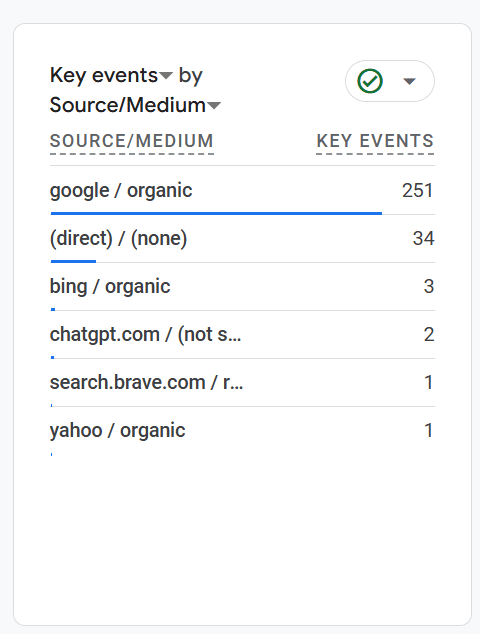
Google Analytics 4 (GA4)
GA4 is Google's free web analytics platform. Once the tracking code is installed on your website, it shows you:
- How many people are visiting your site and where they're coming from (Google, direct, social, paid ads)
- Which pages are most visited and how long people spend on them
- Which actions people take — phone number clicks, form submissions, button clicks
- Which traffic sources are actually generating enquiries
The most important thing to set up in GA4 is event tracking for your key conversion actions — specifically phone number clicks and contact form submissions. Without these, you can see traffic but not whether that traffic is turning into enquiries.
Google Search Console
Google Search Console shows you how your website is performing in Google's organic search results. It's the best tool for understanding your SEO:
- Which keywords are generating impressions and clicks
- Your average position for different search terms
- Any technical issues Google has found with your site (crawl errors, indexing problems, mobile usability)
- Which pages are ranking and which aren't being indexed
Check it at least monthly. If you notice a sudden drop in impressions or clicks, Search Console is usually where you'll find the first clue as to why.
SEO rank tracking and reporting
Beyond GA4 and Search Console, a dedicated rank tracking tool lets you monitor exactly where your website appears for your target keywords week on week. This is where you'll see whether your SEO work is moving the needle.
I use SE Ranking for this — it tracks keyword positions, monitors your Google Business Profile performance, audits your site for technical issues, and produces clear reports you can actually understand. It's well-suited to small business owners who want visibility into their SEO without needing an agency to translate everything.
Monthly SEO reporting is included in all of our SEO packages, so if you'd rather hand this off entirely, we can handle it for you.
The Recommended Digital Marketing Strategy for Plumbers
If you're starting from scratch — or rethinking your current approach — here's the order I'd recommend working through:
Step 1: Get your website right. Before anything else, make sure you have a fast, mobile-friendly website with clear service pages, a visible phone number, a contact form, and your key trust signals in place. This is the foundation. Without it, everything else underperforms.
Step 2: Set up and optimise your Google Business Profile. This is free, takes a couple of hours to do properly, and has a direct impact on how often you appear in local search results. Fill in every field, add photos, and start actively collecting reviews.
Step 3: Start building your SEO. SEO takes time — typically three to six months before you see significant results — which is exactly why you should start now. Focus on location-specific service pages, consistent local citations across directories, and a steady stream of Google reviews.
Step 4: Add Google Ads to accelerate lead flow. Once your website converts well, Google Ads lets you generate leads immediately while your SEO builds in the background. Start with Search Ads targeting your highest-value services and locations, then consider Local Services Ads once you have a solid review base.
Step 5: Build your email list and send regular communications. Collect an email address from every customer. Set up a post-job follow-up sequence and a seasonal reminder email. This is low effort, low cost, and keeps your existing customers coming back.
Step 6: Maintain a social media presence. A tidy Facebook page with regular posts and reviews is enough to support your brand presence. Don't let social media distract you from steps one to five.
If you want to read more about generating leads for your plumbing business specifically, our plumbing lead generation guide and complete guide to digital marketing for plumbers go into further depth on each of these areas.
Frequently Asked Questions
How do plumbers find new clients?
The most consistent sources of new clients for plumbers are: organic Google search (through SEO and a well-optimised Google Business Profile), Google Ads, trade directory listings (Checkatrade, Rated People, etc.), and word-of-mouth referrals. For long-term, sustainable lead generation, building your online presence through SEO is the most cost-effective approach — though it takes time. Google Ads provides faster results while your organic rankings develop.
Do Facebook Ads work for plumbers?
They can, but they're not where most plumbers should start. Facebook Ads work on a passive audience — you're showing your ad to people who aren't currently searching for a plumber. This makes them better suited to planned, higher-value work (bathroom renovations, boiler replacements) rather than emergency call-outs. Google Ads, by contrast, targets people actively searching for your services right now — which is why search advertising almost always delivers a better return for plumbers initially.
How much should a plumber spend on digital marketing?
It depends on your ambitions and your market. As a rough guide: Google Ads for a local plumber in a competitive area typically requires a minimum budget of £500–£1,000 per month to generate meaningful results. SEO retainers for trades businesses start from a few hundred pounds per month and scale depending on the scope of work. Your website is a one-off investment, but it's worth doing properly — a cheap website that doesn't convert will cost you far more in missed enquiries than a well-built one. Our plumber advertising strategies guide covers budget planning in more detail.
How do I advertise myself as a plumber?
Start with the fundamentals: a professional website, a fully optimised Google Business Profile, and a consistent presence on the major UK trade directories. From there, Google Ads is the fastest way to generate enquiries. Social media and email marketing support and retain the customers you've already won. The most important thing is to show up where your customers are already looking — and for plumbers, that's overwhelmingly Google.
Conclusion
Digital marketing doesn't have to be complicated, but it does need to be consistent. For plumbers, the opportunity is clear: high-intent searches, a steady demand for services, and a large proportion of competitors who still aren't showing up properly online.
Start with your website and your Google Business Profile. Build your SEO steadily. Add Google Ads to accelerate results. Collect email addresses from every customer and keep in touch with them. That's the strategy — and it works.
If you'd like to see how your website is currently performing before you dive in, run a free SEO audit — it takes under a minute and gives you a clear starting point. Or if you'd prefer to talk through what's possible for your plumbing business, get in touch and let's have a conversation.