
Most small business owners I speak to have tried content marketing in some form — a few blog posts, some social updates, maybe a video or two — but they struggle to point to a single lead it's actually produced. That's not a content problem. It's a strategy problem.
This article is part of my small business marketing guide.
Content marketing, done properly, is one of the most effective and cost-efficient ways to generate leads for your business. It compounds over time, builds genuine trust with your audience, and brings in enquiries while you're busy doing the actual work. But "publishing content" and "generating leads through content" are two very different things. This guide walks you through how to make your content work harder for your business.
What Is Lead Generation Content?
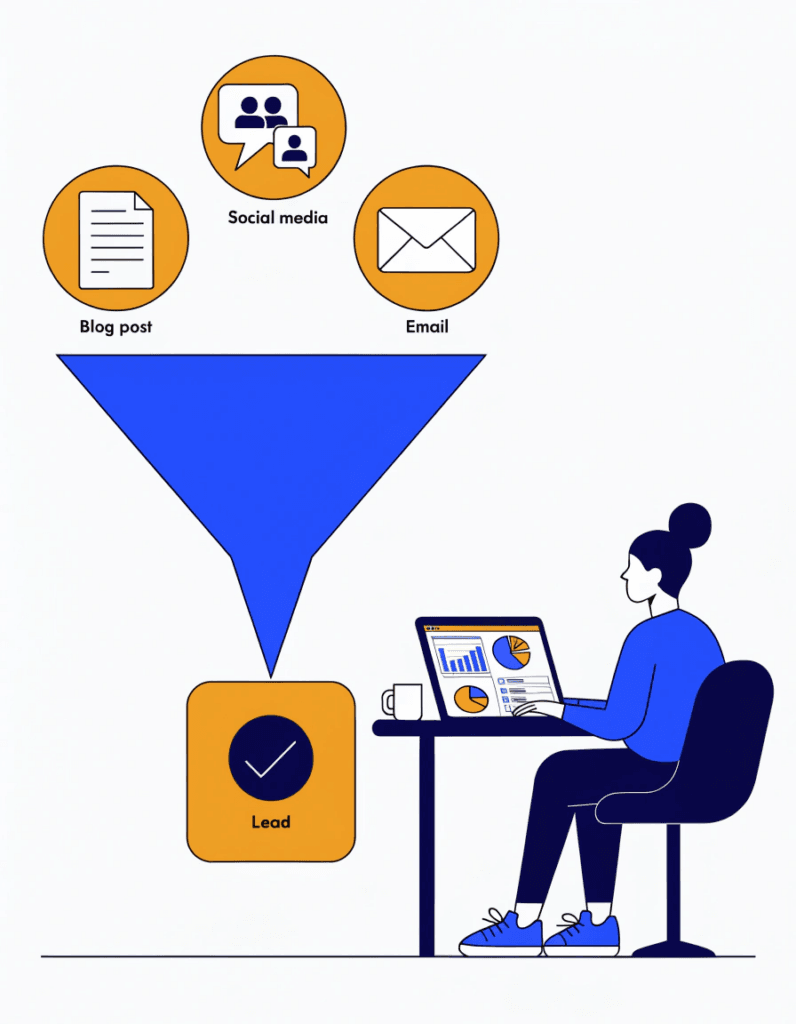
Lead generation content is any content designed to move a potential customer closer to making an enquiry or purchase. That might be a blog post that answers a question they've been Googling, a free guide they download in exchange for their email address, or a case study that tips them from "maybe" to "yes."
The key distinction is intent. Content that educates, builds trust, and positions you as the go-to expert in your field is doing lead generation work — even if a reader doesn't enquire on the spot. Every piece of content you publish is either moving someone closer to your business or doing nothing at all.
Good lead generation content helps your prospects trust you before they've ever spoken to you. And trust, more than anything else, is what turns a prospect into a paying client.
Why Content Marketing Works for Lead Generation
Here's the thing about content marketing that gets overlooked: it builds an asset. A well-written blog post or a useful guide keeps working for you long after you've published it, bringing in traffic and leads month after month. Compare that to paid advertising, which stops the moment you stop spending.
Content marketing also puts you in control of the conversation. Rather than interrupting people with ads they didn't ask for, you're appearing at the exact moment they're searching for an answer to a problem you can solve. That's a fundamentally different kind of lead — warmer, more qualified, and much closer to making a decision.
The compounding nature of content is the real advantage for small businesses. A single strong blog post, optimised for the right keyword, can generate enquiries for years. Build up a library of that kind of content and you've created a lead generation engine that runs in the background whilst you get on with running your business.
The Two Types of Content You Need
Most businesses that struggle with content marketing are missing one of these two things — or confusing them entirely.
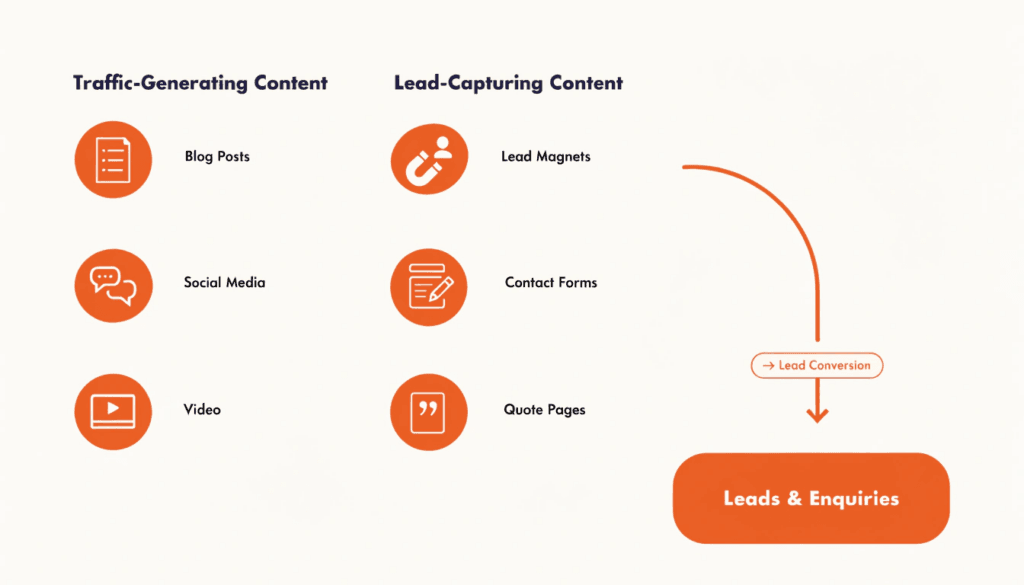
Traffic-generating content is content designed to bring people to your website. Blog posts, social media updates, videos, and podcasts all fall into this category. Their job is to get the right people through the door by answering questions, solving problems, or providing genuinely useful information. This content needs to be optimised for search (the right keywords, the right structure) so people can actually find it.
Lead-capturing content is content designed to convert that traffic into actual leads. This is where lead magnets, contact forms, quote request pages, and gated resources come in. Their job is to encourage visitors to take a specific action — whether that's downloading a guide, booking a call, or requesting a quote.
Most small businesses have too much of one and not enough of the other. They publish blog posts but have no lead magnet, or they've created a great lead magnet but no content to drive traffic to it. You need both, working together.
How to Build Your Content Lead Generation Strategy
1. Know Exactly Who You're Writing For
Before you write a single word, you need to be clear on who your ideal customer is. Not in a vague, "small business owners aged 25–55" kind of way — but specifically. What do they do? What problems are they trying to solve? What questions are they typing into Google at 10pm? What makes them hesitant to buy?
The more precisely you can answer these questions, the better your content will connect with the people you actually want to reach. If you serve tradespeople, for example, the content that resonates with a self-employed plumber is very different from what speaks to a multi-van electrical firm. Get specific, and your content will do a much better job of attracting the right leads.
2. Choose Your Content Formats
You don't need to be everywhere, and you certainly don't need to produce every type of content. Pick two or three formats that suit your business, your audience, and — crucially — that you can sustain consistently.
At minimum, I'd recommend:
For traffic generation: Blog posts are the most reliable long-term driver of organic traffic for small businesses. They're searchable, shareable, and indexable by Google. Social media can complement this, but it shouldn't replace it — you don't own your social audience.
For lead capture: A strong lead magnet (more on this below), supported by a clear, simple contact page or enquiry form.
Video is increasingly powerful for trust-building, and if you're comfortable on camera it's worth incorporating. But don't let the pursuit of a YouTube channel get in the way of producing the blog content that's most likely to bring in leads consistently.
3. Do Your Keyword Research
Traffic-generating content only works if people can find it. That means understanding what your potential customers are actually searching for — and creating content that targets those specific searches.
Keyword research doesn't have to be complicated. Start by thinking about the questions your customers ask you regularly, then use a tool like SE Ranking to check how many people are searching for those terms each month and how competitive they are. Look for keywords with a clear intent that matches what you can offer — questions like "how to get more customers as a plumber" or "what does SEO cost for a small business" are perfect territory.
For a deeper look at why keyword research matters, take a look at our guide to why keyword research is so important.
4. Map Out a Content Plan
Once you know your audience, your formats, and your target keywords, bring it all together into a simple content calendar. This doesn't need to be elaborate — a spreadsheet or even a notes document will do. What matters is that you know:
- What you're going to publish
- When you're going to publish it
- Which keyword or topic it targets
- How it connects to a lead-capture opportunity
Consistency beats volume every time. One well-researched, properly optimised blog post per fortnight will outperform four rushed posts per week. Plan what you can actually deliver, and deliver it reliably.
5. Create a Lead Magnet That Solves a Real Problem
A lead magnet is a piece of content valuable enough that a prospect will exchange their contact details to get it. Done well, it's one of the most powerful tools in your content marketing arsenal. Done badly, it's just digital clutter that nobody downloads.
The key is that it must solve a specific, real problem for your ideal customer. Not a vague "guide to marketing" — but something tangible, like a checklist they can act on immediately, a pricing guide that demystifies something they find confusing, or a short audit that shows them exactly where they're losing leads online.
The best lead magnets are:
- Specific. They address one clear problem or question, not five broad ones.
- Immediately useful. The reader can act on the information straight away.
- Easy to consume. A focused two-page PDF is more effective than a 40-page eBook nobody finishes.
- Positioned correctly. They should be promoted at the most relevant points in your content — not just buried in a footer.
6. Write Your Traffic-Generating Content
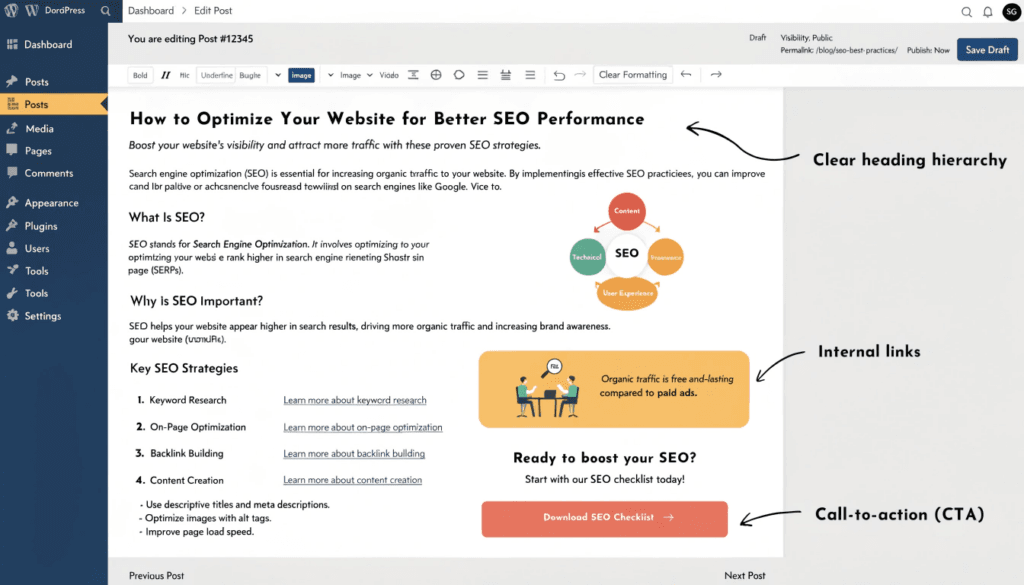
Now you need the content that brings people to your lead magnet. Blog posts are the workhorses here. Each post should target a specific keyword, answer a genuine question in depth, and include a clear, contextual call to action that connects to your lead magnet or a relevant service page.
Great traffic-generating content isn't just keyword-stuffed filler. It's genuinely useful — the kind of thing a reader bookmarks or shares because it actually helped them. The more useful your content is, the more Google rewards it with rankings, and the more prospects trust you when they arrive at your site.
For help making sure your website is structurally set up to support this kind of content, our SEO services can make a significant difference.
7. Publish, Promote, and Update
Publishing your content is not the finish line — it's the starting point. Once a post is live, promote it through your social channels, your email list if you have one, and anywhere else your audience spends time. A single blog post shared at the right moment to the right audience can generate immediate enquiries, not just long-term search traffic.
Equally important: go back and update your content regularly. An article that ranked well for two years can lose ground quickly if it becomes outdated. Refresh statistics, add new examples, update any references that are no longer current, and republish. Existing content that's been updated consistently outperforms newly published content in many cases.
How to Measure Whether Your Content Is Generating Leads
This is the step most guides miss — and it's arguably the most important. If you can't measure it, you can't improve it.
At a minimum, you should be tracking:
Organic traffic. How many people are arriving at your content from search engines? Google Search Console (free) shows you which pages are getting impressions and clicks, and for which search terms.
Time on page and scroll depth. Are people actually reading your content, or bouncing immediately? Google Analytics 4 can show you this. If people are leaving within 10 seconds, the content isn't connecting.
Form completions and enquiries. Are visitors from your blog posts actually submitting enquiries? Set up goal tracking in GA4 so you can see which pieces of content are driving the most conversions — not just the most traffic.
Lead magnet downloads. If you have a gated resource, track how many people are downloading it and where they're coming from. This tells you which content is doing the best job of driving lead capture.
For more detail on getting your web design and content set up to convert, it's worth making sure your site pages are built for the conversion journey, not just the click.
Conclusion
Content marketing is not a quick win — but for small businesses willing to invest consistently in it, it's one of the most reliable and cost-effective ways to generate leads over the long term. The businesses that do it well aren't necessarily producing the most content. They're producing the right content, for the right audience, with a clear path from "visitor" to "enquiry."
Start with your audience. Build both the traffic-generating content and the lead-capturing assets to complement it. Measure what's working, update what isn't, and treat your content as the long-term business asset it genuinely is.
If you'd like to see how your site is currently performing as a lead generation tool, run a free SEO audit — it takes under a minute and will show you exactly where the gaps are.