When a homeowner's boiler starts leaking at 10pm, they are not asking friends for recommendations or flicking through a trade directory. They are on their phone typing "emergency plumber near me" and calling whoever appears at the top of the results. If your business is not visible in that moment, that job goes to a competitor.
That is exactly why local SEO for plumbers is one of the most valuable investments you can make in your business. Unlike Google Ads, where you stop appearing the moment your budget runs out, local SEO builds a permanent foundation of visibility that compounds over time. Done properly, it keeps your phone ringing without ongoing ad spend.
This guide covers everything you need to get your plumbing business ranking in your local area, from Google Business Profile optimisation to citation building, reviews, and content strategy.
What is Local SEO for Plumbers?
Local SEO is the practice of optimising your online presence so that your plumbing business appears when people in your area search for services like yours.
When someone types "plumber in [town]" or "boiler repair near me" into Google, the results they see are not just a list of websites. Google shows three components:
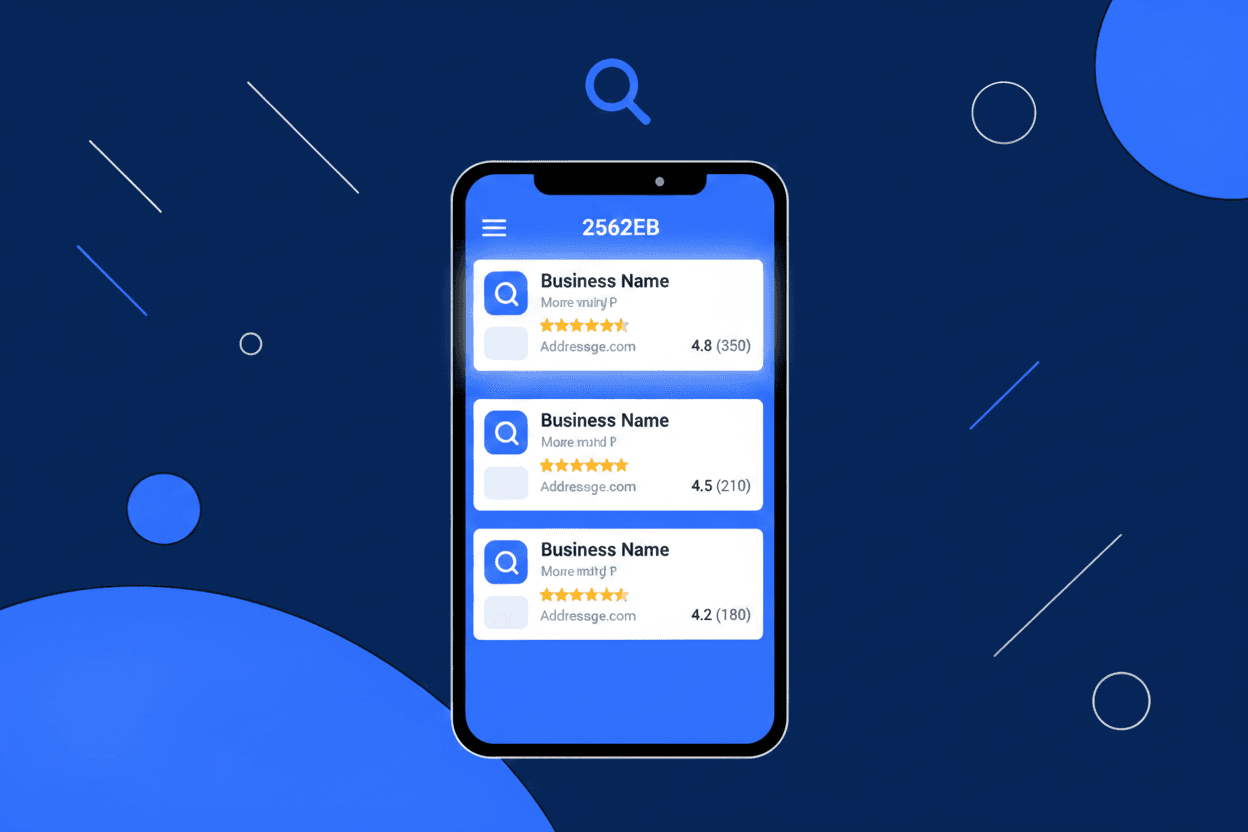
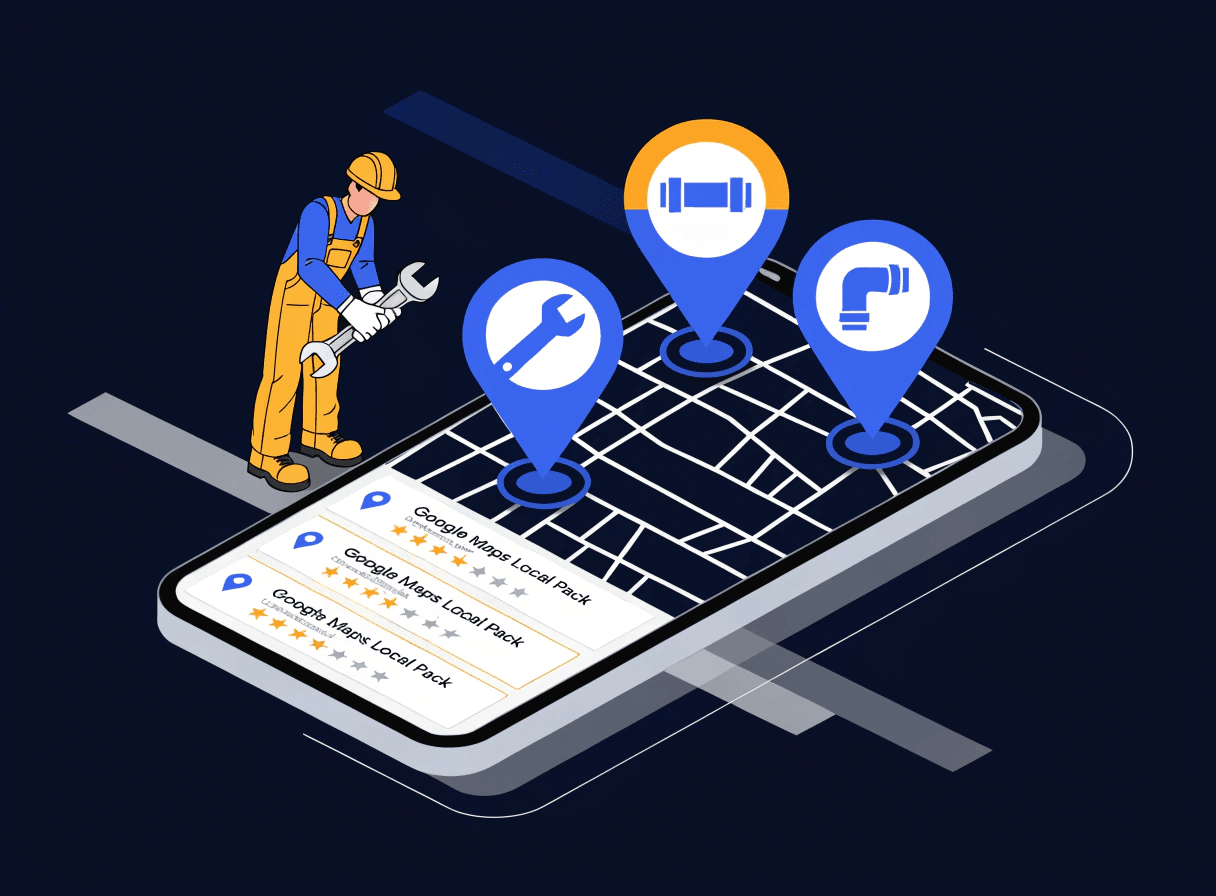
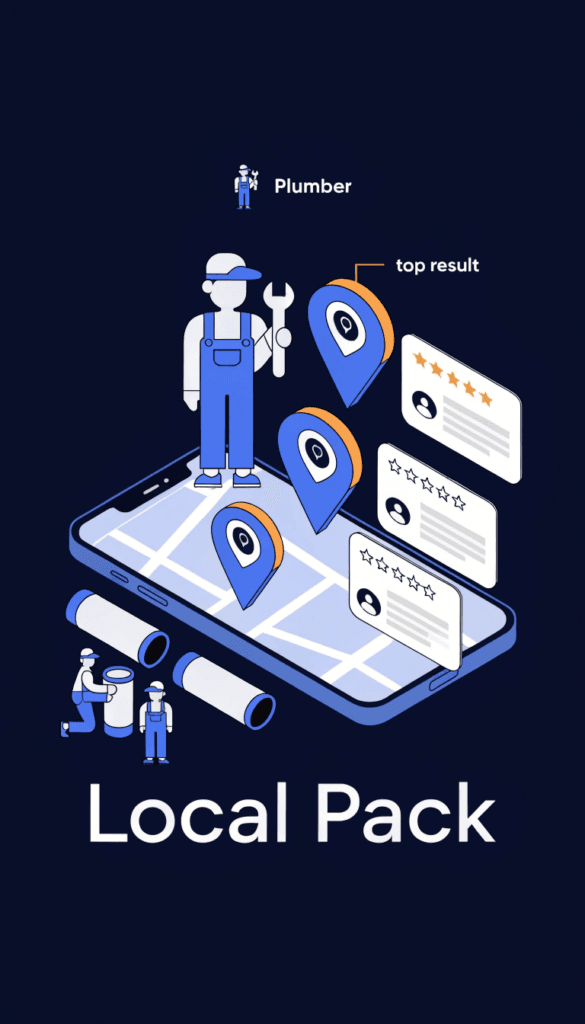
- The Local Pack. This is the map with three business listings that appears at or near the top of the page. It is prime real estate and where most clicks go.
- Local organic results. These are the regular blue-link results below the map, which also factor in your location.
- Google Maps. A separate surface where people search directly for local businesses, especially on mobile.
Appearing in the Local Pack alone can transform the volume of calls you receive. Businesses that show up in those top three map positions capture the majority of clicks for local searches, particularly on mobile where plumbing leads most often originate.
Local SEO is different from general SEO because it focuses on signals that tell Google you serve a specific geographic area. Your address, service areas, citations, reviews, and location-specific content all contribute to how prominently Google shows your business.
Why Local SEO Matters More Than Paid Ads for Plumbers
Google Ads can generate leads quickly, and I do recommend them in the right circumstances. But for most plumbers, local SEO delivers a better long-term return on investment for one key reason: the leads compound.
Once your Google Business Profile is optimised, your citations are consistent, and you have a steady flow of reviews coming in, your local rankings tend to hold and gradually improve. This happens without you paying per click. A well-optimised profile and website keep working in the background while you are out on jobs.
There is also a trust factor. Many homeowners scroll past the paid ads at the top of Google and look specifically for the map results or the organic listings beneath them. Appearing there signals that Google has independently validated your business, which builds credibility before a customer has even clicked through to your site.
Paid search and local SEO work well together, but if you can only invest in one, local SEO builds an asset that lasts. You can read more in my guide to Google Ads for trades if you want to understand how both channels can work alongside each other.
Step 1: Optimise Your Google Business Profile
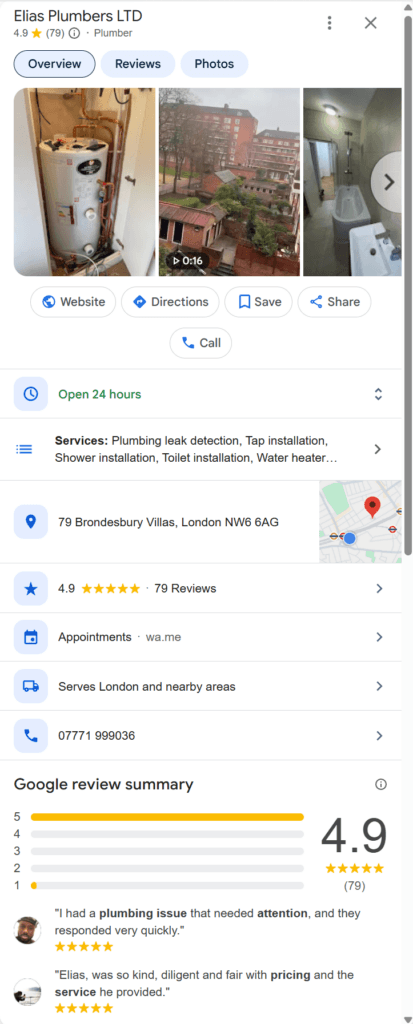
Your Google Business Profile (GBP) is the single most important factor in your local search visibility. When someone searches for a plumber nearby, Google pulls results primarily from GBP data. An incomplete or unclaimed profile is directly costing you calls.
Claiming your profile is free and takes less than 30 minutes. Here is what to do:
- Go to google.com/business and sign in with your Google account.
- Search for your business name. Claim it if it already exists; create a new listing if it does not.
- Complete verification. Google may ask for a postcard, phone call, or short video.
- Fill in every available field without exception.
What to complete on your profile
| Field | Guidance |
|---|---|
| Business name | Use your exact trading name with no keyword stuffing |
| Address | Your registered business address, or set a service area if you work from home |
| Phone number | Your primary business number, which must match everywhere online |
| Website | Link to your homepage or the most relevant service page |
| Hours | Keep these accurate and update them for bank holidays |
| Categories | Primary: Plumber. Add relevant secondaries such as Drainage Service, Boiler Installation, Emergency Plumber |
| Business description | 750 characters to include your main services and the areas you cover naturally |
| Services | List every service you offer individually, from boiler repairs and leak detection to drain unblocking and bathroom fitting |
| Photos | Upload at least 10 images including your van, team on site, completed jobs, and before-and-after work |
Keeping your profile active
Google rewards active profiles. Post updates at least once a week using Google Posts, whether that is a seasonal offer, a recent job highlight, or a practical tip relevant to the time of year. Respond to every review. Answer questions in the Q&A section before customers need to ask them.
Profiles with photos receive significantly more direction requests and website clicks than those without. Upload new photos regularly, not just when you first set up the profile.
Step 2: Build Consistent Citations
A citation is any mention of your business name, address, and phone number (NAP) online, whether on directories, review sites, or other local platforms. Citations help Google verify that your business is legitimate and that you serve the location you claim.
The critical rule with citations is consistency. If your business is listed as "Smith Plumbing Ltd" on your website but "Smith Plumbing" on Yell and "Smith Plumbing & Heating" on Checkatrade, Google struggles to confirm these are the same business. Inconsistencies weaken your local rankings.
Before building new citations, audit the ones you already have. Search your business name and check every listing you can find. Correct any that have outdated phone numbers, old addresses, or name variations.
Key directories to be listed on
For UK plumbers, priority citation sources include:
- Google Business Profile (the most important by far)
- Yell.com
- Checkatrade
- TrustATrader
- Rated People
- Yelp UK
- Facebook Business Page
- Bing Places
- Apple Maps
Your business name, address, and phone number must be identical on every single one. Read my guide to directory sites for plumbers for a more comprehensive breakdown of which platforms are worth your time.
Social media as a citation signal
Your Facebook Business Page, Instagram profile, and any other social accounts also contribute citations when they include your NAP. Maintain accurate contact information on these even if you do not post regularly. The citation value comes from the consistency of the data, not from how often you post content.
Step 3: On-Page SEO and Local Keyword Targeting
Your website needs to clearly signal to Google which services you offer and where you offer them. This is where on-page SEO comes in.
Find the keywords your customers are using
Start with the searches that indicate someone is ready to book. For plumbers, these are often:
- Emergency plumber [town]
- Plumber in [town]
- Boiler repair [town]
- Drain unblocking [town]
- Bathroom fitting [town]
Tools like SE Ranking let you enter a competitor's domain and see which keywords they are ranking for in your area, which is one of the fastest ways to identify opportunities you are missing. Google Keyword Planner is also free and useful for understanding search volume.
Do not ignore long-tail searches. "Emergency plumber in [town] available now" has less competition than "plumber [town]" and is often searched by people with a very specific, urgent need. These are exactly the kind of jobs plumbers want to win. You can read more about why these matter in my post on long-tail keywords.
Optimise your key pages
Each service page on your website should target a specific keyword. The fundamentals are:
- Include the keyword in the title tag, ideally near the front
- Write a compelling meta description that includes the keyword and your location
- Use the keyword naturally in the H1 and at least one H2
- Include your town or city name in the page content naturally
- Add your NAP to the footer of every page so it appears site-wide
If you are using WordPress, a plugin like SEOPress makes managing title tags and meta descriptions straightforward, with no coding required.
Local schema markup
Schema markup is code you add to your website that tells Google structured information about your business: your address, phone number, opening hours, the services you offer, and your service area. It does not change what your website looks like to visitors, but it helps search engines understand and trust the information on your pages.
For plumbers, the most useful schema types are LocalBusiness (specifically Plumber) and Service schema on individual service pages. If you are on WordPress, SEOPress handles this automatically once you configure your business details.
Step 4: Build a Reviews Strategy
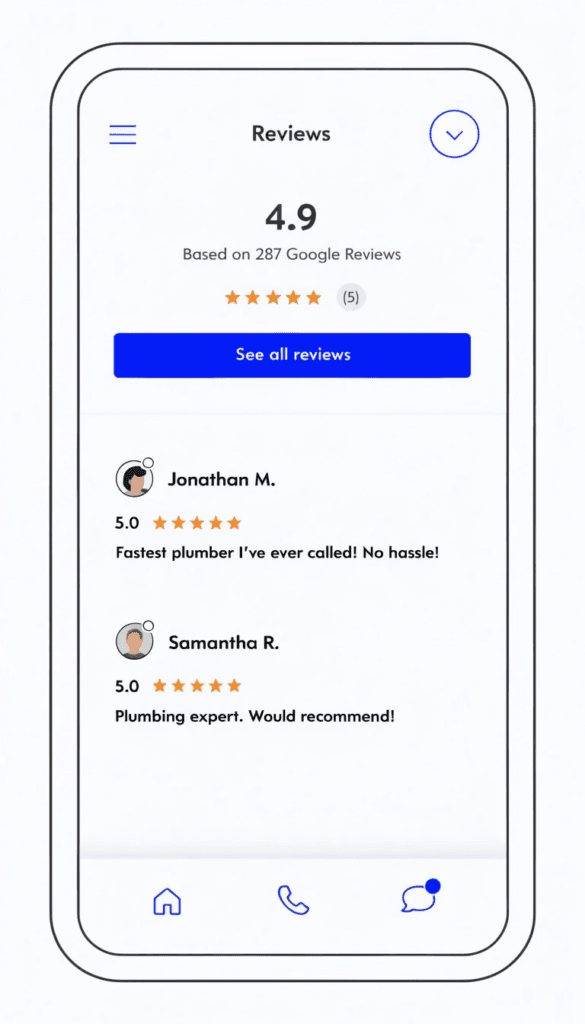
Reviews are one of the most significant factors in Local Pack rankings, and they directly influence whether people choose to call you after finding you on Google. A profile with 12 reviews and a 4.2-star rating will almost always lose out to a competitor with 80 reviews and a 4.7-star rating, even if the underlying quality of work is identical.
The problem is that most plumbers rely on happy customers to leave reviews voluntarily. Most do not, not because they are unhappy, but because it simply does not occur to them.
You need a systematic process for asking. The best time to request a review is immediately after completing a job well, when the customer has just seen clean, tidy work and the relief of a fixed problem is fresh. A simple text message or WhatsApp with a direct link to your Google review page makes it as easy as possible.
Here is a straightforward follow-up template you can adapt:
"Thanks for having me out today, really glad we got that sorted for you. If you have a moment, a Google review would mean a lot to us. Here's the link: [direct link to your GBP review page]"
Respond to every review you receive, both positive and negative. Responses to negative reviews are particularly important because potential customers read them to judge how you handle problems, not just whether problems occur.
Step 5: Create Supporting Content and Service Area Pages
Your Google Business Profile and citation building will only take you so far. To rank across a wider range of searches, and particularly to rank in towns and areas beyond your immediate address, you need supporting content on your website.
Service area pages
If you serve multiple towns or postcodes, a dedicated page for each location is one of the most effective ways to rank in those areas. A page titled "Plumber in [Town]" with genuine content about your services in that area gives Google a clear signal that you serve those customers.
The key word is genuine. Thin pages that just swap a town name into a template are increasingly ineffective and can actually harm your rankings. Each location page should include:
- A specific mention of the area and why you serve it
- The most common plumbing jobs in that type of property or area
- Testimonials from customers in that location where possible
- Your contact details and a clear call to action
Blog content
A blog is not just about traffic for its own sake. A well-targeted post that answers a question your potential customers are asking helps your website rank for more search terms and builds authority in Google's eyes.
Useful blog topics for plumbers include:
- How to find a reliable plumber in [town]
- What to do when a pipe bursts
- How much does a new boiler cost in 2026?
- Signs you need to replace your boiler
- How to deal with a blocked drain
Each of these attracts a different kind of searcher: some at the research stage, some in an emergency. All of them are the kind of person who could become a customer.
If you want a fuller picture of the marketing landscape for plumbers, my complete guide to digital marketing for plumbers covers how SEO, paid ads, and content all fit together.
Step 6: Track Your Local SEO Performance
There is no point investing time in local SEO if you do not know whether it is working. Tracking lets you identify what is improving, what needs more work, and where your leads are actually coming from.
The key tools to use are free:
Google Search Console connects to your website and shows you which search terms are generating impressions and clicks, which pages are ranking, and whether Google has identified any technical issues with your site. Set it up if you have not already. It takes about 10 minutes.
Google Business Profile Insights is built into your GBP dashboard. It shows you how many people have viewed your profile, how many clicked through to your website, how many requested directions, and how many called you directly from the listing. This data is particularly useful for tracking whether your profile optimisation is working.
A rank tracking tool like SE Ranking lets you track where your website appears in search results for specific keywords over time. Watching a keyword move from page three to page one over several months is the clearest evidence that your SEO work is producing results.
Track your results at least monthly. Local SEO for plumbers typically takes three to six months to show meaningful movement, but once rankings improve they tend to hold and compound.
How Much Does Local SEO for Plumbers Cost?
The cost of local SEO depends on several factors: how competitive your local market is, how wide an area you want to cover, and what is already in place on your website and profiles.
As a general guide:
- In a small town or rural area with limited competition, a relatively modest monthly investment combined with a strong GBP and consistent citations can be enough to rank well.
- In a city like London, Manchester, or Birmingham, the competition is significantly higher and a more sustained investment is typically required.
- The more services you want to rank for and the more locations you want to target, the more content and ongoing work is involved.
Be wary of very cheap SEO packages that promise fast results. Tactics like buying links or mass-generating thin content can produce short-term rankings but carry a real risk of a Google penalty that damages your visibility for months or years.
A reputable SEO provider should be able to explain clearly what work they are doing each month, show you progress through data rather than vague assurances, and tie their activity to results that matter to your business: calls, form submissions, and booked jobs.
If you would like to understand what professional SEO support looks like and whether it is the right fit for your business, take a look at our SEO services for small businesses for more detail.
Frequently Asked Questions
How long does local SEO take for a plumbing business?
Most plumbers start seeing meaningful movement in their local rankings within three to six months of consistent effort. GBP optimisation and citation building can produce improvements more quickly than organic rankings, sometimes within a few weeks. Building content and earning backlinks takes longer but produces the most durable effect.
Can I do local SEO myself or do I need an agency?
You can do a significant amount yourself. Setting up and optimising your GBP, building citations, and asking customers for reviews costs nothing but time. Where most plumbers find it harder to keep up is with ongoing content creation and technical website work. Whether you bring in a professional depends on how much time you have and how competitive your local market is.
What is the Google Local Pack?
The Local Pack is the set of three business listings with a map that appears near the top of Google search results for local queries. It is one of the most valuable positions in local search because it sits above most organic results and is visible before users scroll. Appearing in the Local Pack typically requires a well-optimised GBP, consistent citations, and a healthy volume of positive reviews.
Do social media profiles help with local SEO?
Directly, social media has a limited impact on your Google rankings. Indirectly, it helps by creating additional citations (especially when your NAP is consistent across platforms), generating referral traffic to your website, and earning links when you share content that others reference. It is worth maintaining accurate business information on your key social profiles even if you are not actively posting.
Conclusion
Local SEO for plumbers is not a quick fix, but it is one of the most reliable ways to build a consistent flow of leads without ongoing ad spend. The fundamentals are not complicated: claim and optimise your Google Business Profile, get listed consistently in the right directories, build a steady stream of reviews, and create content that demonstrates you serve your local area.
Done consistently over six to twelve months, these strategies put your business in front of customers at the exact moment they need a plumber, which is precisely when they are most likely to call.
If you are not sure where your website currently stands, run a free SEO audit. It takes under a minute and gives you an immediate picture of what is working and what needs attention.