Most roofing companies I come across rely on the same two or three channels: Checkatrade or Bark, word of mouth, and the odd Facebook post. That's not necessarily a bad starting point, but it has a specific weakness. When three to six roofers all receive the same enquiry from a lead site at the same time, the homeowner ends up with several similar quotes and often picks the cheapest, not the best. If every one of your leads arrives that way, you're competing on price by default, whether you meant to or not.
This article is part of my guide to marketing for tradespeople.
There's a deeper reason marketing matters more for roofing than for a trade you might call on repeatedly. Most homeowners only need a roofer once or twice in their entire lifetime, there's rarely a relationship to build on the way there might be with, say, a boiler service. That makes your first impression, your Google profile, your reviews, and your photos, disproportionately important, because for most customers, it's the only impression they'll ever form of you. This guide covers the channels that actually work for roofing, and how to use them without wasting budget.
Build the Foundation First: Google Business Profile and Local SEO
Before spending anything on paid advertising, make sure your Google Business Profile and local SEO are solid. These are free, and for a genuinely local trade like roofing, they generate a steady stream of enquiries at close to zero cost per lead, with conversion rates well above most paid channels once they're properly optimised. I've covered exactly how to set this up in SEO for Roofers: A Practical Guide.
Paid channels below work best layered on top of this foundation, not instead of it.
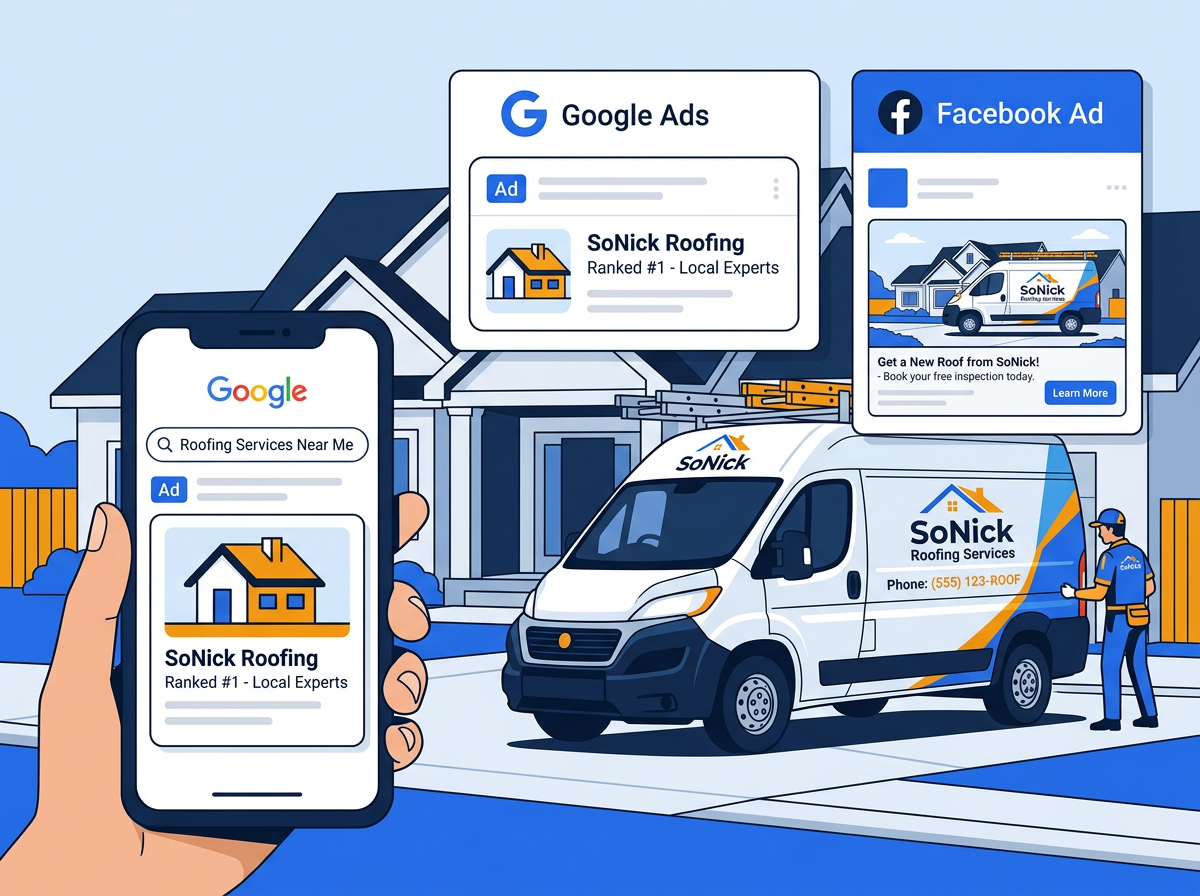
Google Ads: Fast Visibility for High-Intent Searches
Google Ads puts you directly in front of people actively searching for a roofer right now, which makes it particularly effective for two roofing-specific scenarios.
Emergency and storm-driven searches. After a storm or period of heavy rain, searches for "emergency roof repair" and "roof leak repair near me" spike sharply. Being visible at the top of results in that window, when organic rankings haven't caught up to the sudden demand, can win jobs that would otherwise go to whoever ranks organically.
Planned project searches with clear commercial intent. Terms like "re-roofing cost" or "new roof quote" indicate someone close to booking. These are worth a higher bid than broader, vaguer terms.
Structuring and managing this properly is exactly what my Google Ads management service does for trade businesses. A few things that make roofing campaigns perform better specifically:
- Tight geographic targeting matched to where you genuinely travel for work, not an aspirational radius.
- Negative keywords early, excluding terms like "roofing course," "DIY roof repair," and "roofing jobs" that will burn budget without converting.
- Conversion tracking on calls and form fills, not just clicks, so you can see which keywords are actually generating enquiries.
Facebook and Social Proof
Facebook isn't where most homeowners start searching for a roofer, but it's effective for reaching people before they start searching, and for the kind of visual proof that roofing work lends itself to particularly well.
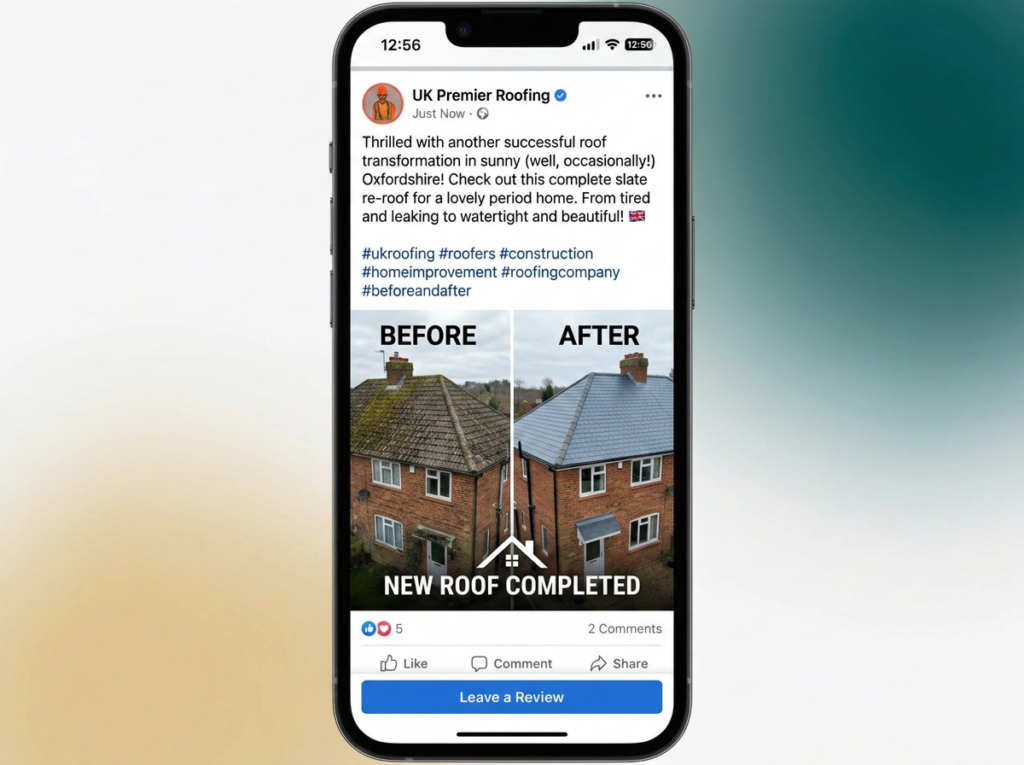
Before-and-after photos of completed re-roofs and repairs consistently outperform generic graphics or stock imagery, and for roofing specifically, one well-lit photo of a finished job will often generate more genuine interest than a paid ad. Roofing is inherently visual work, and homeowners respond to seeing real, local jobs far more than they respond to a polished but generic ad. Tag the location when you post, it builds the same local relevance signal that helps your Google Business Profile. Van and team content, short videos or photos of the team working, also builds trust before a homeowner ever picks up the phone.
Retargeting is worth setting up too. Anyone who's visited your website but not enquired is a warm audience, and a retargeting ad showing a relevant project or a genuine testimonial can bring a meaningful share of those visitors back.
Checkatrade, Bark and Directory Listings: Use Them, Don't Depend on Them
Checkatrade, Bark, MyBuilder, and Rated People remain genuinely useful for roofing businesses, particularly for building initial reviews and credibility when you're starting out. The risk is treating them as your entire strategy. Aggregator sites in particular charge per lead and often send the same enquiry to several roofers simultaneously, so you end up competing on price against four or five other companies before you've even spoken to the customer.
Use these platforms to build your review base and pick up incremental work, but treat your own Google Business Profile and website as the channels where you compete on your actual strengths, quality, reliability, and proof of past work, rather than being the cheapest quote in a pile of five.
There's another reason to keep your Checkatrade profile tidy even if it isn't your main source of work. When I tested 10 local searches in ChatGPT, roofer Farnham among them, Checkatrade was cited as a source for 8 of the 10, and trade bodies such as TrustMark were cited too. If you're wondering how AI tools decide which roofer to mention, I've covered how ChatGPT finds local tradespeople.
Reviews: Build Past the Point Where You Blend In
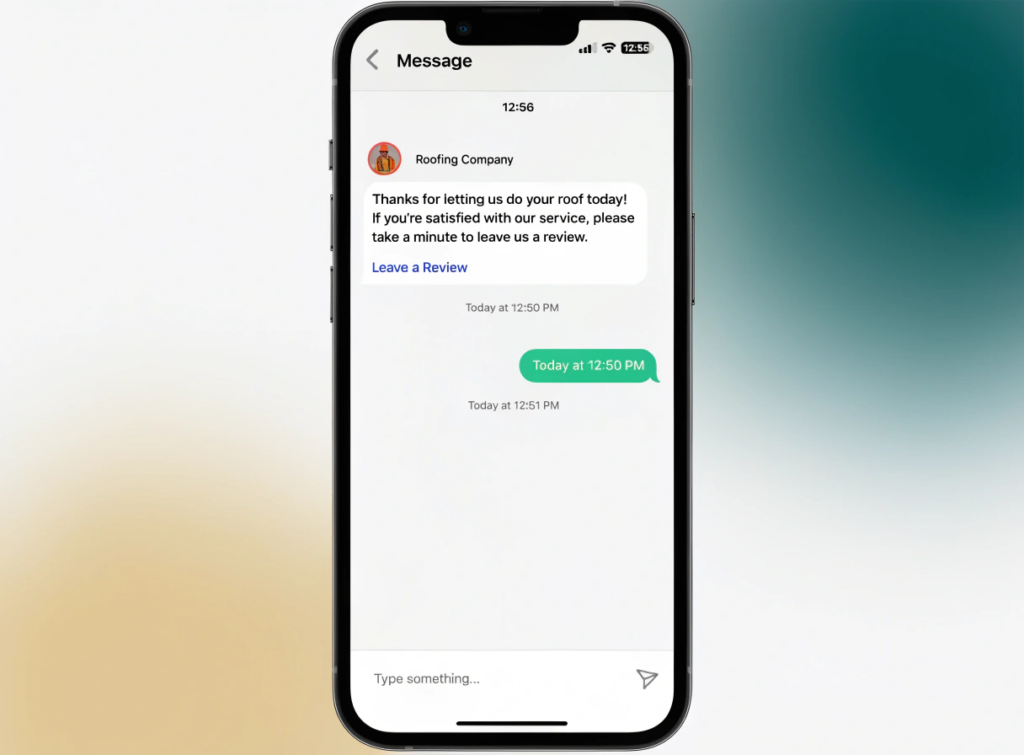
Because most homeowners only hire a roofer once or twice in their life, they lean heavily on reviews to make a decision they can't make from personal experience or repeat custom. A handful of reviews isn't enough to stand out any more, aim for at least 30 genuine reviews before you expect them to meaningfully differentiate you from local competitors, and keep adding steadily rather than stopping once you hit a round number. Ask every satisfied customer directly, ideally by texting a direct review link the same day the job's signed off, and reply to every review you receive, good or bad.
How Much to Actually Spend
As a general guide, most roofing companies should aim to invest somewhere in the region of 5 to 10% of turnover in marketing, split across the free foundations (Google Business Profile, local SEO) and paid channels (Google Ads, Facebook) in whatever proportion matches your current visibility gaps. A business with strong organic local rankings already can lean more heavily on paid ads for growth. A business that's invisible in local search needs to fix that first, since it's the channel with the best long-term return.
Documenting Every Job
The single habit that improves every channel above at once is documenting your work properly. Clear before-and-after photos of every job, or a representative selection if documenting every single one isn't practical, feed your Google Business Profile, your website's project pages, and your social content simultaneously. It's the cheapest, highest-leverage marketing activity available to a roofing business, and it's one most roofers do inconsistently at best.
Quick Wins You Can Do This Week
If you want to move fast rather than plan for months, three things genuinely shift the needle within days: spend half an hour adding ten recent job photos to your Google Business Profile and double-checking your service area and service list; text your last five satisfied customers a direct link to leave a Google review; and post one strong before-and-after photo, tagged with the job's location, to Facebook or Instagram. None of this costs anything beyond time, and together they're a meaningfully stronger starting position than most competitors bother to build.
Bringing It Together
Roofing marketing works best as a layered system: a properly optimised Google Business Profile and local SEO as the free foundation, Google Ads for high-intent and storm-driven searches, Facebook for visual proof and retargeting, and directory listings used deliberately rather than relied upon entirely. None of it needs a large budget to start, but it does need consistency, particularly around documenting work and collecting reviews, since for most of your customers, this is the only impression of your business they'll ever get to form.
For the broader picture of how these channels fit together for trade businesses, see my trades marketing page. If you'd like help building this out for your roofing business, get in touch and let's talk through what's possible.