DIY website builders have come a long way. Platforms like Wix, Squarespace, and WordPress.com will have you looking at a live website within a few hours, often for less than the price of a monthly gym membership. So why would anyone pay a professional hundreds or thousands of pounds to do the same thing?
This article is part of my small business website guide.
The honest answer is: it depends. But the question isn't really "can you build your own website?" Most people can. The question is whether you should. For most small businesses that depend on their website to generate enquiries and revenue, the answer is more nuanced than the DIY platforms would have you believe.
I've built websites for small businesses across the trades, legal, wellness, and ecommerce sectors. Before that, I spent 16 years running trade businesses myself. This guide walks through the decision clearly, without the bias you'd get from a website builder trying to sell you a subscription or an agency trying to inflate the complexity.
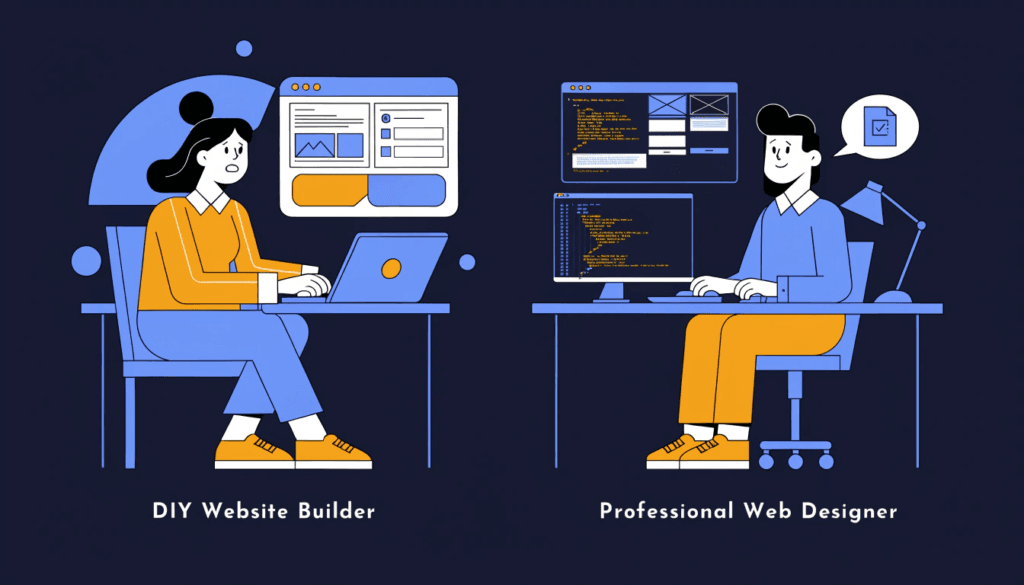
What Kind of Website Do You Actually Need?
This is the first and most important question, because it determines whether a DIY route is even realistic.
A basic brochure site covering your services, your location, and a contact form in a handful of pages is genuinely achievable on a DIY platform. If you're just starting out and testing whether your business idea has legs, getting something live quickly and cheaply makes sense. There is no shame in starting with Wix or Squarespace if budget is tight.
But the moment your website needs to do more than sit there looking presentable, the calculus shifts. If you need any of the following, DIY is likely to cause you real problems:
Ecommerce capability. Selling products online is a lot more involved than adding a shop icon to your homepage. Payment processing, inventory management, tax rules, and product page optimisation all need careful setup.
Appointment or booking systems. A booking tool that works seamlessly, sends confirmations, and integrates with your calendar is not straightforward to configure. Getting it wrong costs you clients.
Complex forms or lead capture. Multi-step forms, conditional logic, CRM integrations, and tracking setups are well beyond drag-and-drop territory.
Client portals or login areas. If your business model requires clients to access anything securely, this needs professional development.
Multiple service areas or location pages. If you're targeting several towns or regions, a proper location page strategy requires planning and technical SEO knowledge that most DIY builders don't support well.
The more functionality you need, the stronger the case for hiring someone who does this every day.
How Much Time Do You Actually Have?
Building a website from scratch takes longer than most people expect, particularly for someone who has never done it before. A polished five-page site built on a DIY platform realistically takes 20 to 40 hours when you account for choosing a template, customising the design, writing the copy, setting up navigation, configuring your domain and hosting, and getting everything looking right on mobile.
That's before you've thought about SEO. Getting the page titles, meta descriptions, headings, and content structure right adds another meaningful block of time. Get these wrong and you'll have a website that looks fine but is virtually invisible on Google.
Then there's ongoing maintenance. Websites aren't static. You need to keep plugins updated, replace expired security certificates, fix things when platforms change, and add new content to stay relevant in search. That work doesn't stop when the site goes live.
Time you spend learning website builders is time you're not spending running your business. For a sole trader or small business owner, that trade-off deserves serious thought.
How Honest Are You Being About Your Skill Level?
This is the point where most people need to be truthful with themselves. Modern website builders are designed to feel intuitive, and they mostly are. The limitations only become apparent once you need to do something the template doesn't support.
Getting a site to look the way you want it, rather than the way the template wants it, often requires overriding CSS, editing HTML, or wrestling with settings that aren't clearly labelled. Mobile layouts frequently need manual adjustment. Images need to be sized and compressed correctly or they'll slow your site down. Fonts, spacing, and colour consistency need careful attention if the site is to look professional rather than like a hurried first attempt.
If you're comfortable with technology, enjoy learning new tools, and are willing to spend time troubleshooting when things don't work as expected, DIY is a reasonable path. If technology tends to frustrate you or you find yourself Googling basic tasks repeatedly, the hours will mount up quickly. The end result may not reflect well on your business either.
How Critical Is Your Website to Your Revenue?
Not every business website carries the same weight. If your site is essentially a digital business card, somewhere for people to confirm you exist before they call you based on a referral, then a DIY build may be perfectly adequate. The stakes are lower.
But if your website is where most of your new business comes from, the calculation changes entirely. A site that fails to rank on Google, loads slowly, isn't mobile-friendly, or doesn't convert visitors into enquiries is actively costing you money every day.
Consider the numbers. If a professionally built website generates even two or three additional enquiries per month that you'd otherwise have missed, it pays for itself many times over. A £1,500 to £2,500 investment amortised over two or three years costs less than most people spend on advertising in a single month.
For trade businesses, service businesses, and any company where the website is a primary source of new customers, cutting corners on the build is a false economy.
What About SEO? This Is Where Most DIY Sites Fall Short
This is the part of the website conversation that DIY platforms consistently underplay, because it's difficult to package into a template.
Search engine optimisation is not an add-on. It's baked into how your website is built. The structure of your pages, the way your headings are nested, your page loading speed, your mobile performance, your internal linking, your title tags and meta descriptions: all of these affect whether Google shows your site to people searching for what you do.
DIY builders have improved their SEO capabilities, but they still carry limitations. Page speed is a common problem. Many builder-created sites load slowly because of the way the platforms render code, and Google's Core Web Vitals actively factor this into rankings. Template-generated code is often cluttered in ways that are invisible to you but visible to search engine crawlers. And the SEO guidance built into most platforms assumes a level of knowledge that most business owners simply don't have.
A professional web designer builds with SEO in mind from the start: clean code, proper heading structure, correctly implemented schema markup, fast load times, mobile-first layouts, and a logical internal linking structure. For businesses where ranking on Google is important, and for most small businesses it is, this technical foundation is the difference between a website that generates leads and one that doesn't.
If you want to understand more about what makes a site rank, my guide to ranking higher on Google covers this in detail.
What Does Hiring a Website Designer Actually Cost in the UK?
This is the question most guides dance around, so I'll be direct about it.
For a UK small business, professional website design typically falls into these ranges:
Freelance web designer: £800 to £3,000 for a standard brochure or service site. Quality varies enormously, so reviews and a portfolio of completed work are essential. A good freelancer can deliver excellent results at the lower end of the professional market.
Small specialist agency (trades, local services, small business focus): £895 to £3,995 for a professionally built, SEO-ready site. At SoNick Marketing, this is where our web design packages sit. We focus specifically on small businesses and build every site with lead generation and search performance in mind from the outset.
Generalist web design agency: £3,000 to £8,000 or more, often with ongoing retainer fees of several hundred pounds per month. Quality can be high, but generalist agencies don't always understand the specifics of your sector and you'll pay accordingly.
DIY platform: £12 to £50 per month ongoing, plus your time. This sounds cheap until you factor in 30 to 50 hours of your own time to build it, ongoing maintenance, and the opportunity cost if the site doesn't generate leads.
The honest conclusion is that for most established businesses, the professional route pays for itself if the site is built correctly. The return on a £1,500 to £2,500 investment is straightforward to justify when a single new customer is worth hundreds or thousands of pounds.
Should You Hire a Designer or Go DIY? A Practical Framework
Here's how I'd frame the decision:
DIY makes sense if: you're in the earliest stage of your business, budget is genuinely the primary constraint, your site is a simple brochure (five pages or fewer), you're comfortable with technology, and your website is not yet a critical source of new customers.
Hire a professional if: your business is established, your website is your main source of enquiries, you need functionality beyond a basic brochure, you want to rank on Google for competitive keywords, or your time is better spent running your business than learning web design.
There is also a middle path worth considering. Some business owners start with a DIY platform to get something live, then invest in a professional rebuild once the business has traction. This is a perfectly reasonable approach. The important thing is to recognise when the DIY site has reached its ceiling and is holding you back rather than supporting your growth.
One thing I consistently see is business owners who built their own site a few years ago, never quite got it working, and have been quietly losing leads to competitors ever since. The site looks functional, but it doesn't rank, it's slow on mobile, and the enquiry form doesn't reliably work. The cost of that invisible problem is almost always greater than the cost of fixing it properly.
Conclusion
Website builders are more capable than they've ever been, and for the right business at the right stage, DIY is a sensible starting point. But for most established small businesses that need their website to generate enquiries consistently, a professionally built site is not a luxury. It's the foundation everything else is built on.
The true cost of a poorly performing website isn't what you spent to build it. It's the enquiries you didn't get, the customers who found a competitor instead, and the months spent wondering why your marketing isn't working.
If you're weighing up whether a professional build makes sense for your business, I'm happy to talk through the options without any pressure. Get in touch and let's look at what your site currently does and what it could be doing instead. You might also want to take a look at our best practices in web design post for a sense of what a well-built site should look like, or explore our web design service to see the packages available.