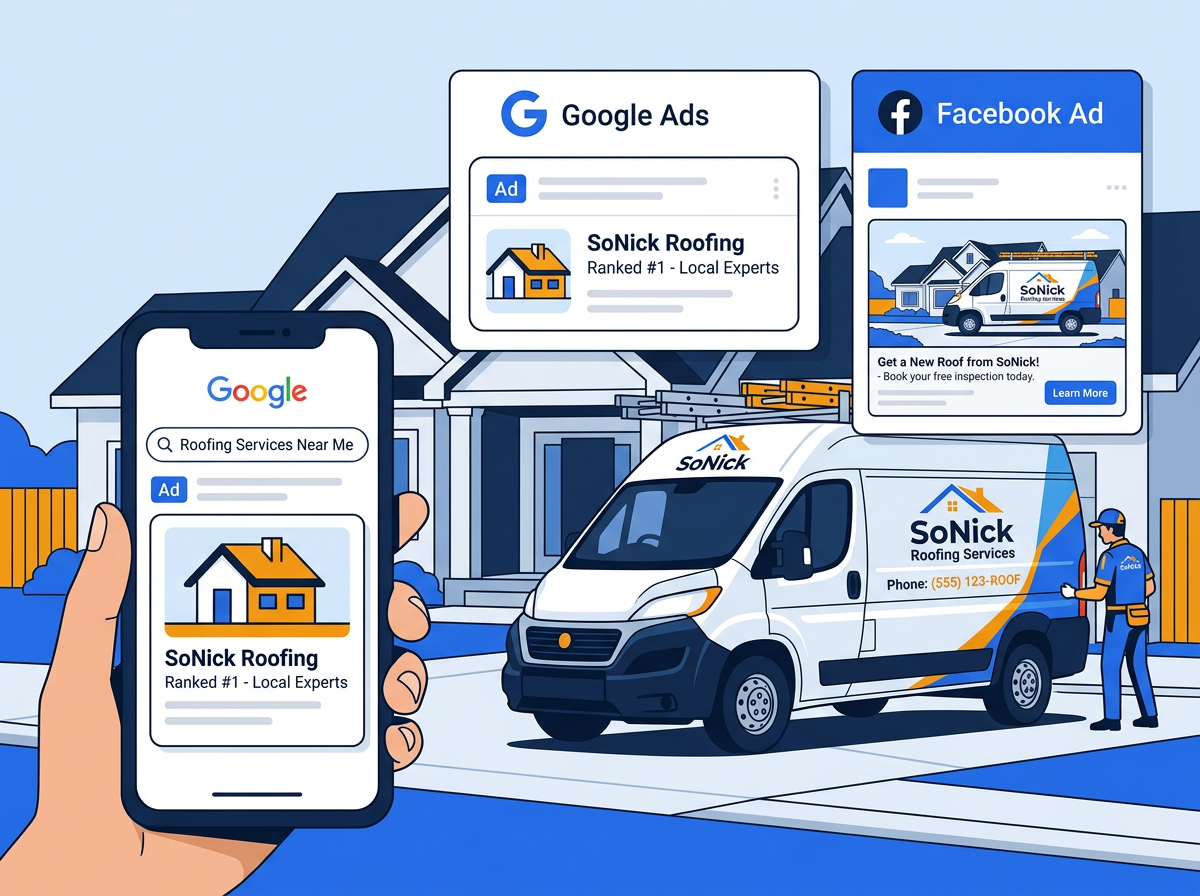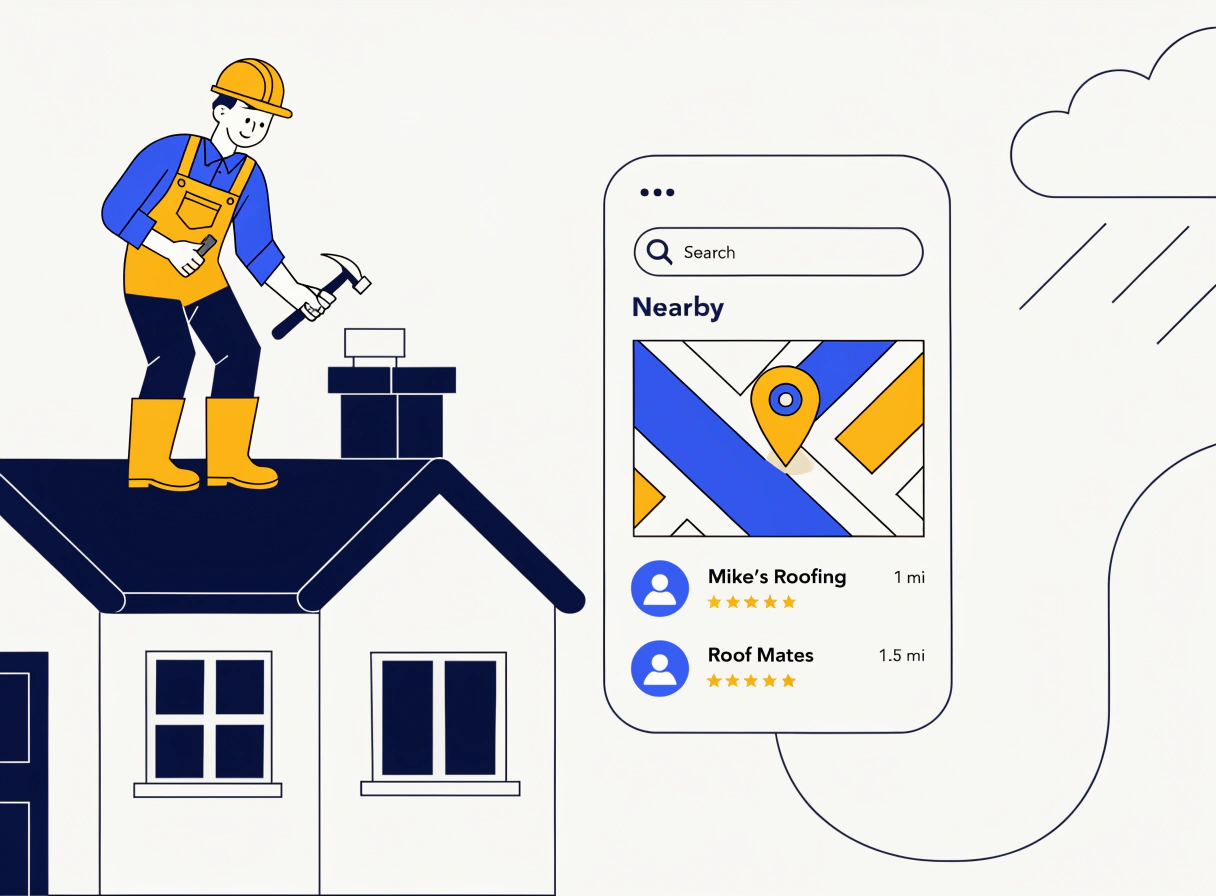
Roofing has one of the most seasonal, weather-driven demand patterns of any trade. After a storm, a Met Office wind warning, or a spell of heavy rain, searches for "emergency roofer," "roof leak repair," and "slipped slate repair near me" spike sharply in exactly the areas affected, and the roofer who's ready in that moment wins the job, often without any other comparison at all. The rest of the year, demand is steadier but more considered, homeowners planning a full re-roof or an extension compare quotes carefully.
This article is part of my small business guide to SEO and my guide to marketing for tradespeople.
I spent 16 years running trade businesses before moving into digital marketing, and roofing's boom-and-bust search pattern is one of the more distinctive things about marketing it well. This guide covers what actually gets a roofing business found, both in the emergency moment and the considered one, and closes with the schema markup and tracking most roofer websites still skip entirely.
Two Very Different Buyers, One Website
Before getting into tactics, it's worth being clear about who you're optimising for, because roofing genuinely has two distinct buyer types.
The emergency searcher has a leak, storm damage, or slipped tiles right now. They're searching on a phone, often in poor weather, and they'll call whoever looks legitimate and answers fastest. Long-form content does nothing for this person. Speed, visible trust signals, and a working phone number do everything.
The planned-project searcher is considering a full re-roof, an extension roof, or a significant repair. They're comparing two or three roofers, checking reviews and photos of previous work, and will often wait days or weeks before enquiring.
Your Google Business Profile serves both. Your website content needs to serve the second group specifically, since the first rarely reads past the homepage.
Be Ready Before the Storm Hits, Not After
This is the single most roofing-specific piece of advice in this guide. When the Met Office issues a wind, rain, or storm warning for your area, search demand for emergency roofing work spikes sharply in that exact patch, often within hours. Scrambling to sort your Google Business Profile, opening hours, and phone availability after the first calls start coming in means you're already behind. Keep your profile accurate, your photos current, and your phone genuinely answered year-round, so you're ready the moment demand jumps rather than reacting to it.
Google Business Profile: Where Most Roofing Leads Actually Come From
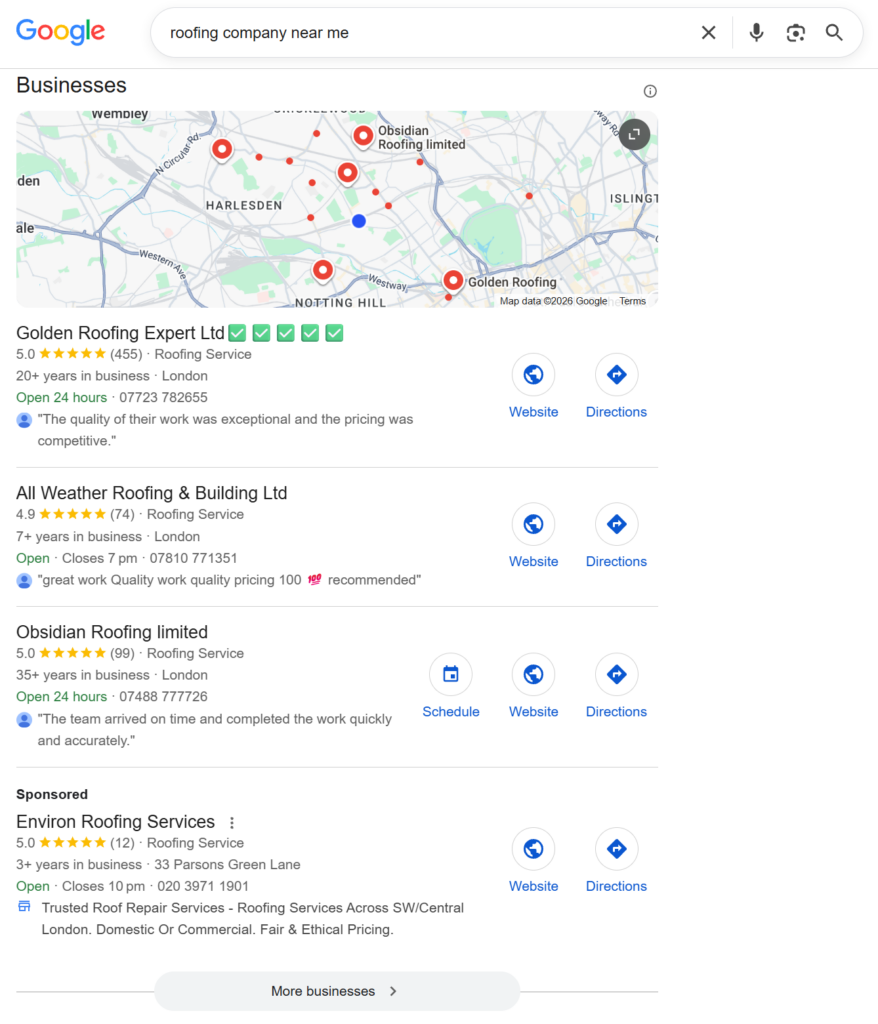
The map pack, the three results with reviews, phone numbers and a map that appear above the standard organic results, is where the large majority of local roofing searches convert, particularly for emergency terms. Getting this right matters more than almost anything else in this guide, and it's the focus of my local SEO service for trade businesses.
Choose the most accurate primary category. "Roofing Contractor" will outperform a generic "Contractor" category for roofing-specific searches. Add genuinely relevant secondary categories like "Gutter Cleaning Service" only if you actually offer that work, padding your categories with unrelated services doesn't impress Google and confuses customers trying to work out what you actually do.
Configure your service area properly, targeting the specific districts you actually cover rather than a broad, unrealistic radius.
Write a keyword-informed business description that naturally covers your core services: re-roofing, flat roofing, repairs, guttering, whatever applies to your business.
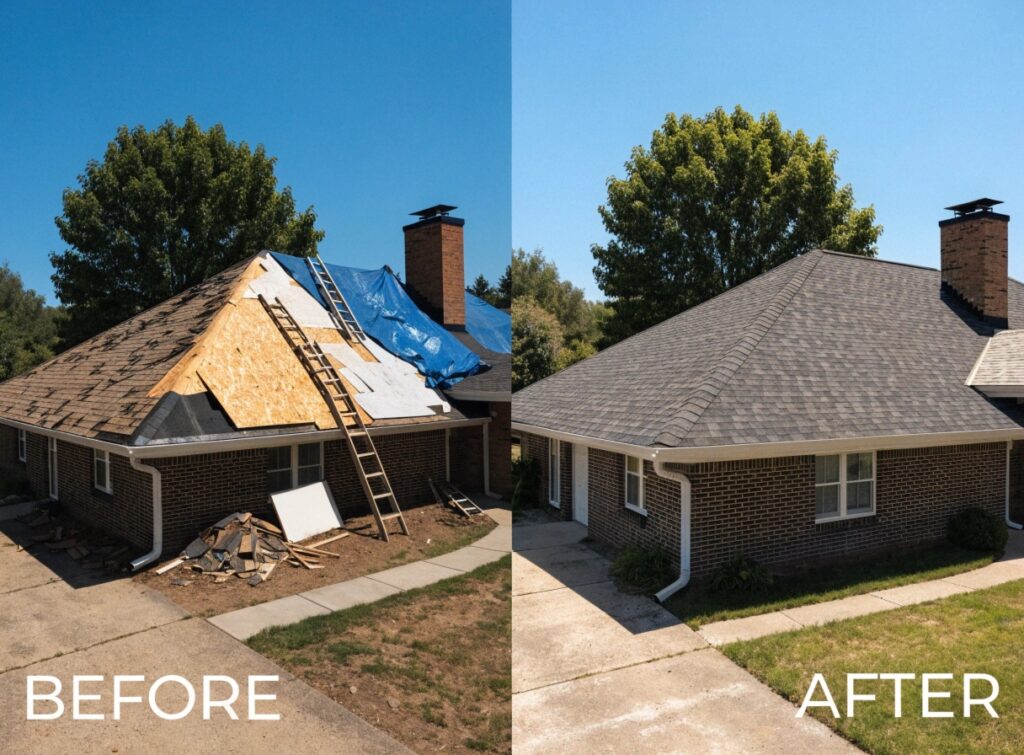
Upload real job photos consistently, and be specific about where. Before and after shots of a finished re-roof or a repaired leak are some of the strongest trust signals available to any trade. Go further where you can: a caption noting a job was "near Heaton Park" or "off the Wilmslow Road" does more to convince both a homeowner and Google that you're genuinely active in that area than a generic "we cover Manchester" ever will.
Keep an actively managed Q&A section and respond to reviews promptly, particularly during storm season when your profile gets far more traffic than usual.
Your profile also shapes what AI tools say about you. When I ran 10 local searches through ChatGPT, roofer Farnham among them, businesses in Google's local pack appeared in ChatGPT's recommendations in 74 of 87 cases, and where it showed star ratings and review counts for those businesses, they matched Google's in 66 of 67. I've covered how ChatGPT chooses which local tradespeople to recommend if you want to be the roofer it names.
Local Citations: Use the Ones People Actually Trust
Local citations, your name, address and phone number listed on other sites, still help, but the goal isn't scattering your details across dozens of low-quality directories. In UK roofing specifically, the citations that carry real weight are the ones homeowners already recognise and check before hiring: Checkatrade, TrustATrader, and Yell in particular, alongside Google Business Profile itself.
Keep your name, address, and phone number identical across every one of these. If you appear as "J Smith Roofing Ltd" on Google, "John Smith Roofing" on Checkatrade, and something different again on Yell, Google has to work harder to confirm it's the same business, and it trusts you a little less for the effort. One detail worth watching if you run call tracking numbers on landing pages: keep your core business number, the one on your Google Business Profile and major directories, stable and unchanged, and use tracking numbers only where they won't create inconsistency in your main listings.
Service Pages Built to Answer the Actual Question
A strong roofing service page reads like a roofer turned up, assessed the problem properly, and explained the fix in plain English, not like generic brochure copy about "quality and craftsmanship." For a page targeting something like "emergency roof repair [town]", structure it around what the homeowner actually wants to know, in this order: what counts as an emergency, what problems you fix, which parts of the area you cover, what happens when they call, how fast they can expect a response, and why they should trust your team. Follow with local proof and photos, a short FAQ section, and a clear call to action.
Avoid the trap of one page trying to cover repairs, new roofs, flat roofs, guttering, fascias and emergency call-outs all at once. Build a proper page per core service, and add location-specific pages only where you can back them with genuine local proof, real jobs, real response times, not a template with the town name changed.
Schema Markup: The Quiet Technical Win Most Roofers Skip
Schema markup is structured code that tells Google exactly what your business is, rather than leaving it to guess from the page text. For a roofer, the useful types are LocalBusiness schema (your name, address, phone and service area), Service schema on each individual service page, and FAQPage schema wrapped around any genuine FAQ section. Beyond helping traditional rankings, well-implemented local schema meaningfully improves your odds of being cited in Google's AI-generated search summaries, which are increasingly where some of your potential customers see a business recommended before they ever click through to a website. Most WordPress SEO plugins, including SEOPress, can generate this markup without custom development.
Project Pages: A Roofer's Strongest SEO Asset
A well-built gallery of completed projects does more for a roofing business's SEO and conversion than almost any other type of content, because it proves real, local experience in a way that generic service copy can't. For each significant project, include the type of work, the general location, before and after photos, and a short description of the problem and how it was resolved. This ranks for job-type-plus-location searches over time, and it's genuinely persuasive to a homeowner comparing quotes who wants to see real, local proof of quality before they commit.
Technical Basics That Matter More During Storm Season
When search volume spikes after a storm, a slow or broken website costs you leads at exactly the moment demand is highest. As a practical benchmark, aim for your key pages to load with a Largest Contentful Paint under 2.5 seconds, most free page speed testing tools will show you this figure directly. Beyond raw speed, test your phone number is genuinely tap-to-call on mobile, and that your contact form doesn't have fiddly fields that fail on a phone mid-emergency.
A Steady Content Rhythm, Not a Single Push
Beyond your service and project pages, a small, consistent flow of content, aim for at least a couple of genuinely useful pieces a month rather than a single burst, builds authority over time and captures searches your service pages won't. The best topics are usually questions you're already answering on the phone: cost questions ("how much does a re-roof cost"), decision questions ("repair or replace a leaking flat roof"), and urgency questions ("what to do after storm damage to your roof"). Each piece should link back to the relevant service page, so it feeds enquiries rather than sitting in isolation. A tool like SE Ranking is useful here for confirming which of these questions genuinely have search volume in your area before you commit time to writing about them.
Tracking What Actually Matters
Rankings alone don't pay the bills, calls and booked jobs do. Track a short list every month rather than drowning in metrics: your rankings for service-plus-town terms that actually bring paying work (not vanity phrases nobody searches), Google Business Profile actions like calls and direction requests, which service and location pages are actually pulling in visitors, and genuine leads from organic search, calls, forms, and quote requests. If you can't currently connect a lead back to the page or search that produced it, fixing that tracking gap is worth doing before spending more on content or links.
For a broader look at how to turn this visibility into actual enquiries once someone lands on your site, see Marketing for Roofing Companies, or my SEO services page for the full approach.
Bringing It Together
Roofing SEO rewards businesses that get the fundamentals right, stay ready before demand spikes rather than scrambling after, and back up their claims with genuinely specific local proof rather than generic coverage claims. An accurate, actively managed Google Business Profile, the citations homeowners actually trust, a proper page per service and area, basic schema markup, and a steady rather than sporadic content rhythm together give you a durable advantage that a templated competitor site can't easily match.
If you'd like to see exactly where your roofing business currently stands in local search, run a free SEO audit, it takes under a minute.