
More homeowners are asking ChatGPT things like "who's a good emergency plumber in Guildford?" instead of typing it into Google. If you are a tradesperson, you have probably also started getting calls and emails from agencies offering to get you "into ChatGPT" for a monthly fee.
This article is part of my small business guide to SEO and my guide to marketing for tradespeople.
Before you spend anything, it is worth knowing what ChatGPT actually looks at. I spent 16 years running a plumbers' merchants before moving into digital marketing, so trades are where I focus, and I wanted real evidence rather than sales talk. So I tested it: I ran local trade searches across Surrey and Hampshire through ChatGPT three times each and compared the results with Google.
What I found is good news for tradespeople who have their basics in order, and it means you almost certainly do not need to pay for anything new.
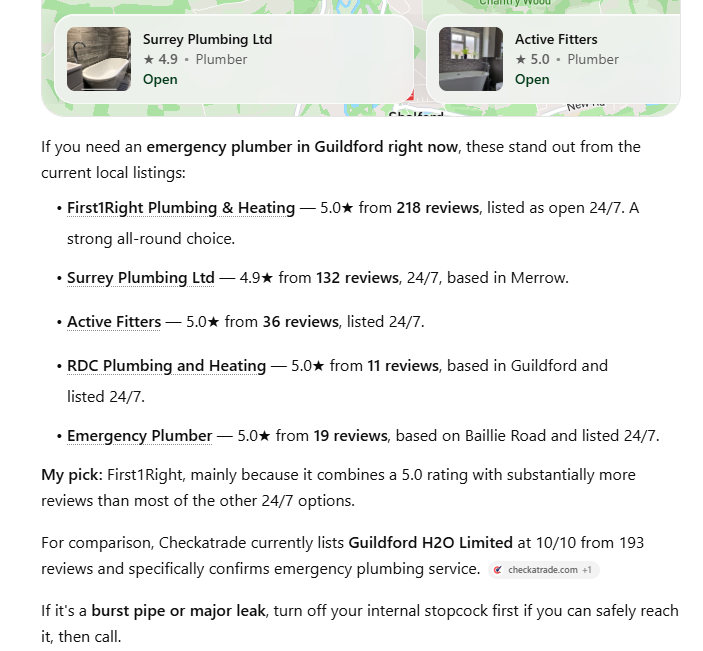
What ChatGPT did when I searched for local trades
The trade searches in my ChatGPT local business study included emergency plumbers in Guildford, boiler repair in Woking, electricians in Basingstoke, roofers in Farnham, builders in Winchester, heat pump installers in Southampton, locksmiths in Reigate and carpet cleaning in Camberley.
Here is what happened, in plain terms.
It showed a list of local businesses, like a map listing. Each business had its address, phone number, star rating and review count.
Those ratings were Google's. Across the whole study, the star rating and review count ChatGPT showed matched the business's Google listing exactly in 66 of 67 cases. Surrey Plumbing Ltd in Guildford showed 4.9 stars from 132 reviews in both Google and ChatGPT.
It recommended the businesses already in Google's map results. Across all 10 searches, ChatGPT recommended 85% of the businesses in Google's top three map results.
It cited trade directories and trade bodies as its sources. Checkatrade was cited for 8 of the 10 searches. For electricians it also cited NICEIC and TrustMark. For boiler repair it cited the Gas Safe Register. For builders it cited the Federation of Master Builders.
It talked about credentials and availability. For the Guildford plumbing search, ChatGPT pointed out which plumbers were listed as available 24/7, and told the user to check that anyone working on a boiler was Gas Safe registered.
It was inconsistent. Only 40% of recommended businesses appeared in all three runs of the same search. For boiler repair in Woking, 30 different businesses appeared across three runs, and one run listed mostly businesses in Nantwich and Crewe.
In other words, ChatGPT built its answers from your Google listing, your reviews, the directories you are on and the trade bodies you belong to. Those are exactly the things good local SEO for tradespeople has always focused on.
The checklist: how to be the tradesperson ChatGPT picks
1. Get your Google Business Profile right
Your Google Business Profile looked like the most important input in my test, because ChatGPT's business list mirrored Google's data so closely.
- Choose the most specific primary category. "Plumber", "Electrician", "Roofing contractor" or "Heating contractor", not a vague catch-all.
- Set your service areas properly. List the towns you actually cover. When ChatGPT got confused about location, it listed businesses well over 100 miles away, so clear location data matters.
- Keep your hours accurate. If you offer emergency call-outs, say so. ChatGPT highlighted plumbers "listed as 24/7".
- Add real photos of your work, your van and your team.
- List your individual services, such as boiler repair, boiler servicing, landlord gas safety certificates and emergency plumbing.
2. Keep the reviews coming
ChatGPT displayed each business's Google rating and review count directly, so a customer comparing options in ChatGPT sees the same numbers they would see in Google Maps.
Build asking for reviews into the end of every job. A text message with a direct link to your review page, sent the same day, works far better than hoping customers remember. Reply to every review, good or bad. I explain the SEO side in how online reviews benefit SEO.
3. Be listed on the directories ChatGPT cites
Checkatrade was cited as a source for 8 of the 10 searches in my test, and TrustATrader, MyBuilder and Yell featured heavily in Google's top results for the same searches.
You do not need to pay for every directory, and I have written about whether paid platforms are worth it in the best tradesperson recommendation sites. But you should at least have accurate, consistent listings on the major ones, with the same business name, address and phone number everywhere. My guide to directory sites for plumbers lists the ones worth prioritising, and most apply to other trades too.
4. Make your trade body registrations visible
ChatGPT cited the Gas Safe Register for boiler repair, NICEIC and TrustMark for electricians, and the Federation of Master Builders for builders. For plumbing it went further and advised the user to check Gas Safe registration.
- Make sure your profile on each trade body's "find a member" directory is complete and uses the same business details as your website.
- Show your registrations on your website, with your Gas Safe or NICEIC number where relevant, ideally linking to your listing on the trade body's site.
- If you are a heat pump installer, keep your MCS certification current and your listings on heat pump installer directories complete. Installer directories were cited for the Southampton search.
5. Build a website that answers "who does this, here?"
Your website is what Google, Bing and ChatGPT read when they want to confirm what you do and where.
- A page for each main service, such as boiler repair, bathroom installation or rewiring.
- Pages for the main towns you cover, written specifically for each area rather than copied with the town name swapped.
- Clear credentials and guarantees near the top of each page.
- Your phone number and service area on every page.
If you are starting from scratch, my trade-specific guides cover the detail: local SEO for plumbers, SEO for electricians, SEO for roofers and SEO for builders.
6. Check nothing is blocking AI tools from reading your site
Some website security settings block AI crawlers. Blocking the ones that collect content for training AI models is fine, but blocking the ones that fetch pages to answer questions stops ChatGPT reading your site when someone asks about you. It is also worth adding your site to Bing Webmaster Tools, which takes about 15 minutes. Whoever manages your website can check both. I set up Bing Webmaster Tools for my SEO clients as standard.
What not to spend money on
If an agency offers to get you "into ChatGPT", here is what to watch out for:
- Monthly AI visibility scores. ChatGPT's answers changed a lot between runs in my test, so a single score does not tell you much. Search for your own services in ChatGPT a few times instead.
- llms.txt files. Google says they neither help nor harm visibility, and no major AI company has confirmed using them. See llms.txt and the other AI SEO myths.
- Guarantees. Nobody controls what ChatGPT recommends.
- Fake reviews or planted forum posts. They can get your listings penalised and your reputation damaged.
I go through the full list in what GEO agencies are really selling you.
How to check where you stand
Try this today. It takes five minutes:
- Search Google Maps for your main service and town, for example "electrician Basingstoke". Note whether you are in the top three.
- Ask ChatGPT the same thing. Then ask again in a new chat, and once more.
- Compare the two. If you are in Google's top three map results, there is a good chance you are appearing in ChatGPT too. If you are not in either, the fix is the checklist above.
Conclusion
For local trade searches, ChatGPT is not a mysterious new search engine with its own rules. In my test it recommended the tradespeople already in Google's map results, showed their Google ratings, and cited Checkatrade and the trade bodies homeowners already trust. That means the tradespeople who get recommended in ChatGPT are the ones who have done their local SEO properly, and it means you do not need to pay extra for it. For the wider picture, see GEO vs SEO.
I work with plumbers, heating engineers, electricians, roofers and builders on exactly this, including Bing Webmaster Tools set-up and ChatGPT visibility tracking. See how I help on my marketing for trades page, or find out more about my local SEO service. If you would rather talk it through, get in touch and I will tell you honestly where your business stands.