If you've ever searched for your own business by the services you offer and not found yourself on the first page, you already know why this matters. Homeowners and facilities managers don't scroll to page two. They call one of the two or three electricians they can see, and if you're not one of them, that work goes to someone else, regardless of how good you actually are.
This article is part of my small business guide to SEO and my guide to marketing for tradespeople.
The good news for electricians specifically is that this is a genuinely winnable niche. Competition for the term "seo for electricians" itself is low, and the practical steps below apply directly to ranking for the searches your customers are actually typing, both in traditional results and in the AI-generated answers taking a growing share of search.
How Google Actually Decides Who Ranks Locally
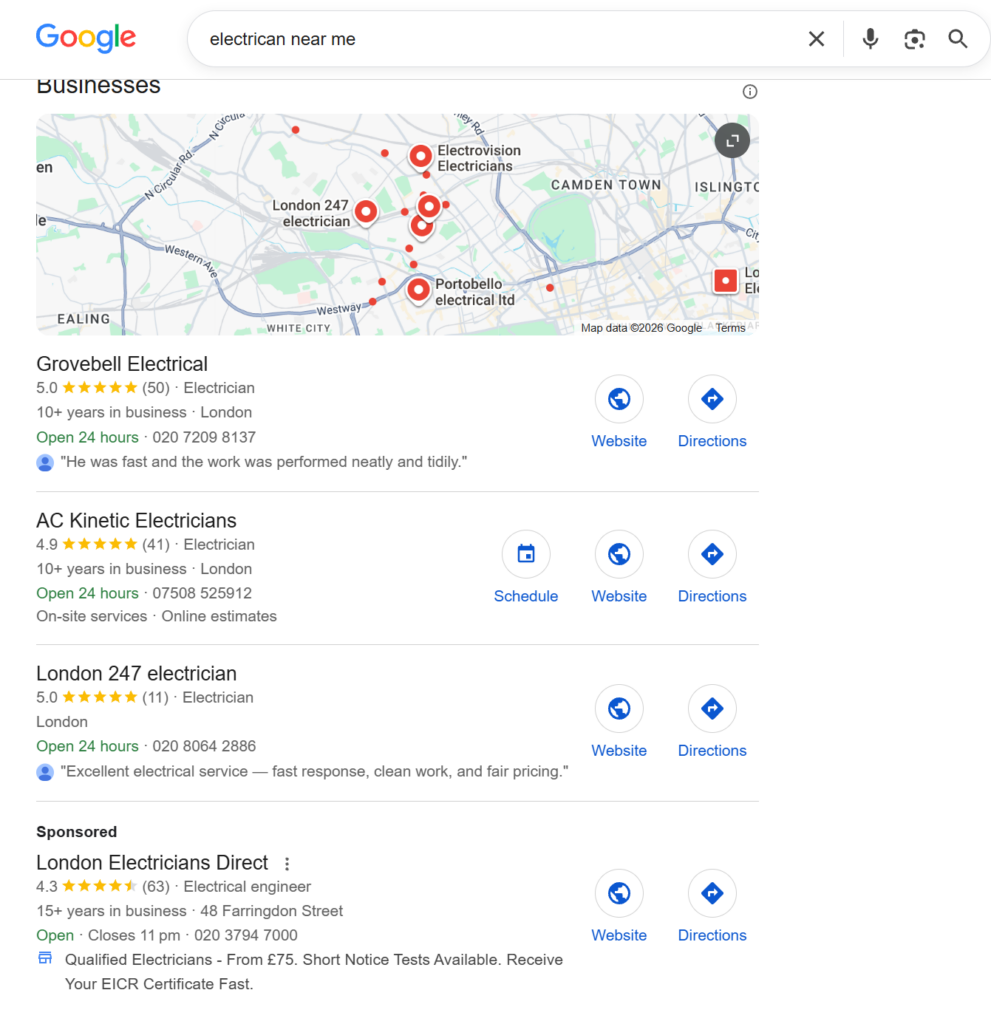
For local results, Google weighs three things: relevance (how well you match the search), proximity (how close you are to the searcher), and prominence (how well known and trusted you are). You can't do much about proximity, that's simply where your business is registered, but relevance and prominence are both won through consistent work, not luck.
Prominence comes from reviews, citations, and genuine local backlinks, the kind of trust signals a lot of electricians overlook entirely in favour of just building a website and hoping. Relevance comes from clear service information, accurate Google Business Profile categories, consistent contact details, and increasingly, structured data that spells your business out clearly to both Google and AI search tools. Get both right and you'll appear in the local map pack and the organic results for the searches that matter, not just one or the other.
Start With the Two Kinds of Search You're Trying to Win
Electrical SEO splits into two distinct targets, and they need different content.
Local pack visibility is about appearing in the three-result map pack for searches like "electrician near me" or "electrician in [town]." This is driven mostly by your Google Business Profile, reviews, and citation consistency, not your website content.
Organic rankings are about your website appearing in the standard results below the map pack, for searches like "consumer unit upgrade cost" or "how much does a rewire cost." This is driven by your website's content, structure, and technical health.
Most electricians focus entirely on one and ignore the other. You need both, and ideally a paid presence too, appearing in the map pack, the organic results, and a Local Services Ad or Google Ad simultaneously leaves very little of the results page for a competitor to occupy. My SEO services page covers how I approach both sides of this for trade businesses if you want the full picture.
Keyword Research: Find What People Actually Search
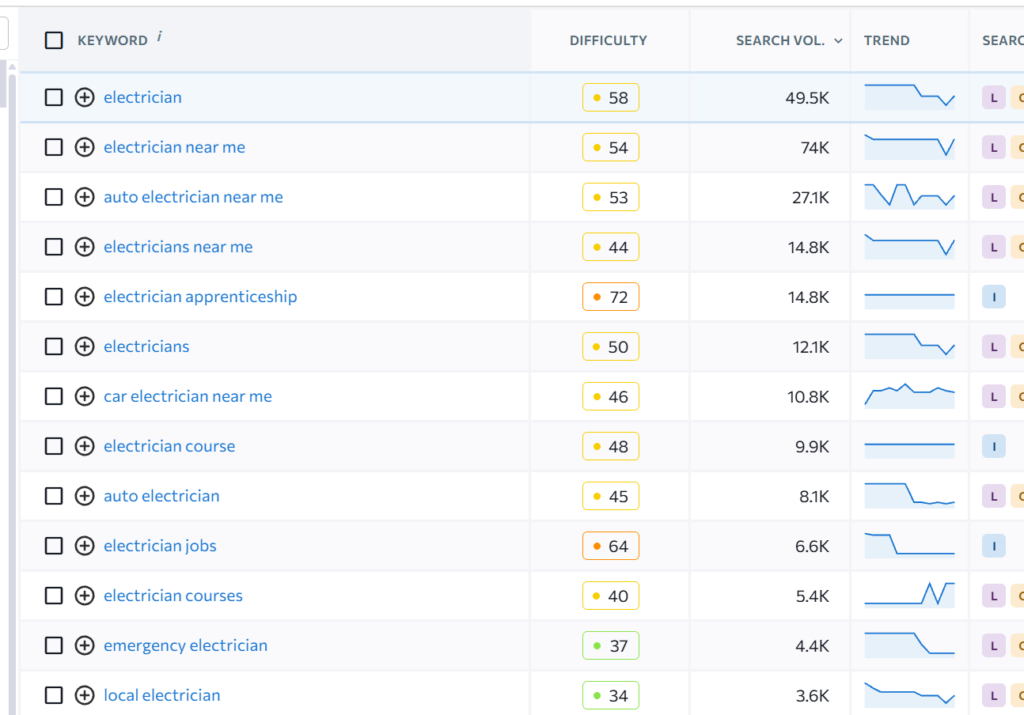
Before writing or restructuring anything, work out the specific terms your customers use. A tool like SE Ranking will show you real monthly search volume for terms in your area, which helps you prioritise service pages by actual demand rather than guesswork. Google's own free Keyword Planner is a reasonable starting point too, type "electrician [your town]" into its keyword discovery tool and it will surface genuine local search patterns.
A few patterns worth knowing before you start:
- Service-specific terms ("EV charger installation," "consumer unit upgrade," "rewire cost") tend to have far more commercial intent than generic terms like "electrician."
- Cost-related searches ("electrician cost UK," "how much does a rewire cost") are high-value even though they look informational, because someone researching cost is close to booking.
- Problem-driven searches ("why does my breaker keep tripping," "why do my lights flicker") aren't ready to book yet, but they're a genuine content opportunity, answer them well and you build the trust that converts them later.
- Emergency terms ("no power in house," "emergency electrician") are high-intent but need to be matched with genuinely fast page load and prominent phone numbers, not long-form content.
- Qualifying modifiers, "certified," "NICEIC," "landlord," "same-day", narrow the intent before someone even clicks, which improves lead quality as much as volume.
A simple way to build your own list without expensive tools: start broad in Keyword Planner with "electrician [your town]", then narrow to a genuine target list built from a service-plus-location formula, "emergency electrician [town]", "consumer unit upgrade [town]", "EICR [town]", "EV charger installation [town]", "rewire cost [town]", "fault finding [town]". Start with the lower-competition end of that list while your site is new, and go after the harder, higher-volume terms once you've built some genuine authority. Confirm real demand with Google Search Console once pages are live, it shows you what people are already finding you for, which is more reliable than any third-party estimate.
On-Page SEO: Build a Page Per Service
The single biggest structural mistake I see on electrician websites is one page trying to cover everything: rewires, EV chargers, fault finding, testing, all crammed onto a single "services" page. Google, and your customers, respond better to focused pages, one clear outcome per page.
For each core service, build a dedicated page that covers:
- What the service involves, in plain language, not trade jargon.
- Typical cost range, even a rough bracket. Hiding pricing entirely pushes people to a competitor who's more transparent.
- How long the job typically takes.
- What certification or compliance it involves (Part P, BS 7671, EICR), which builds trust and signals genuine expertise to Google.
- A short FAQ section in genuine question-and-answer format. This is worth doing properly rather than as an afterthought, it captures long-tail searches, and it's precisely the format Google's AI Overviews tend to pull from when answering a related question.
- A clear call to action, a phone number and a simple enquiry form, not buried at the bottom of the page.
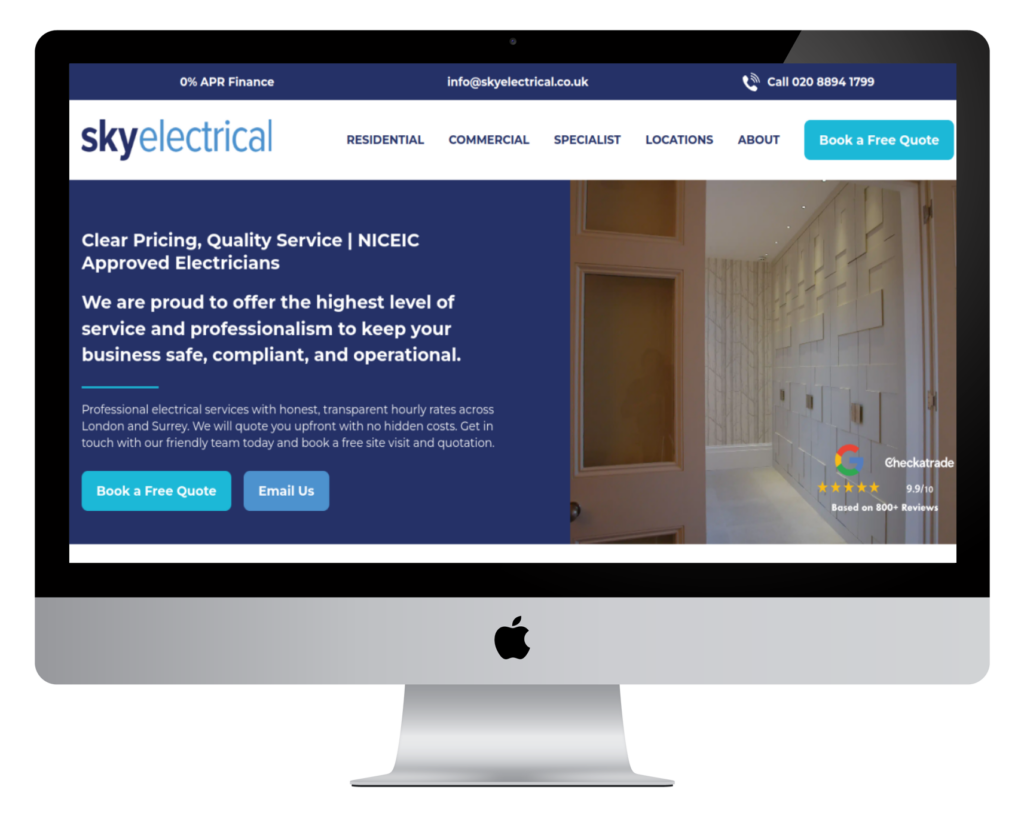
Title tags and meta descriptions should include the service and your location naturally, "EV Charger Installation in [Town] | [Business Name]" rather than a generic title repeated across every page. Internal linking matters more than most electricians realise too: link your EICR page to your consumer unit and landlord compliance pages so a visitor, and Google, can see the natural next step.
If you cover several distinct towns, build a genuinely unique page for each rather than the same template with the town name swapped in. Thin, duplicated location pages tend to do more harm than good, both to rankings and to how a visitor perceives your legitimacy.
Building Each Page: A Simple Checklist
Beyond the structure above, a consistent process for building or updating a service page keeps quality even across the whole site. On WordPress with SEOPress, this is a reasonable order to work through for each page:
- Set one focus keyword per page in the SEOPress title/meta box, don't try to target several unrelated terms on the same page.
- Outline before you write: intro, what the job involves, cost, timescale, certification, FAQ.
- Write a title tag with the keyword near the front, under 60 characters.
- Write a meta description under about 155 characters, with the keyword and a soft call to action.
- Use the keyword once in your H1, naturally, not forced.
- Work it into the first paragraph without it reading like it was written for a search engine.
- Use a natural variation in at least one subheading.
- Keep the URL clean, the keyword and nothing else cluttering it up.
- Add two or three internal links to genuinely related pages, using descriptive anchor text.
- Check SEOPress's on-page analysis and fix anything it flags, including image alt text.
- Publish, then check it in an actual search after a few days and adjust if needed.
Schema Markup: Speaking Google's Language Directly
This is the part most trade websites skip entirely, and it's a genuine gap worth closing. Schema markup is structured data added to your site's code that tells Google exactly what your business is, rather than leaving it to infer this from the page text.
LocalBusiness schema on your homepage and contact page, covering your name, address, phone number and service area. Service schema on each individual service page. FAQPage schema wrapped around any genuine FAQ section, which feeds directly into rich results and AI-generated answers. If you publish step-by-step guides, HowTo schema does the same job for process content.
None of this requires custom development, most WordPress SEO plugins, including SEOPress, can generate this markup without touching code directly.
Local SEO: Where the Real Leverage Sits
For a genuinely local trade like electrical work, local SEO consistently outperforms broad organic SEO in terms of leads per hour invested, which is why it's the core of my local SEO service for trade businesses. The core elements:
Google Business Profile, covered in full in Marketing for Electricians, is the foundation. Get the category, service list, and photos right before anything else, and keep the profile visibly active, weekly posts, prompt review responses, and regular photo uploads all signal to Google that the business behind it is genuinely operating.
Local citations. Getting listed accurately on Yell, Thomson Local, Checkatrade, and the NICEIC or NAPIT directory builds citation authority. Keep your name, address, and phone number identical across every listing, inconsistencies are one of the most common reasons local rankings underperform, and clear out any duplicate listings that have built up over time.
Those listings now do double duty. I ran 10 local searches through ChatGPT, one of them electrician Basingstoke, and Checkatrade was cited as a source for 8 of the 10, with trade bodies like NICEIC among the sources too. If you want the detail, I've explained how ChatGPT picks which tradespeople to recommend.
Reviews. Volume, rating, and recency of reviews are among the strongest local ranking signals available, and they compound over time. A profile with a steady trickle of new reviews consistently outperforms one with a single large batch followed by silence. Build asking for a review into your process at the point a job is signed off, and reply to every one, mentioning the type of work naturally reinforces relevance without looking manipulated.
Backlinks: The Part Most Electricians Ignore Completely
A backlink, another website linking to yours, works as a vote of confidence in Google's eyes, and it's one of the most overlooked levers available to a trade business. You don't need hundreds of them. A handful from genuinely relevant local sources does more than a large volume of generic ones.
Three tiers worth working through in order:
Start with directories. Yell, Checkatrade, NICEIC or NAPIT's own directory, and similar trusted trade listings are the quickest wins, claim them all and keep your name, address and phone number identical across every one.
Build partnerships with complementary local businesses. Letting agents, builders, and property managers who serve the same customers but don't compete with you are worth a genuine relationship, a mention on their site or a reciprocal recommendation carries real local relevance.
Pursue editorial mentions where they're genuinely earned. A feature in local press after a standout project, a "best electrician in [town]" roundup, or sponsoring a local community team or event all build authority that's harder to fake and carries more weight than any directory listing. Keep anchor text natural rather than keyword-stuffed, a link that reads like a genuine recommendation is worth more than one engineered to look like an SEO tactic.
Turning Visitors Into Booked Jobs
Ranking is only half the job, a page that ranks but doesn't convert is wasted effort. A few things consistently lift conversion rate once someone lands on the page: the phone number visible and tappable in the header on every page, not just the contact page; a short quote form higher up the page than the bottom, since few people scroll a full service page before deciding whether to enquire; genuine trust signals, NICEIC accreditation, insurance, real reviews, placed prominently rather than buried in a footer; and a simple line after any form confirming what happens next and how quickly you'll respond, which measurably reduces the number of people who fill in a form and then call a competitor anyway out of uncertainty.
Tracking What's Actually Working
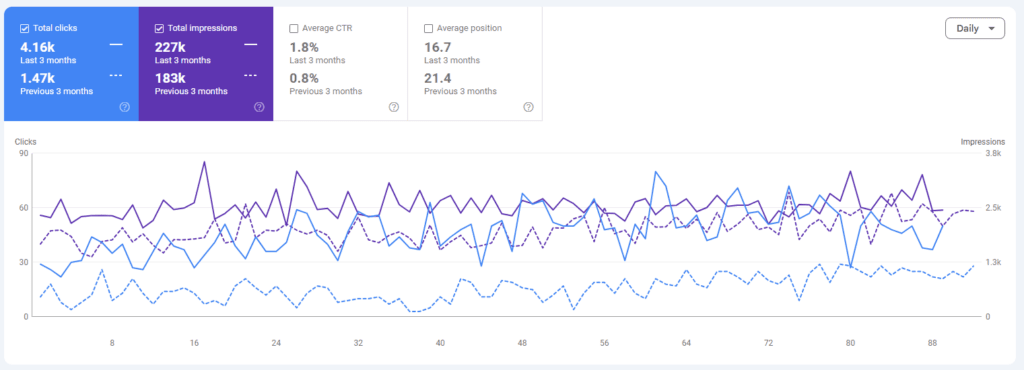
Rankings and traffic don't pay the bills, booked jobs do, so it's worth tracking a small set of numbers rather than drowning in reports. Connect Google Search Console to see which searches you're appearing for and your average position, Google Analytics 4 to see what visitors actually do once they land, and call tracking with dynamic number insertion so a ranking can be traced all the way through to a phone call. Split your view between leading metrics, the work you control, like pages published and links earned, and lagging metrics, the payoff, like calls and booked jobs, since the payoff genuinely lags the work by weeks or months and it's easy to lose patience before it shows.
Technical SEO: The Foundation Most Trades Ignore
None of the above matters much if your site is slow or broken on mobile, since most electrical searches happen on a phone, often urgently.
Page speed. A site that takes more than a couple of seconds to load on mobile loses visitors before they've read anything. Compress images, avoid heavy page builders that load unnecessary scripts on every page, and check your actual score in Google PageSpeed Insights rather than assuming it's fine.
Mobile usability. Test every service page on an actual phone. Click-to-call needs to work without scrolling, and text needs to be readable without zooming.
A clean sitemap and internal linking. Make sure your service pages link to each other where relevant, and that your homepage links clearly to your core services.
For a broader look at what makes a trade website convert once the SEO fundamentals are in place, see Web Design for Electricians.
Content That Actually Helps, and Ranks
Beyond your core service pages, a small amount of genuinely useful content builds authority over time and captures the searches your service pages won't. This doesn't need to be a high-volume blog. A handful of well-researched pieces answering the questions customers actually ask before booking, "how much does a consumer unit upgrade cost," "why does my breaker keep tripping," "do I need an EICR to sell my house", tends to outperform a large volume of thin, generic posts.
Case studies are particularly effective for electricians specifically, because they combine proof, local relevance, and service detail in one piece of content. A simple structure works well: the problem, what you found on inspection, how you resolved it, how long it took, and the outcome. This mirrors exactly how a customer judges competence, so it ranks and converts at the same time.
Each piece should answer the question directly and completely, then point toward the relevant service page. This is where a tool like SE Ranking is genuinely useful again, tracking which of your pages are climbing and which need more work lets you focus effort where it will actually move rankings, rather than spreading it thin.
Common Mistakes That Quietly Undermine Rankings
One generic page trying to rank for everything, rather than dedicated pages per service. A Google Business Profile that's set up once and forgotten, no fresh photos, no posts, reviews left unanswered for weeks. Inconsistent NAP details across your website and directory listings. Thin, templated location pages with the town name swapped but nothing else genuinely local. No tracking at all, which makes it impossible to know which changes actually produced an enquiry rather than just a click.
Quick Wins You Can Action This Week
Rewrite your title tags and page headings so each one reflects a single, clear service. Add a short, genuine FAQ section to your top two or three service pages. Ask your last few happy customers for a review, and reply to every review you already have that's been left unanswered. Check your name, address and phone number match exactly across your website, Google Business Profile, and your biggest directory listings.
What This Realistically Costs and How Long It Takes
For context when comparing quotes, a focused local SEO campaign for an electrician in the UK typically runs somewhere between £500 and £1,000 a month for a single service area, rising for multi-location coverage. Results build over months rather than overnight, expect 3 to 6 months for consistent, meaningful movement, longer in more competitive cities, though quick technical fixes and Google Business Profile improvements can show smaller gains within 60 to 90 days.
Bringing It Together
SEO for electricians isn't complicated in principle, get your Google Business Profile right, build a proper page for each service with genuine FAQ content and basic schema markup, earn a handful of real local backlinks, and make sure the technical basics don't get in the way. It takes consistent effort over a few months rather than a single push, but unlike paid ads, it keeps generating enquiries long after the work is done, and increasingly, it's exactly what gets you cited when someone asks an AI assistant to find a good electrician nearby.
If you'd like to see exactly where your site currently stands, run a free SEO audit, it takes under a minute and shows you precisely what's holding your rankings back.