Most electricians I speak to didn't get into the trade to think about keyword research or Google Business Profile categories. You trained to wire consumer units safely, not to run a marketing department. But the electricians winning the best jobs in their area right now, the rewires, the EV charger installs, the commercial fit-outs, aren't necessarily the best electricians. They're the ones who show up first when a homeowner or a facilities manager searches for help, and increasingly, the ones an AI search result quotes by name.
This article is part of my guide to marketing for tradespeople.
I spent 16 years running trade businesses before I moved into digital marketing, so I've sat on both sides of this problem. This guide covers everything that actually moves the needle for an electrical business in its current form: Google Business Profile, getting cited in Google's AI Overviews, Local Services Ads, paid ads, your website, reviews, and the referral and van-branding tactics that still work alongside all of it.
Why Marketing Matters More for Electricians Than Most Trades
Electrical work splits into two very different buyer journeys, and most electricians market themselves the same way for both.
The first is emergency and reactive work: a tripped consumer unit, a burning smell, no power to half the house. These searches happen on a phone, they happen fast, and the person searching will call whoever answers first, not whoever has the nicest website.
The second is planned work: rewires, EV charger installations, consumer unit upgrades, commercial and landlord compliance testing. These buyers compare two or three electricians, check reviews, and often want to see photos of previous work before they'll pick up the phone.
A marketing strategy that only accounts for one of these journeys leaves money on the table. Emergency-only marketing (just a Google Business Profile and a van) misses the higher-value planned work. Planned-work marketing (a polished website with no local visibility) misses the reactive jobs that keep the diary full between bigger projects.
Google Business Profile: Your Most Important Free Asset
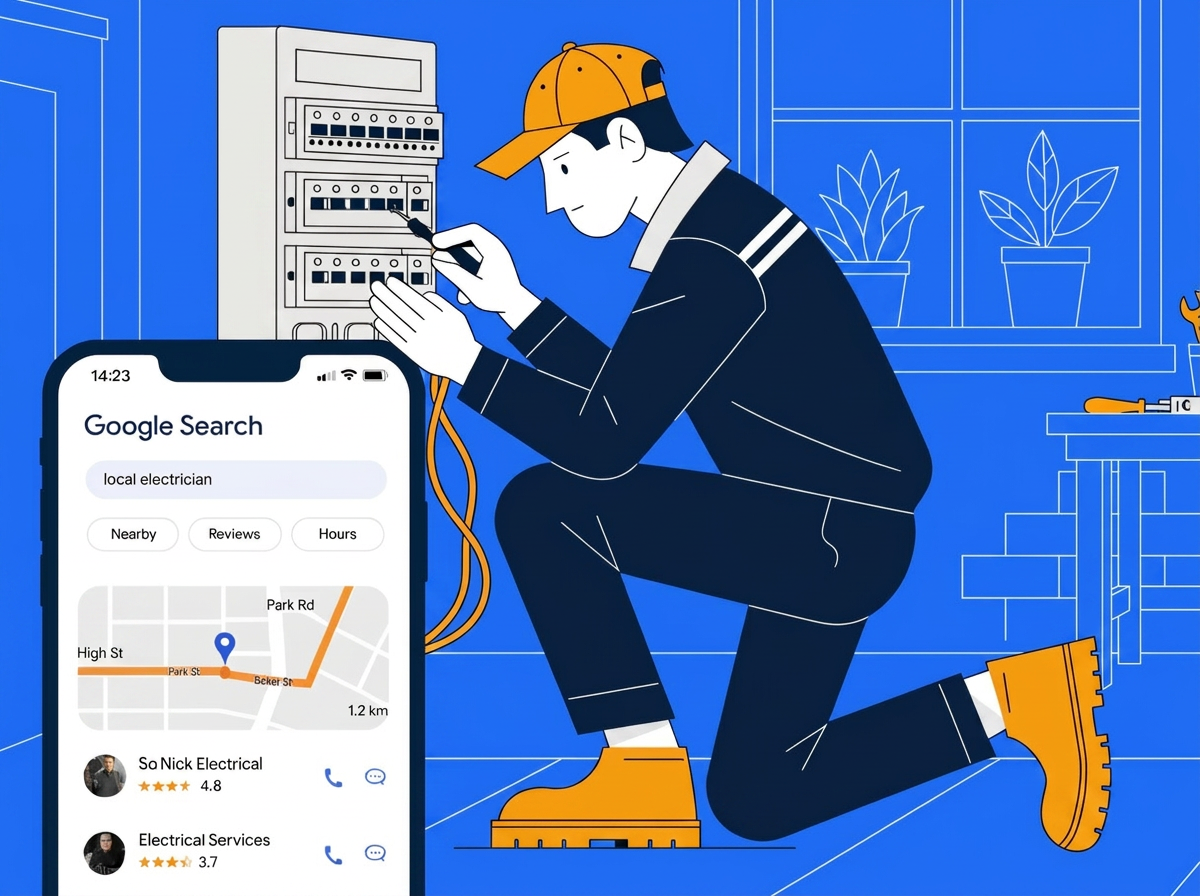
If you do nothing else in this guide, do this. For local, in-person trades like electrical work, the three-result map pack that appears above the normal search results is where most people click first, and it's driven almost entirely by your Google Business Profile (GBP), not your website.
A few specifics that make a real difference:
Choose the most specific category available. "Electrician" is fine, but if you specialise, "EV Charging Station Contractor" or "Electrical Installation Service" as a secondary category helps Google match you to more specific searches.
List every service individually. Don't leave this as a single line in your description. Rewires, EV charger installation, consumer unit upgrades, fault finding, EICR testing, each should be listed as a distinct service with its own short description, because Google uses this to decide which searches your profile is relevant for, and increasingly, to decide whether to surface you in an AI-generated answer too.
Keep your service area accurate, not aspirational. Setting your service area to cover three counties when you realistically only travel 15 miles dilutes your relevance for the searches that actually matter, the ones near your base.
Photograph real jobs, consistently. Before and after shots of consumer unit upgrades, EV charger installs, and finished rewires do two jobs at once: they're a ranking signal, and they're the single biggest trust-builder for someone deciding whether to let a stranger into their home.
Keep your NAP (name, address, phone number) identical everywhere. Your website, GBP, Checkatrade, NICEIC listing, and any other directory need to match exactly, even a "Street" versus "St." mismatch weakens local rankings. Inconsistencies are one of the most common, and most fixable, reasons electricians underperform in local search.
Getting all of this genuinely right, category, service list, photos, NAP consistency, is exactly what my local SEO service focuses on for trade businesses, if you'd rather have it set up properly once than keep tweaking it yourself.
Getting Found in AI Search, Not Just Traditional Results
This is the part most marketing advice for trades still hasn't caught up with. As of early 2026, somewhere between roughly 48% and 60% of Google searches now trigger an AI Overview, the AI-written summary that appears above the traditional blue links, pulling from a handful of sources Google trusts enough to cite. Some of your potential customers are also asking an AI assistant directly, "find me a good electrician near me", before they ever open a normal search engine.
The reassuring part for a local trade like electrical work is that action-led, local searches hold up better than pure information searches, someone with no power in the house wants to call a real person, not read a summary. But you still need to be one of the sources the AI quotes, and you can't pay your way into that.
What actually earns a citation is the same fundamentals done properly, not a separate strategy:
- A complete Google Business Profile with every service filled in, since this data feeds directly into AI-generated local answers.
- Clean, well-structured service pages, ideally with LocalBusiness and Service schema markup, so search engines and AI systems alike can parse exactly what you do and where.
- A short FAQ section on your site or service pages, in genuine question-and-answer format, marked up with FAQPage schema, since this is precisely the format AI Overviews tend to draw from.
- Genuine authority signals: reviews, local mentions, and consistent citations across the web.
In practice, this means the work below, done properly, gets you visibility in both the traditional map pack and the newer AI-driven answers. Track your visibility and citations over time, not just raw click numbers, since some searches that used to send you a click now resolve inside the AI answer itself.
Reviews: The Signal That Compounds
Review volume and recency are among the strongest local ranking signals, and they're also the thing that actually convinces a homeowner to pick up the phone. A profile with 60 reviews at 4.7 stars will consistently outperform one with 8 reviews at 5 stars, both in rankings and in conversion.
The mistake most electricians make is asking inconsistently, if at all. Build it into your process: the moment a job is signed off and the customer is happy, ask for the review there and then, ideally with a direct link sent by text. Waiting a week and sending a generic email gets a fraction of the response rate.
Respond to every review, good and bad. A thoughtful response to a negative review, specific about what happened and what you did about it, often does more for your credibility than another five-star review would, and it signals to Google that your profile is actively managed.
Building a Website That Actually Converts
Traffic without conversion is wasted traffic, whether it comes from SEO, paid ads, or an AI citation sending someone your way. A handful of things consistently separate electrician websites that convert well from ones that don't:
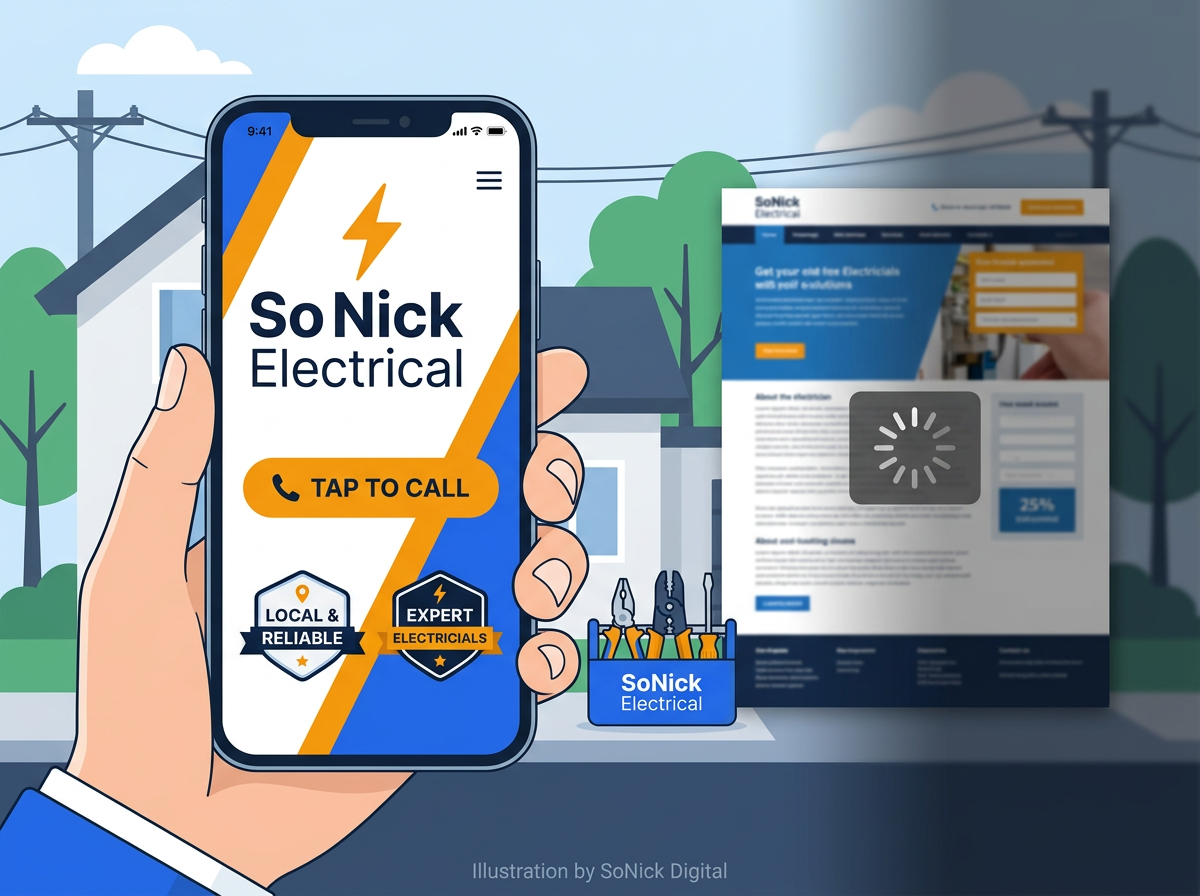
Click-to-call at the top of every page, on mobile. Most electrical enquiries, especially reactive ones, happen from a phone. If the number isn't tappable within the first screen, you're losing calls.
Individual service pages, not one page trying to cover everything. A dedicated page for EV charger installation, targeting the specific keywords people search for that service, will outperform a single "electrical services" page trying to rank for everything at once.
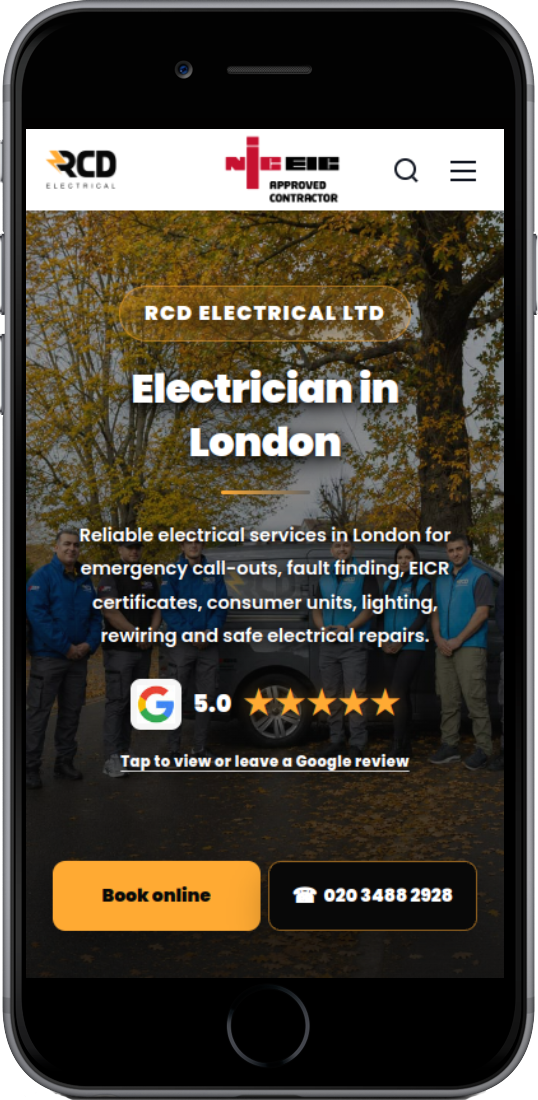
Trust signals above the fold. NICEIC or NAPIT accreditation, Part P registration, public liability insurance, and genuine reviews should be visible without scrolling. Someone letting an electrician into their home or business needs reassurance before they'll enquire.
A fast-loading, mobile-first site. Conversion rates drop sharply as load time increases. If your site takes more than a couple of seconds to load on a phone on a mobile connection, you're losing leads before they've read a word.
I've written a full breakdown of what makes electrician websites convert, including real examples, in Web Design for Electricians.
Paid Advertising: Google Ads and Local Services Ads Are Not the Same Thing
Two distinct Google paid products matter for electricians, and treating them as interchangeable wastes budget.
Google Local Services Ads (LSA) sit at the very top of the search results, above regular Google Ads, and carry the green "Google Guaranteed" badge. Unlike standard Google Ads, you're only charged when someone actually calls or messages through the ad, not per click, which makes LSA genuinely lower-risk for a trade business testing paid channels for the first time. Google favours profiles with strong, consistent reviews and fast response times here, so it rewards the same fundamentals as your Google Business Profile.
Google Ads (standard PPC) gives you far more control, choosing specific keywords, writing your own ad copy, and targeting exact search terms like "EV charger installation cost" or "emergency electrician [town]". This is where a proper campaign structure matters:
Separate campaigns for emergency and planned work. Someone searching "no power in house" wants a phone number immediately. Someone searching "EV charger installation" wants pricing and reassurance about the process. The ad copy, landing page, and even bidding strategy should reflect that difference.
Tight geographic targeting, matched to where you actually travel, not where you'd theoretically go for the right job.
Negative keywords from day one. Terms like "electrician course," "how to become an electrician," and "DIY" burn through budget on clicks that were never going to convert.
Conversion tracking connected to calls and form fills, not just clicks, so you know which keywords are actually generating enquiries.
Running LSA alongside a solid Google Business Profile and organic visibility means you can occupy the Google Guaranteed badge, the map pack, and the organic result all at once, three separate footholds on the same search page.
I go into full organic campaign structure and keyword strategy in SEO for Electricians: How to Rank on Google.
The Compliance Detail Most Trade Marketing Advice Skips
If you run Google Ads or Google Analytics and any of your visitors are in the UK or EU, Google Consent Mode v2 is a genuine legal requirement, not an optional extra. It's been mandatory since March 2024, confirmed for UK businesses that same year, and Google tightened it further in June 2026 by retiring an older fallback method, meaning your cookie consent banner now controls your advertising data directly. Without it properly configured, your Google Ads and GA4 tracking degrades, your remarketing audiences shrink, and you risk falling short of UK data protection requirements. If a web developer or agency is building or rebuilding your site, this needs to be part of that build, not an afterthought.
What This Realistically Costs and How Long It Takes
For context when you're comparing quotes: a focused local SEO campaign for an electrician typically runs somewhere in the region of £500 to £1,000 a month, with any Google Ads or LSA spend sitting on top of that, often another £300 to £1,000+ a month depending on how competitive your area is.
On timeframes, SEO is genuinely not instant. Expect 3 to 6 months for consistent movement in most areas, longer in more competitive cities, though quick technical fixes and Google Business Profile improvements can shift things within 60 to 90 days. Paid channels like Google Ads and LSA bring leads almost immediately, but you're paying for every one, which is exactly why most electricians end up running both together rather than choosing one.
Referrals, Van Branding, and Local Relationships
Digital channels will generate the bulk of your leads, but the offline tactics that have worked for trades for decades still work.
Referrals. A customer referred by a trusted neighbour or friend arrives with a level of trust a cold enquiry doesn't have. Build asking for referrals into your process, straight after a job is signed off and the customer is pleased.
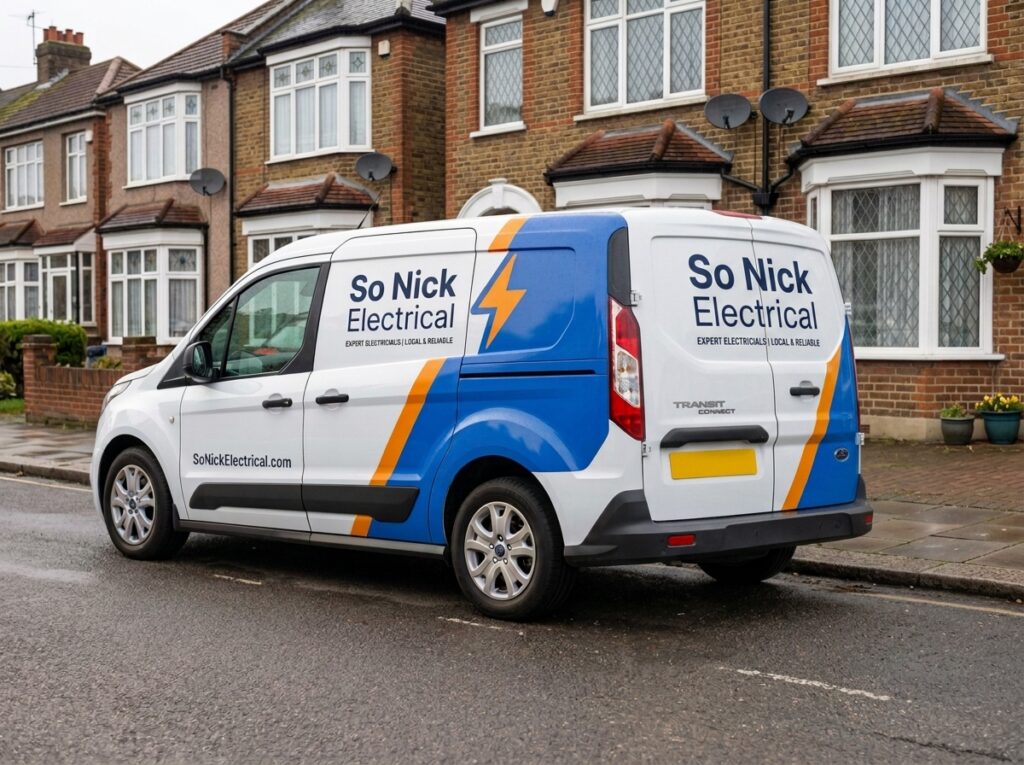
Van branding. A branded vehicle parked outside a house while you're working is passive advertising running all day, particularly effective for electrical work since jobs like rewires and consumer unit upgrades often take hours, giving neighbours plenty of time to notice.
Relationships with letting agents, property managers, and builders. These are people who regularly need electrical work done for other people's properties. A handful of solid relationships here can produce a steady stream of consistent, often higher-value work.
Frequently Asked Questions
How much does marketing cost for an electrician? It depends on what you need. Local SEO typically runs £500 to £1,000 a month, with Google Ads or Local Services Ads spend on top, commonly another £300 to £1,000+ a month depending on how competitive your local market is.
How long does it take to see results? Realistically 3 to 6 months for SEO to show consistent movement, longer in competitive cities, though some technical and Google Business Profile fixes can move the needle within 60 to 90 days. Paid channels bring leads almost immediately, but you pay for every one.
Do I need Google Ads if I'm already doing SEO? Often, yes, at least to begin with. SEO builds visibility that compounds over months. Google Ads and Local Services Ads give you access to high-intent searches, particularly emergency call-outs, while that organic visibility is still building.
Does the rise of AI search mean SEO doesn't matter any more? No, if anything it raises the bar on the fundamentals. A complete Google Business Profile, genuine reviews, clearly structured content, and proper schema markup are exactly what get you cited in AI-generated answers as well as ranked in traditional results.
Does ChatGPT recommend the same electricians as Google? Largely, yes. When I tested 10 local trade searches in ChatGPT, including electrician Basingstoke, businesses in Google's local pack appeared in its recommendations in 74 of 87 cases, although its answers changed from one run to the next. I've explained how ChatGPT finds local tradespeople and how to be the one it picks.
Bringing It Together
The electricians who consistently win the best work aren't doing one thing brilliantly, they're doing several things adequately at the same time: a properly optimised Google Business Profile, a steady flow of reviews, a website that converts the traffic it gets, targeted paid ads for the jobs worth bidding on, visibility in the AI-driven answers that are taking a growing share of search, and the offline relationships that have always worked in trade businesses.
None of it needs to happen at once. If you're starting from nothing, get your Google Business Profile right first, it's free, and it's the single highest-leverage thing on this list. Then build outward from there. If you'd like a wider look at how this fits together for trade businesses specifically, my trades marketing page covers the full picture.
If you'd like to see how your business is currently performing in local search, run a free SEO audit, it takes under a minute.