Small business marketing goes wrong in a predictable way: a bit of Google Ads one month, a burst of social media the next, a batch of leaflets, and no idea which of it brought in any work. The businesses that get a steady flow of enquiries usually aren't spending more. They've built a few channels properly, in the right order, and they know what each one is producing.
I ran a plumbers' merchants for 16 years before moving into digital marketing in 2019, so I've been on the business owner's side of this. I now run SEO, Google Ads and websites for small businesses from London, and every client deals with me directly. This page is my own route through small business marketing: what to do first, what can wait, and links to the full guides I've written on each part, including guides for salons, law firms and tradespeople.
If you're starting from scratch, read it from top to bottom. If you already know which channel you need, the chapter list below will take you straight there. These three articles are where most people should start.
Start here
- Why Digital Marketing Is Important for Small Businesses. What digital marketing is, the main channels, and six practical steps to get started.
- The Complete Guide to Local Lead Generation. How to build a system that brings in local enquiries month after month.
- How to Increase Website Traffic. Twelve free and paid ways to get more of the right people to your site.
What's in this guide
- The short version: the order I'd market a small business in
- 1. Why market online, and where to start
- 2. Getting leads and traffic
- 3. Content marketing
- 4. The main channels in depth
- 5. Marketing for salons
- 6. Marketing for law firms
- 7. Marketing for tradespeople
- Where to get help
- FAQ
The short version: the order I'd market a small business in
If you only read one section, make it this one. This is the order I'd work in for a local service business with a modest budget and no marketing team.
- Get your Google Business Profile right. It's free, and for anyone serving a local area it's often the first thing a customer sees. Complete every field, add real photos and keep your details accurate.
- Start collecting reviews. Ask every happy customer. Reviews help you rank locally, persuade people to call you, and are what AI tools like ChatGPT quote when they recommend a local business.
- Make sure your website can turn a visitor into an enquiry. Fast on a phone, clear about what you do and where, with a tap-to-call number and a short form. Paying to send people to a weak website is wasted money.
- Track every enquiry. Know which calls, forms and emails came from which source. Without that you can't tell which marketing is paying.
- Build SEO for the long term. It takes a few months, but the enquiries it brings don't stop when you stop paying.
- Use Google Ads if you need work now. Ads can bring in enquiries within days while SEO builds underneath. Pick one paid channel and learn it before adding another.
- Then add content, email and social. Useful content supports your SEO and builds trust; email and social keep you in front of people who already know you.
- Answer fast and review weekly. Reply to every enquiry quickly, and set aside time each week to look at cost per lead and what's working.
The biggest mistake is trying to do everything at once and ending up doing nothing well. For most of my clients, the core is a strong website with SEO and Google Ads working together, and everything else is added once that's paying. The chapters below take each part in turn.
| If this sounds like you | Go to |
|---|---|
| I don't know where to start with marketing | Chapter 1: where to start |
| I need more enquiries or more website visitors | Chapter 2: leads and traffic |
| I've been told I should be blogging | Chapter 3: content marketing |
| I want to go deep on SEO, ads or my website | Chapter 4: the main channels |
| I run a salon | Chapter 5: salons |
| I run a law firm | Chapter 6: law firms |
| I'm a plumber, electrician, roofer or builder | Chapter 7: tradespeople |
1. Why market online, and where to start
Almost every customer checks a business online before they get in touch, even when they were recommended by a friend. If they can't find you, or what they find looks neglected, they call someone else. Marketing online isn't about being everywhere. It's about being findable and convincing at the moment someone is looking for what you do.
It also helps to know the difference between digital marketing as a whole and digital advertising. Advertising is the paid part: Google Ads, social media ads and the like, which stop when you stop paying. Marketing also includes the things you build and own, such as your website, your search rankings, your reviews and your email list. A good plan uses both.
- Why Digital Marketing Is Important for Small Businesses (and Where to Start). What digital marketing is, its key benefits, the main channels from your website to email, six practical steps to get started and the fastest route to results.
- What Is Digital Advertising? A Plain-English Guide for Small Businesses. A jargon-free overview of the main types of paid online advertising (search, social, display, video and shopping) and how they differ from digital marketing as a whole.
2. Getting leads and traffic
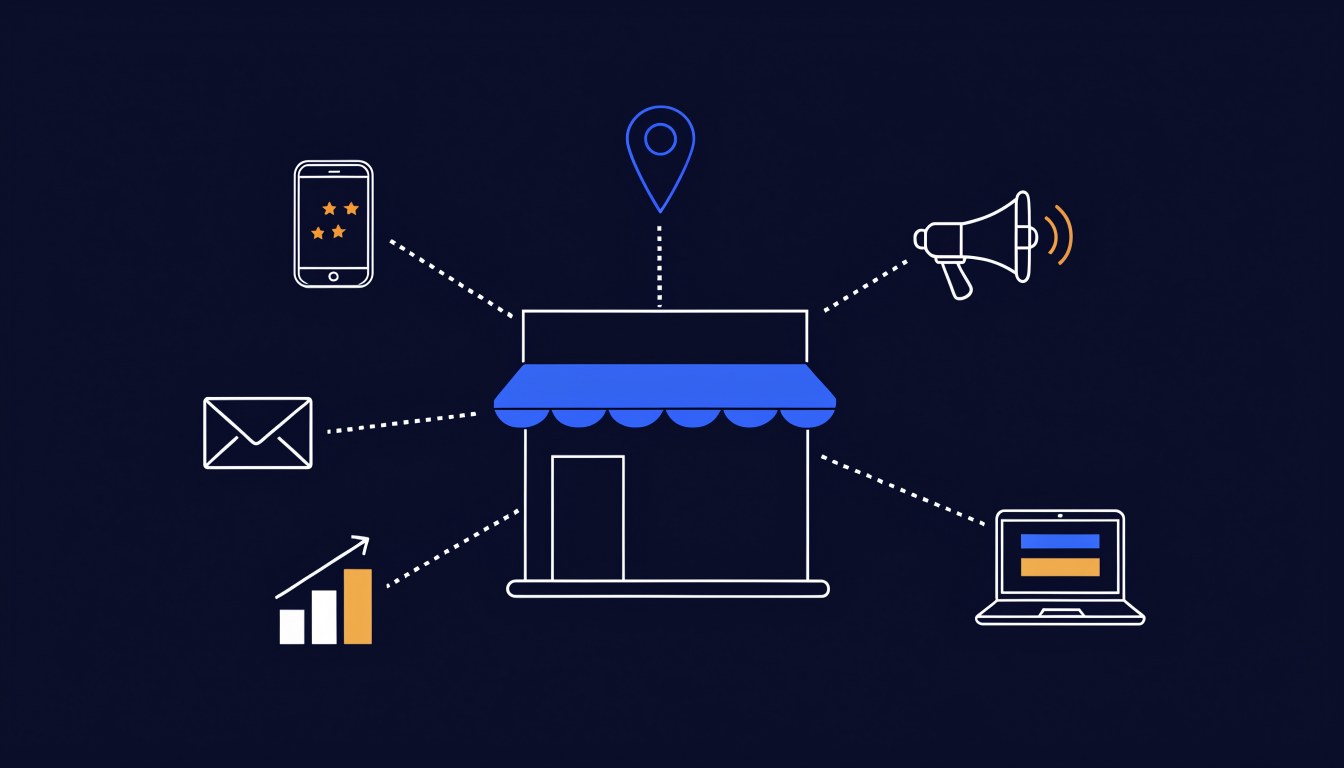
Most small businesses don't have a lead problem, they have a system problem. The ones that get enquiries every month treat their marketing as a set of channels that support each other: a website and Google Business Profile as the foundation, one paid channel they've committed to, tracking so every enquiry has a source, and a habit of replying quickly and reviewing the numbers every week.
Traffic on its own isn't the goal. A thousand visitors from the wrong town or looking for something you don't sell are worth less than twenty who want exactly what you do, nearby. So aim for the right visitors, and make sure the website can turn them into enquiries before you spend on getting more of them.
- The Complete Guide to Local Lead Generation for Small Businesses. Six sources of local leads, from local SEO and Google Ads to landing pages, reviews and leaflets, and how to turn them into a system with tracking and weekly reviews.
- How to Increase Website Traffic: 12 Strategies That Actually Work for Small Businesses. Twelve free and paid ways to grow traffic, from SEO, local search and email to PPC, directories, PR and fixing site speed, and how to act on what your analytics show.
- Website Marketing: A Complete Guide for Small Businesses. Why your website needs to work before you market it, the main channels, which one to start with and how to build a simple website marketing strategy.
3. Content marketing
Content marketing means publishing things your customers genuinely want to read or watch: answers to the questions they ask you, guides, prices, examples of your work. Done well, it helps you rank, shows you know what you're talking about, and brings in enquiries without a hard sell. Done badly, it's a blog with six posts from 2021 that nobody reads.
For a small business, I'd start with the questions customers ask you every week and answer each one properly on your website. That content supports your SEO, and it's the kind of experience-led material that stands out now that the internet is full of generic AI-written text. A downloadable guide can work too, if it solves a real problem and there's a plan for following up with the people who download it.
- The Benefits of Content Marketing for Small Businesses. What content marketing is and isn't, why it suits smaller businesses, the key benefits from rankings to credibility, and what types of content to create.
- How to Generate Leads Through Content Marketing. The two types of content you need, a seven-step strategy from knowing your audience to a lead magnet that solves a real problem, and how to measure the leads it brings.
- How to Use eBooks in Your Content Marketing Strategy (and Actually Generate Leads). Choosing a topic, what to include, building a landing page that converts downloads, promoting it, following up and what an eBook costs to produce.
- Content Marketing Trends: What Small Businesses Need to Know. Why human expertise matters more with AI everywhere, AI-powered search, short-form video, E-E-A-T, content hubs, interactive content and repurposing.
4. The main channels in depth
For most small businesses, the channels that do the heavy lifting are the same three: a website that converts, SEO for long-term enquiries and Google Ads for enquiries now. I've written a separate guide to each, with every article I've published on the subject, plus one for tradespeople.
- The Small Business Guide to SEO. Keywords, on-page SEO, local SEO and reviews, links, technical fixes and AI search, in the order I'd tackle them.
- The Small Business Guide to Google Ads. Whether ads will pay, what they cost, how to set them up and track them, and what to do when they aren't working.
- The Small Business Website Guide. Who should build your site, which platform, what makes it bring in enquiries and how to track them.
- Marketing for Tradespeople: The Complete Guide. Everything above applied to plumbers, heating engineers, electricians, roofers and builders.
5. Marketing for salons
Salons have one big advantage: the work is visual, so your own photos and videos do a lot of the selling. The order I'd work in is the same as above, with a few salon priorities. Get your Google Business Profile and reviews right so you appear when someone nearby searches "hair salon near me". Make booking online effortless. Then focus as much on keeping clients as finding new ones, because rebooking reminders, a loyalty scheme and referrals are cheaper than any ad.
- How to Market a Hair Salon: A Complete Guide. Every channel worth a salon owner's attention, from Google Business Profile and local SEO to Instagram, TikTok, paid ads, retention, referrals and local partnerships.
- Salon Marketing Strategy: How to Get More Clients and Keep Them Coming Back. The core pillars of a salon strategy, from local visibility to email and SMS, referral and loyalty programmes, influencer collaborations and tracking.
- How to Grow Your Salon's Online Presence (and Actually Get More Bookings). Google Business Profile, a salon website that converts, SEO, social media, reviews, email as a rebooking engine and where to start if it all feels too much.
- SEO for Salons: The Complete Guide to Getting Found on Google. Keywords, website, on-page SEO, Google Business Profile, Bing Places and Apple Maps, backlinks and content for hair and beauty salons.
- How to Create a Salon Website That Attracts Clients and Fills Your Books. Five decisions to make before you start, an eight-step build from domain to online booking, the pages a salon site needs and what it costs.
6. Marketing for law firms
People rarely choose a solicitor on a whim. They search, read and compare before they pick up the phone, so for a law firm, credibility and useful content carry more weight than in almost any other sector. Local SEO and legal directories bring the quickest wins, practice area pages and plain-English guides build trust over time, and Google Ads can bring in enquiries while that builds. Everything has to stay within the SRA's rules on publicity.
- Digital Marketing for Law Firms: The Complete Guide to Getting More Clients Online. A seven-step plan covering the website, local and organic SEO, Google Ads, content, legal directories and social media, plus SRA compliance and in-house versus agency.
- The Complete Guide to Content Marketing for Law Firms. Building a content strategy around your niche and your client's journey, the best content types for law firms, keyword clusters and measuring what works.
- SEO for Lawyers: A Practical Guide for UK Law Firms. Keyword research, local SEO, on-page and content strategy, technical basics and link building for UK law firms, plus E-E-A-T and AI search.
7. Marketing for tradespeople
Trades are where I spent the first 16 years of my working life, and they're the biggest part of what I write about. Tradespeople have their own questions, from whether recommendation sites are worth paying for to how to stop buying shared leads. My complete guide to marketing for tradespeople covers every trade in detail. These two are the best places to start.
- The Complete Guide to Digital Marketing for Plumbers. Every channel worth a plumber's attention (website, SEO, local search, Google Ads, social media and email), how to measure it and the order I'd recommend tackling them in.
- The Best Tradesperson Recommendation Sites in the UK (And Why Your Own Website Matters More). How Checkatrade, Rated People, MyBuilder, Bark and the other UK platforms work, the three ways they charge, how to choose between them and why owning your leads matters more.
Where to get help
If you'd rather hand some or all of this over, this is how I can help. There are no long-term contracts, you own your accounts, and you deal with me directly.
- SEO and PPC packages. SEO building long-term enquiries with Google Ads bringing them in now, with 10% off when you take both.
- SEO services. Getting found on Google and in AI search tools, with AI search included at no extra cost.
- Google Ads management. Campaigns I set up and run myself, in an account you own.
- Web design. Fast, mobile-first websites built to bring in enquiries, from £895 plus VAT.
- Industries I work with. Including trades, professional services such as law firms and health and wellness businesses such as salons.
FAQ
What is the best marketing for a small business?
For most local service businesses, a website that converts, a well-kept Google Business Profile with plenty of reviews, SEO for long-term enquiries and Google Ads for enquiries now. Add content, email and social once those are working.
How much should a small business spend on marketing?
There's no single right figure. Work backwards from what a new customer is worth and what an enquiry costs in each channel. For Google Ads, I treat £10 a day as the realistic minimum ad spend for a local Search campaign.
Where should a small business start with marketing?
With the free foundations: your Google Business Profile, reviews and a website that makes it easy to get in touch. Then set up tracking, so you know which channels bring in work before you spend more.
Is social media worth it for a small business?
It depends on the business. For visual businesses such as salons it can bring in bookings. For most service businesses, social media is better at keeping you in front of people who already know you than at finding new customers who need you today.
Should I do my own marketing or hire someone?
You can do a lot yourself, and the guides on this page are written so that you can. Hiring help makes sense when the time it takes is worth more spent on the business, or when you've tried and the numbers aren't adding up.
Want a hand with your marketing?
Ready to take this further? Get in touch and tell me what you do, where you work and what you've tried so far, and let's talk through what's possible for your business. If you'd like a quick check first, run a free SEO audit on your website. It takes under a minute.